


By Dr. Privilege Hang’andu & Dr. Gregory Gondwe
Recent political context
On August 13 2026, Zambia went to the polls that resulted in the incumbent President Hakainde Hichilema defeating his opponents, including the closest contestant Brian Mundubile of the National Reconciliation Party for Unity and Prosperity (NRPUP). This was the first election under the Constitution of Zambia (Amendment) Act, No. 13 of 2025, that significantly altered the constitution of Zambia’s National Assembly with the introduction of the mixed-member proportional representation.
In the parliamentary race, numerous independent parliamentary candidates won seats, occasioned by disputed intra-party adoption processes. Despite these decisive victories and losses, Zambia is now confronted with post-electoral grievances, including unfortunate loss of life, ethnic rhetoric, and political polarity.
On August 15, Secretary to the Cabinet, Mr. Patrick Kangwa, made stunning announcements of law enforcement busting an underground militarised group that planned lethal political resistance to unfavorable political outcomes. In the said operation, law enforcement exchanged gunfire with the alleged militarised group leading to several arrests.
The country later learned that a former minister was killed in the crossfire. After the confirmation of the death of former minister under the Patriotic Front (PF), Mutotwe Kafewaya, Zambian social media has been replete with commentary from prominent Zambians, reverberating the mantra “no life should be lost due to elections”. International media, international human rights organisations (including the United Nations and the Commonwealth Secretariat), and other activists have weighed in, condemning the killing of the former minister and several arrests of opposition leaders caught in the highly sensitive and inflammatory criminal allegations.
It should be universally accepted that life should not be lost in the process of electoral disputes in a democracy. Human life must be preserved at all cost and electoral disagreements should be settled with utmost civility and, when contested, through established institutional mechanisms.
While the death of Mr. Kafwaya is regrettable and raises concerns, Zambia has always had the need to examine its pre- and post electoral political management. The country has had bloodier electoral experiences (See Figure 1 below). The difference is that previous deaths from political violence have not involved prominent elites. It has been ordinary Zambians without similar social and political standing that have been killed over the years under successive governments, without similar civil society, UN, or academic agitation.
Many of those deaths occurred without comparable national security concerns currently obtaining in Zambia, and were almost always met with little recognition or heightened civil society or UN reprimands. A few years ago, a Rwandan Jesuit priest, academic and friend of ours worked on a brilliant PhD thesis at Boston College that theologises the experience of the 1994 genocide in Rwanda. Fr. Marcel Uwineza was a young teen in Rwanda in 1994. He was beaten and his home and all his family’s belongings were burned. His two brothers, a sister, and an aunt were killed. His mother was beaten and later died from her injuries. Fr. Uwineza and his three younger siblings were saved when a Hutu man hid them on his property. He would later narrate his experiences of these hideous experiences in his memoir, Risen from the Ashes: Theology as Autobiography in Post-Genocide Rwanda.
One thread out of this work is that it’s only when a society pieces together seemingly isolated occurrences that it understands collective wrong and begins to address it! A society that fails to conceptualise its experiences as trends will not understand the need for systemic changes and solutions to negative experience. Zambia has, by now, witnessed numerous enough of such hideous pre- and post electoral calamities and deaths to arrive at a turning point. We must confront these seemingly isolated experiences and piece together what ugly larger reality they could be pointing to. Before we attempt to construct that ugly global picture, let us recount those seemingly isolated incidents of political ruptures, the pieces we need to glue or piece together to arrive at the moment of decision.
A broken past with selective blame apportionment
Who are the heroes and the villains in Zambia’s tainted political history? Are the 2026 election aftermaths, despite the death of an individual or individuals and several arrests, the darkest mark in our political history? Have Zambians apportioned equitable blame to worse previous experiences? Has the 2026 incident been placed within its rightful contest of national security threat? Should external actors determine how independent states deal with national security threats? These are all seemingly simple but important questions for supporting one’s epistemic analysis of the pre and post 2026 electoral experiences (See figure 1 below for a violence trends analysis)
1991 Elections
The 1991 general election was preceded (in fact occasioned by) widespread food riots, leading to clashes between the police and the public. This resulted in numerous reports of death (~23). Riots were followed by a failed coup attempt. May Zambians were killed pre and post the 1991 elections.
1996 Elections
The 1996 elections were preceded by a period of heavy political tension, resulting from President Frederick Chiluba’s attempts to constitutionally disqualify the former president, Kenneth Kaunda who, at the time, led the largest opposition political party, the United National Independence Party (UNIP). There were widespread fears that the new constitutional amendments by the ruling Movement for Multi-party Democracy (MMD) parliamentarians, amid protests from the opposition, civil society organisations and individual citizens could cost the country’s newly earned democracy. President Kaunda and his supporters had repeatedly threatened to lead a civil disobedience campaign and create violence to make it impossible for Chiluba to govern, if the bill was not changed to allow him to contest the elections.
2001 Elections
In 2001, when then Republican Vice President Christon Tembo resigned from his position, occasioning a parliamentary by-election in Lusaka’s Chawama Constituency, the nation would be introduced to one of the bloodiest political scenes in national memory. Michael Sata—then serving as the national secretary for the ruling MMD—led a group of supporters into the Chawama Constituency, triggering a bloody riot following a tense parliamentary by-election. Some modern Zambian political analysts argue that this singular incident, and Sata’s political character and style, are responsible for modern-day political violence in the country.
2006 Elections
The 2006 tripartite elections in Zambia were characterised by lots of contention, including legislative uncertainties and disputes, electoral management disputes and allegations of vote thefts, ballot paper printing and transparency doubts, and outright incidents of political violence. The pre-election period was punctuated by increased incidents of political violence. Violent clashes were reported in Lusaka between different political party supporters. MMD and PF cadres also fought in Lusaka and the Copperbelt Provinces. It was reported that at one point, a mob of PF activists blocked the motorcade of President Patrick Mwanawasa who was returning from campaigning. Violence also accompanied the removal of campaign posters of rival candidates. The ECZ Director, Dan Kalale, condemned the violence as violations of the electoral code of conduct and as criminal offences, appealing “to all parties to desist from violent behaviour”. Violence persisted during the pre and post election periods.
2011 Elections
Like the 1991 elections when the MMD defeated Kenneth Kaunda’s UNIP which had been in power for 27 years, the 2011 election was a decisive experience in Zambia’s democratic experience and, arguably, one of the most violent. In that election, Sata’s PF defeated the well-established MMD under President Rupiah Banda. The country witnessed yet another bloody pre- and post electoral experience. On January 14, 2011, approximately 19 Barotseland activists and citizens were killed in Mongu when state security forces violently cracked down on a meeting calling for self-determination and honoring the 1964 Barotseland Agreement. Mkhondo Lungu, then Minister of Home Affairs, carried the ugly tag of this bloody occasion the rest of his political career. There were several other reports of killings during and after the elections.
2016 Elections
Prior to the 2016 general elections, several incidents of political violence and death were reported. For example, Mapenzi Chibulo, a supporter of the then opposition United Party for National Development, was shot and killed by police on July 8, 2016, during a political disturbance in Lusaka. As the 2016 U.S. Department of State Human Rights Report indicates, state institutions were instrumentalised to violate human rights pre- and post elections. “In one of the more prominent examples, police teargassed and raided the family house of the opposition UPND’s vice presidential candidate on July 20, ostensibly to search for illegal weapons”. The report further notes that “the government remained sensitive to criticism in general and by the political opposition in particular. It was quick to prosecute critics on the pretext of incitement of public disorder and hate speech.”
FIGURE 1: ELECTION VIOLENCE AND THE ACCOUNTABILITY GAP IN ZAMBIA
Reported deaths and institutional responses in selected major incidents, 2001-2026
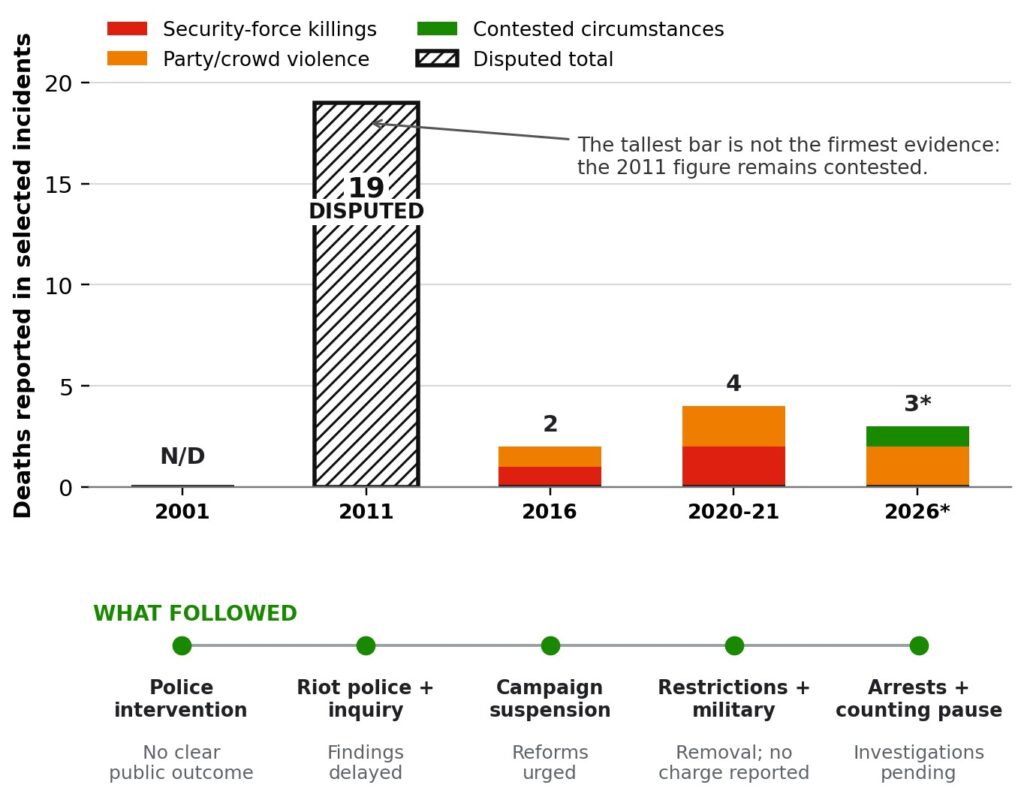
Note: Bars show deaths reported only in the selected, source-checked incidents. N/D means violence was documented but no reliable fatality total was established. The 2011 total of 19 is shown separately because it is disputed. The 2026 figure is provisional through 25 August 2026. Across election cycles, authorities repeatedly restore immediate order through suspensions, deployments or arrests, while publicly documented evidence of completed investigations and individual accountability remains limited or delayed.
- Also note that the 23 deaths sometimes associated with the 1991 election occurred during food-price riots in June 1990. Zambia’s October 1991 election was largely peaceful, so those deaths are excluded.
2021 Elections
The 2021 elections under President Edgar Lungu were probably among the bloodiest in Zambia’s political memory. In February 2020, police shot and killed a 13-year-old boy Frank Mugala in Lusaka under unprovoked circumstances. In December 2020, Police in Lusaka shot and killed Joseph Kaunda, a supporter of the then opposition UPND in Lusaka. Kaunda was among the UPND supporters that went to offer solidarity to their leader when he was summoned for questioning at the police headquarters in Lusaka.
In December of 2020, Police shot and killed Nsama Nsama, an innocent passerby, while opposition leader Hakainde Hichilema appeared for questioning at the police headquarters in Lusaka. Pictures and videos from the day project a country at war, without functioning institutional restraints. To imagine that President Edgar Lungu presided over such anarchy and horror (to not even mention the rampant corruption, obnoxious prevarication of policy and morality, drunkenness, etc.) and still be presently considered a political hero in a country of sane human beings is mind-boggling! But that’s a discussion for another day.
Lessons for the country
What we see from this historical account is a country gripped with political indiscipline, punctuated by rogue presidents, political elites, and unruly state police functionaries. If one was intellectually honest, it is clear that Presidents Sata and Lungu win the trophy for presiding over the bloodiest political establishments in living Zambian memory. President Lungu, though deceased, was an influential figure in the August 2026 elections. The opposition NRPUP fronted him as their model and summoned his legacy as exemplary. His violent political persona and culture were probably equally influential in determining alleged political militarisation of the opposition NRPUP groups.
Stop political violence
Political violence is a cancer Zambia must address, and address decisively! It must be clearly legislated and sufficiently punished to prevent it. Violences should never be part of the political discourse, and its elimination cannot be left to the benevolence of a sitting president. While President Hichilema has positioned himself well in addressing political violence and other forms of political violence, the solution must outlive an incumbent president. The solution should be institutional, impersonal, universal, enduring, and uncompromising.
De-politicise the Zambia Police Service
National law enforcements must be professional, non-partisan, and be seen to be credible by all citizens. Zambia must make the Zambia Police Service independent – a truly national police not answerable to political elites. Police must be sufficiently trained to manage crowds and to not use live ammunition when dispersing crowds. Above all, Zambia Police must be accountable to the constitution and the law so no extrajudicial killings could possibly go unpunished.
End tribal hate and marginalisation
Any objective intelligent political observer in Zambia understands that ethnicity has increasingly become problematic and a determinant of political analysis, allegiance, and political perception. This trait particularly characterises political dessent and acrimony during the Sata and Lungu periods. Increasingly, particularly during this period of time under these two former Presidents, certain ethnic identities have increasingly become politically marginalised, spoken about in the negative, and almost made to apologise for their existence. This is despite the fact that the country is deeply integrated socially through cross-cultural marriages, family ties, religious and professional cleavages, etc. It is almost irrational to harbour hate of another fellow citizen because of ethnic identity. Unfortunately, despite all odds, ethnic hate is rife in Zambia, and it must be addressed to avoid regrettable ethnic ruptures.
The 2026 elections are instructive about what we could potentially become when political elites rally masses along ethnic and tribal lines, feed those allegiances with propaganda, and potentially militarise them for citizens to rise against each other. Unfortunately, some religious leaders and academic commentators have band-wagoned on this atrocious rhetoric and fueled the hatred. In the days after the 2026 elections, videos, sometimes from children, have surfaced uttering hateful messages against Tonga-speaking people. This ethnic and tribal hate has its most recent roots in the political culture of the PF under both Sata and perfected by Lungu. One could be almost excused for concluding that the PF is the worst political mistake ever to have happened in Zambia’s democratic history, and its toxic legacy will take balanced, bold, and decisive political, religious, and civil society leadership to annihilate. It will take a new generation of leaders in the country to nip this tribal and ethnic cancer in the bud which, sadly, has infiltrated even the historically balanced Catholic church. We should remember that the Catholic Church, in spite of its global fame for neutrality, balanced leadership, was complicit in the massacre of Tutsis in the 1994 Rwanda genocide.
Introspect and avoid more catastrophic political deaths and harms
Zambia just can’t afford to continue on its current path! We can’t all sit in fear of future elections because of current extremes we have witnessed and entertained. The larger picture is this: Zambia needs to introspect and determine a political course that practices politics where ideas are either accepted or rejected, where citizens accept political outcomes without veiled agitation for violence.
There are no Zambians entitled to political leadership and there are none without that right to seek public office. The 2026 election stands out in many ways. We had key political players vowing commitment to violence, killing, as a price tag to the importance of the election. We had, according to publicly available government reports, militarised positions by political players.
On top of this, we have witnessed a deeply polarised church that has previously risen above partisan inclinations. For example, we have seen select Catholic bishops endorse political candidates, ignore inflammatory remarks by significant political actors, and basically bulldoze the Bishop’s conference into issuing hollow and pastorally poor comments on issues needing more depth and pastoral guidance. We have collectively reneged our responsibility as a people and we need to introspect. We, as a country, need to insist on forbearance, management of political expectations, and avoidance of extremes such as we are seeing in the post August 13 2026 elections. This requires serious systemic and structural initiatives to build a sustained solution to these seemingly isolated incidents which, just like in Rwanda, could result into immeasurable costs to national identity, history, and security.
*Dr. Priva Hang’andu is a political scientist, public policy advisor, and academic based in Ottawa, Canada. He works as a policy advisor at the Canadian Institutes of Health Research (CIHR) and as an adjunct professor at the Canada School of Public Service (CSPS). Dr. Hang’andu has written and published extensively on electoral democracy, social policy reforms, and human rights in Sub-Saharan Africa, with his most recent book published in December 2025: "The State and the Imperative for Social Policy Reform in Africa”. The ideas and thoughts in this article are Priva’s and do not reflect or represent those of either the CIHR or CSPS.
**Dr. Greg Gondwe is a Professor of Journalism at California State University – San Bernardino, and a scholar with the Institute of Social Media Rebooting at Harvard. He researches contemporary media ecosystem in Africa with particular interest on how emerging trends shape media structure, journalistic practice, and civic engagement. His works include cross-national studies about mis/disinformation in sub-Saharan Africa related to gender, geo-location, age, and media literacy.

Discover more from MAKANDAY
Subscribe to get the latest posts sent to your email.