


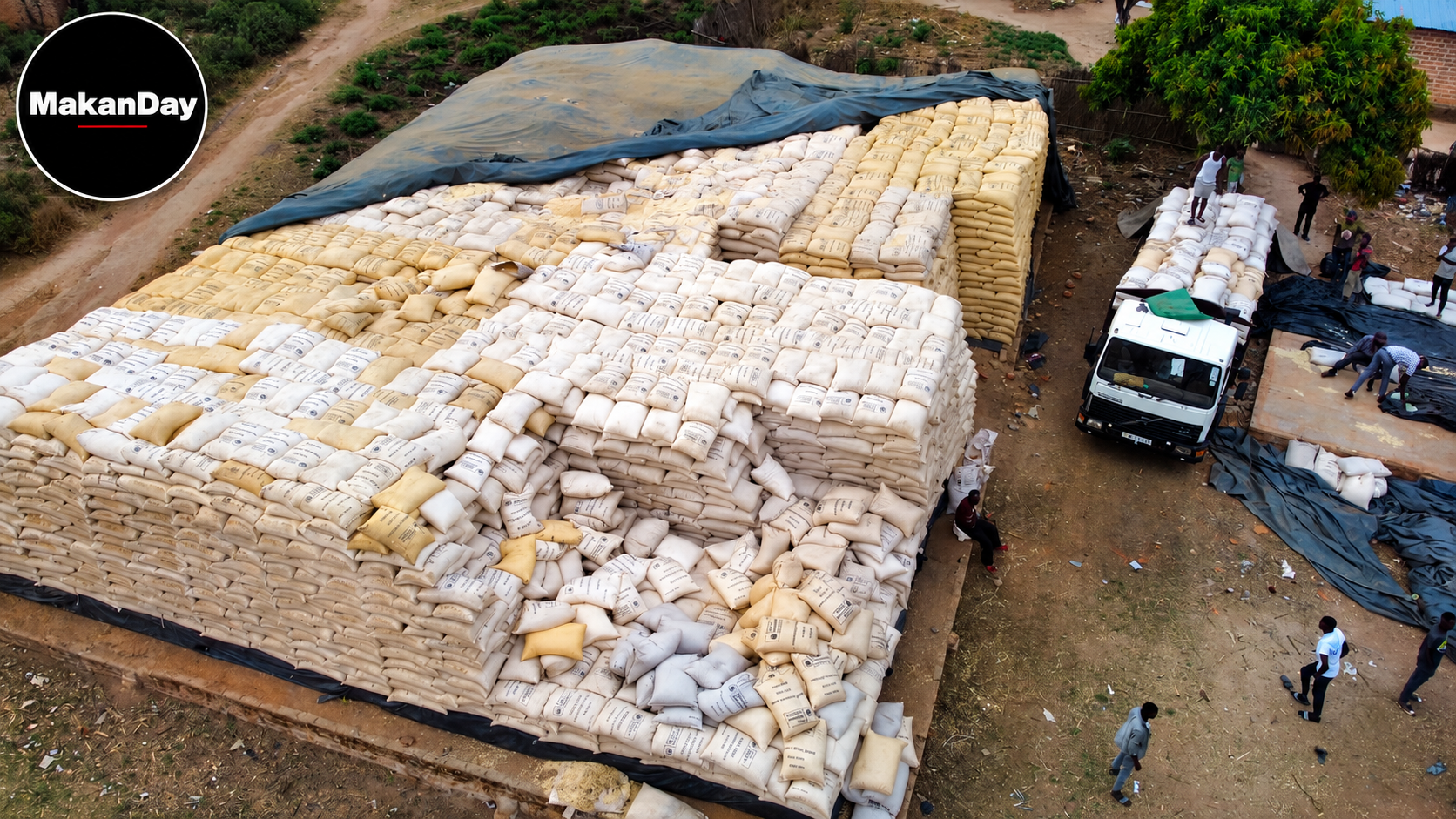
A maize-buying point that does not appear on the official Food Reserve Agency (FRA) depot list was operating at Liondo Village in Chipata, with FRA-marked bags and a weighing scale moved from an established depot. Farmers say they were also required to pay to sell their maize there. One farmer who delivered 200 bags told MakanDay he paid K1,500 to officials at the site.
By Esther Nkhoma in Chipata
For the past month, MakanDay has been trying to establish who authorised a maize-buying point at Liondo Village in Chipata, where maize was being purchased from farmers under an arrangement involving alleged Food Reserve Agency (FRA) officials.
The investigation has now established another important detail: farmers using the buying point say they were being charged a fee to sell their maize there.
One farmer who delivered 200 bags of maize told MakanDay that he paid K1,500 to officials at the site, providing a specific account of payments that farmers had previously alleged were being collected at the buying point.
MakanDay has not established who ultimately received the money, what the K1,500 payment was for, or whether FRA authorised officials or anyone operating at the site to collect such fees from farmers.
FRA headquarters in Lusaka asked MakanDay for more time to establish the circumstances surrounding the buying point but has yet to provide its findings.
Eastern Province Deputy Permanent Secretary Dr Lewis Mwape, one of the officials linked to the arrangement, acknowledged that he helped facilitate the establishment of the maize-buying point at Liondo Village.
A buying point outside the official list
Liondo Village, in the Luangeni area of Chipata district, is located in Chief Mpezeni’s chiefdom.
Dr Mwape acknowledged that he was involved, together with FRA officials and a ruling United Party for National Development (UPND) official, in establishing the buying arrangement.
He said it was intended to make it easier for farmers in the area to sell their maize and confirmed that the site was not registered as an official FRA depot.
Under the Food Reserve Act No. 6 of 2020, FRA has powers to buy designated agricultural commodities and to establish, manage, lease and maintain storage facilities and equipment used in connection with those commodities.
The law also allows the Agency, when buying commodities locally, to identify, enter and operate markets in rural areas, as well as other domestic markets determined by the Agency.
Liondo’s absence from the official depot list does not, by itself, establish that the buying point was unauthorised. But questions remain about the authority under which it was established and whether those operating it were permitted to collect money from farmers.
Farmer says he paid K1,500
When MakanDay visited Liondo, hundreds of bags bearing FRA markings were stacked near a loading point as a truck was being loaded.
The site does not appear on the official list of FRA buying depots examined by MakanDay.
Farmers interviewed in the area said they had been directed to take their maize to the site and sell it through a buyer operating there. They also alleged that they were required to pay a fee to sell their maize at the buying point.
One farmer provided MakanDay with a specific account, saying that after taking 200 bags of maize to Liondo, he paid K1,500 to officials at the site.
The payment raises questions about the operation of the buying point: who was collecting the money, on whose authority, and what were farmers paying for?
MakanDay has not independently established who ultimately received the farmer’s K1,500, whether the payment itself was recorded or receipted, or whether FRA regulations permit such a charge.
What MakanDay has established, however, is that farmers who sold their maize at the Liondo buying point were being issued with official FRA receipts for their maize transactions.
Was it a ‘Feni Sub-Depot’?
Questions about the status of the buying point first arose after Mabvuto Mbuzi, who was alleged to be coordinating maize purchases at the site, described Liondo as an officially registered sub-depot under Feni Depot.
However, when MakanDay visited the official Feni Depot, members of its depot committee said they were unaware of any sub-depot operating under Feni at Liondo.
MakanDay also established that the weighing scale normally used at Feni Depot had been moved to Liondo, leaving farmers at Feni unable to sell their maize there.
The question of who authorised the Liondo operation has been further complicated by conflicting accounts from officials and people operating at the site.
Mbuzi told MakanDay that he was acting on instructions he said had been issued by FRA Eastern Province Marketing Coordinator Clyde Muunza.
Officials give conflicting accounts
Muunza initially told MakanDay that he was unaware of the Liondo buying point.
However, when he was informed that a person operating at the site had identified him as the FRA official who issued instructions for the operation, Muunza requested an in-person meeting with the journalist.
FRA headquarters in Lusaka has yet to provide an official explanation of who authorised the Liondo buying point, under what arrangement it was operating, who authorised the movement of the weighing scale from Feni, and why farmers say they were required to pay to sell their maize there — a service ordinarily provided free of charge at FRA buying points.
Photo Credit | Victor Musonda
Discover more from MAKANDAY
Subscribe to get the latest posts sent to your email.