


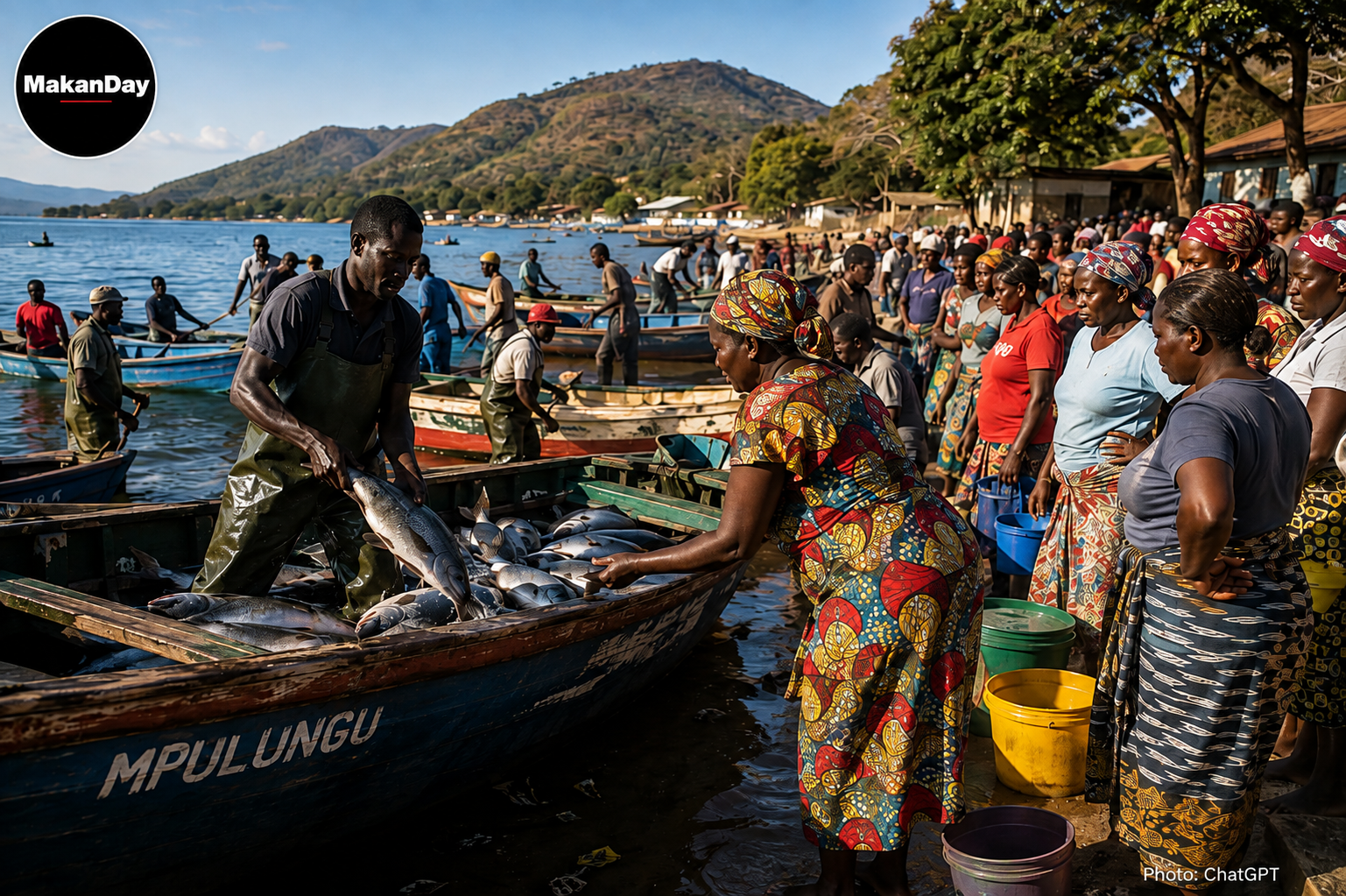
Three days before Zambians vote, a decision to reopen Lake Tanganyika to fishing nearly two months early has become part of the election conversation in Mpulungu. MakanDay investigated whether politics influenced the decision—and found the evidence points elsewhere.
By Angela Mtambo in Kasama, Northern Province
Weeks before the government unexpectedly lifted the annual fishing ban on Lake Tanganyika, former Mpulungu Member of Parliament and National Revolution Party United (NRPUP) parliamentary candidate Freedom Sikazwe had publicly questioned the timing of the closure.
Sikazwe argued that the ban did not correspond with the lake’s breeding season and said that, if elected, he would push for fishing restrictions based on biological evidence rather than fixed calendar dates.
Then, on 25 June, the government unexpectedly reopened the lake—nearly two months before the annual ban was due to end on 15 August.
The timing immediately raised questions.
And three weeks later, fishing entered the presidential campaign. At a rally in Mpulungu on 17 July, President Hakainde Hichilema told residents there would be no fishing ban again.
In a district where thousands of livelihoods are connected directly or indirectly to Lake Tanganyika, the political significance was difficult to miss.
Had government responded to political pressure? Was the early reopening an election-season concession to fishing communities? Or, as some residents and traditional leaders suspected, had Zambia simply stopped enforcing the closure because fishermen in neighbouring countries sharing Lake Tanganyika were continuing to fish?
The Ministry of Fisheries and Livestock offered a different explanation: science.
It said the lake had been reopened to facilitate a Catch Assessment Survey intended to help evaluate Zambia’s three-year fisheries management programme.
But that explanation raised another question: if the annual closure was intended to allow fish stocks to recover during the breeding season, why did conducting a scientific survey require fishermen to return to the lake nearly two months early?
MakanDay examined the competing explanations through interviews with fishing communities, traditional leaders, fisheries officials and regional sources, alongside official documents and government statements.
The evidence points away from the political and regional explanations that circulated around the lake and towards the government’s scientific assessment.
But the investigation uncovered another problem: poor communication around the decision created an information vacuum in which speculation flourished.
A town built around the lake
For decades, fishing communities along Lake Tanganyika in northern Zambia have planned their lives around one certainty. Every year, the annual fishing ban begins on 15 May and remains in force until 15 August, allowing fish stocks to recover during the breeding season.
For communities dependent on the lake, those three months shape both incomes and expectations.
Nowhere is that relationship more visible than in Mpulungu.
Here, fishing is woven into the district’s economy and the daily lives of communities along the lakeshore. Zambia’s principal port on Lake Tanganyika is located here, but for many households it is fish, rather than the ships passing through the harbour, that provides the most immediate connection to the lake.
A fishing boat returning to shore supports a much wider chain of livelihoods.
Fishers depend on the catch, but so do people who unload and sort fish, traders who sell it, processors who dry or smoke it, transporters who move it to markets and families whose household income depends on these activities.
Fish from Lake Tanganyika is also an important source of food locally and is transported to markets elsewhere in Zambia.
That dependence means a change in the fishing calendar travels quickly through Mpulungu’s economy. When fishing stops, the consequences extend beyond fishermen on the lake to traders, processors, transporters and households whose incomes depend on the catch.
But in 2026, the familiar calendar suddenly changed.
On 25 June, nearly two months before the scheduled reopening, the Ministry announced that fishing could immediately resume. The announcement triggered confusion throughout Mpulungu district.
Why had the government departed from a long-standing conservation measure?
What prompted the early reopening?
In its 25 June statement, the Ministry of Fisheries and Livestock said the ban had been lifted to facilitate the second round of the Catch Assessment Survey (CAS), scheduled for July 2026, and to begin a comprehensive review of Zambia’s three-year fishing ban programme.
According to the Ministry, the review would assess fish stock recovery, compliance with fisheries regulations and the socio-economic impact of the annual breeding closure.
MakanDay established that Catch Assessment Surveys are not new to Zambia’s fisheries management system. However, available records suggest the planned 2026 exercise would be the first comprehensive evaluation since the annual breeding closure programme on Lake Tanganyika was introduced three years ago.
The early reopening itself also appears unprecedented. Previous annual fishing bans were maintained until mid-August.
That left an important question unanswered. If Catch Assessment Surveys had been conducted before, why was it necessary to reopen the fishery nearly two months early this time?
Did politics influence the decision?
The chronology, however, complicates the political explanation.
Sikazwe’s comments came before the reopening, making his intervention relevant to questions about whether political pressure influenced the decision.
But MakanDay found no documentary or testimonial evidence linking his campaign position to the Ministry’s decision to reopen the lake on 25 June.
President Hichilema’s remarks came later. By the time he told a campaign rally in Mpulungu on 17 July that there would be no fishing ban again, the lake had already been reopened for more than three weeks.
His remarks therefore could not have prompted the original decision to lift the ban. They did, however, bring the fishing issue more directly into the election campaign, reinforcing the political significance of an issue already attracting considerable attention in Mpulungu.
What did fishing communities make of it?
For people whose livelihoods depend on the lake, the debate was not simply about politics or fisheries policy.
Interviews with fishermen at several landing sites found that fishing had resumed and fish trading had largely returned to normal.
Many welcomed the reopening because it restored their livelihoods. Others questioned whether ending the breeding closure before mid-August could undermine conservation efforts.
Several residents argued that strong seasonal winds naturally reduce fishing activity during breeding periods and therefore provide additional protection for fish stocks.
But as MakanDay continued examining the reasons behind the early reopening, another explanation emerged.
Senior Chief Tafuna suggested the decision may have been influenced by regional fisheries discussions involving Zambia, Tanzania, Burundi and the Democratic Republic of the Congo—the four countries that share Lake Tanganyika.
According to the traditional leader, neighbouring countries had not continued implementing the agreed seasonal closure, creating concerns that Zambian fishermen were being disadvantaged while fishermen across the border continued operating.
He said traditional leaders raised those concerns with the government before the temporary reopening.
If true, that would offer a different explanation for the decision: Zambia may have reopened its waters because keeping its fishermen ashore while those in neighbouring countries continued fishing would have placed local communities at a disadvantage.
MakanDay sought evidence to test that claim.
What the regional evidence shows
Further reporting challenged that explanation. An official from the Lake Tanganyika Authority (LTA)—the regional institution responsible for coordinating fisheries management among Zambia, Tanzania, Burundi and the Democratic Republic of the Congo—said the early reopening was not prompted by neighbouring countries abandoning the annual closure.
The official, who requested anonymity because they were not authorised to speak publicly, said the reopening was intended to facilitate the Catch Assessment Survey.
The explanation also addressed a question that had puzzled fishermen: why did conducting a survey require the lake to be reopened?
According to the official, the survey requires active fishing operations so fisheries experts can measure catch volumes, fishing effort, species composition and fish sizes.
Those findings will then be used to evaluate Zambia’s three-year fisheries management programme before future decisions are made.
The official also disputed the suggestion that the annual fishing ban had been abolished, saying the reopening was temporary and the breeding closure remained part of Zambia’s fisheries management framework.
MakanDay further established that although the survey is being conducted on the Zambian side of the lake, fisheries officials from Tanzania, Burundi and the Democratic Republic of the Congo are expected to participate in reviewing Zambia’s findings.
A regional communiqué seen by MakanDay confirms that representatives from the four riparian states are scheduled to meet in Zambia between 18 and 31 August 2026 as part of that regional review.
So why did the rumours spread?
Taken together, the interviews, chronology and documentary evidence support the Ministry’s explanation that the temporary reopening was primarily intended to facilitate the Catch Assessment Survey and review Zambia’s three-year fisheries management programme.
MakanDay found no evidence that election campaigning caused the 25 June decision.
Neither did the investigation substantiate the claim that Zambia reopened the lake because neighbouring countries had abandoned the seasonal closure.
But the investigation points to another failure: communication.
The Ministry announced a significant change to a long-established fishing calendar without sufficiently explaining why fishermen needed to be actively fishing for the scientific survey to work.
For communities whose livelihoods depend on Lake Tanganyika, that missing explanation mattered. In its absence, other explanations filled the gap.
There was an election underway. A parliamentary candidate had publicly questioned the ban. Traditional leaders had concerns about what neighbouring countries were doing. And weeks after the reopening, the President himself told a campaign rally that there would be no fishing ban again.
Seen separately, each development could easily feed speculation. What MakanDay’s investigation found, however, is that the chronology and available evidence do not establish that those political developments caused the decision taken on 25 June.
The finding
Three days before Zambia votes, fishing has become part of the political conversation in Mpulungu.
But the evidence gathered by MakanDay does not support claims that election campaigning drove the government’s decision to reopen Lake Tanganyika nearly two months early.
Instead, the available evidence indicates that the temporary reopening was primarily intended to allow active fishing so scientists could conduct the Catch Assessment Survey and review Zambia’s three-year fisheries management programme.
The investigation also found no evidence that neighbouring countries abandoning the seasonal closure prompted the decision.
What the controversy does expose is the cost of poor public communication. In Mpulungu, decisions about fishing are not abstract government policy. They reach from boats on Lake Tanganyika to the people unloading the catch, traders waiting on shore, processors, transporters and households whose incomes depend on the lake.
Lake Tanganyika is also shared by Zambia, Tanzania, Burundi and the Democratic Republic of the Congo, meaning changes to fisheries management on one side of the lake can quickly attract attention across borders.

Discover more from MAKANDAY
Subscribe to get the latest posts sent to your email.