

By ZAM Reporter
Millions of EU money in “elections support” prop up bad African leaders
An estimated hundred+ million euros of EU taxpayers’ money, intended to support democratic elections in five African countries, has instead strengthened autocratic and corrupt leaders in these countries over the past decade. Expensive training programmes and workshops for state officials, ruling parties and police have been funded with this money, while countless “voter education” programmes continue to prop up a façade of democracy in places where even the best-educated citizens are cheated out of their votes. EU observer missions have regularly pointed out failings, but change has not followed.
These findings result from a five-month-long investigation across five African countries: Kenya, Zambia, Ivory Coast, Nigeria, and Uganda. The project, conducted by investigative journalists in each of these countries, spans ten election cycles in total and traces the history of EU election funding across these cycles over the past decade. The total amount spent by Europe—though difficult to determine due to a lack of information from various EU offices in the countries concerned, and incomplete information from the EU in Brussels—over this period is estimated at at least €100 million.
Counting Euros for African elections
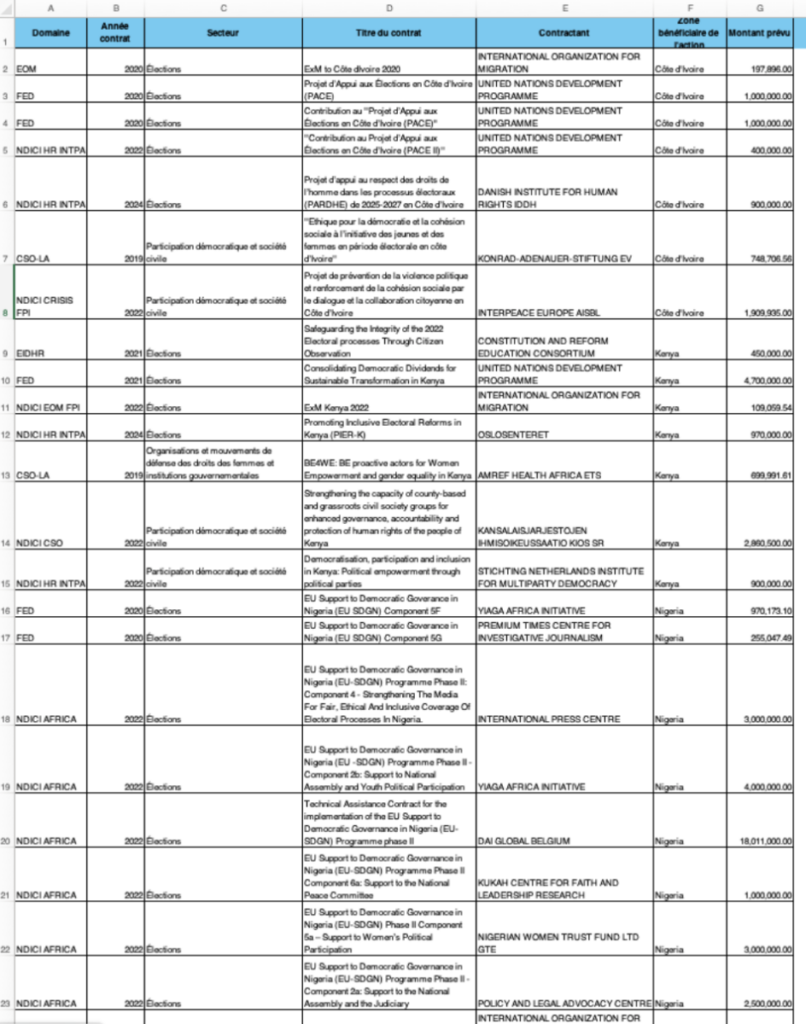
Financial data on EU election support in the five countries, obtained through an appeal to EU Regulation 1049/200 which grants EU citizens the right of access to EU documents, was provided to ZAM in the form of an extensive Excel spreadsheet. As per our request, the sheet reflected amounts paid to state structures in the five countries, either directly or through intermediaries’ so-called basket funding, as well as amounts intended for civil society, often through European-based NGOs.
Following this money in the five countries, we discovered that the sheet was incomplete in some instances; we added the extra amounts we found. In other instances, we discarded amounts -like training projects for young entrepreneurs- that appeared unrelated to elections. The detail is in the country chapters; in the graph below we reflect only what we believe to be a fair representation of the totals.
Due to its size, we were unable to reproduce this sheet in a legible form with our story. A partial screenshot is placed below; the entire sheet can be made available upon request.
Country | Funding (€) | Sources |
| Nigeria | 47 million | EU sheet |
| Cote d’Ivoire | 13 million | EU sheet (6 million); separate project (7 million) |
| Zambia | 31,5 million | Various, see country chapter |
| Kenya | 15 million | EU sheet (10,5 million); separate project (3,5 million) |
| Uganda | 2 million | EU sheet |
| Total | 107.5 million |
Discussions and torture
In Uganda, the EU has decreased electoral support due to the country’s dismal human rights record, but in 2024 it still paid €2 million into a project that organises “discussions” between political parties, including the ruling party and the opposition in that country, even though ruling party–linked security forces have been kidnapping, incarcerating, torturing and killing members of the opposition since at least 2020. Meanwhile, Europe continues funding flows to Ivory Coast, Kenya and Nigeria, where national and state authorities have also killed, imprisoned and disappeared pro-democracy activists.
“A printed script will say the elections were ‘free and fair’”
In Zambia, no killings or torture were reported, but there, too, election fatigue was observed because “the printed script will always say free and fair”, while “outcomes appear predetermined”, as a disillusioned voter said.
Among the findings of the transnational investigation are:
- In Nigeria, €18 million for the 2023 and upcoming 2027 electoral cycles was paid to the Belgian AI company DAI Global. The contract entailed training thousands of electoral officers in handling top-of-the-range voting systems for the 2023 elections, but turned out to be a waste since technical “glitches”, widely seen as manipulated by those in power, still ensured a ruling party presidential win. In contrast, poverty-stricken and suppressed independent media received very little support from the EU (less than 7% as opposed to 38% for DAI Global from the total EU Nigerian elections budget for the 2023-2027 period). The second-highest slice of EU Nigerian elections support money, over €7 million or 16%, was paid to the International Organisation for Migration (IOM), which assists refugees and returned migrants, including rejected asylum seekers from Europe. It was unclear what role the IOM was thought to play in Nigeria’s elections.
- In Ivory Coast, an autocratically ruled country mostly known globally as the world’s largest supplier of cocoa, €7 million of EU money was paid in 2025 into an election that saw opponents and critics incarcerated. In the same elections, 11 people died, including a police officer; 71 people were injured, and over 1600 people were arrested. Several hundred jailed civil society activists are still awaiting trial. While some NGOs also received EU support, activists said that “the EU money barely reaches those who fight for real change” and that the EU prefers “a government that keeps the cocoa exports flowing and the migrants out of Europe.”
- In Kenya, an “endless cycle of workshops” on voter education, paid for by the EU, creates an impression of free public debate and participation, while one of two dominant parties, each representing the political elite, routinely win elections. Pro-democracy activists are increasingly met with police repression: in 2024 and 2025, protesters were shot in the streets. In the upcoming elections in 2027, a budget of €420 million worth of Kenyan taxpayers’ money is to be spent by the Kenyan state on opaque contracts for election technology, while the persistent absence of a campaign finance law enables the richest candidate to run the most overpowering campaign. “The EU provides the software for all this”, in the words of reporter Eric Mugendi of independent media house Africa Uncensored.
- In Zambia, a Public Order Law favours those in power, while most public broadcaster time is dedicated to propaganda for the ruling party. Issues like opaque campaign finance and misuse of state resources have been repeatedly flagged by EU observer missions, but no change has followed. Of at least €6.5 million for the 2021 election cycle, partly paid by the EU, 90% was destined for Zambia’s state institutions, including training and conferences for the police and ruling party. In comparison, grassroots pro-democracy activists received little to no support at all. An independent candidate recently stepped back after authorities blocked his attempt to register the civil society movement he represents as a political party.
EU observers routinely mention the failings
The investigative team perused scores of EU election observer mission reports, finding that most of these routinely mention failings such as untransparent expenditure by the state, police repression, campaign finance opacity, and corruption. Yet election support to such state structures has kept flowing, even after the same states repeatedly ignored the recommendations.
An unfree context
Peter Hermes, a Dutch independent consultant on African democracy issues who has observed several election cycles in South Africa and Zimbabwe, says that the EU seems to believe that voter education will help combat the failings in states whose elections it supports. “The problem is not that citizens do not know how to vote — that is, in fact, explained quite well at the voting stations. The problem is that the context for the citizens is unfree. Either they (the rulers) cheat, or government-linked individuals look over your shoulder.”
“Government-linked individuals look over your shoulder”
As part of (NGO- and not EU-linked) observer missions, Hermes has noted that, in autocratic countries, electoral commissions are weighted towards those in power and formal opposition is often fully aware it cannot win. “In Zimbabwe, the opposition participated anyway because some representatives would get into parliament, which comes with many perks. Meanwhile, ordinary people simply hoped for elections to pass as quickly as possible, because there was so much intimidation.” Like the activists interviewed in this investigation, Hermes believes that grassroots pro-democracy forces should receive support. “Democracy starts at the base. Small local organisations often know very well what needs to be done. They need support to build a democratic movement from the ground up.” On the statement made by one activist, that the EU appears to focus on stability, keeping exports flowing, and migrants out of Europe, Hermes says that “unfortunately, that seems indeed to be the case.”
Closed route
For this investigation, financial data on EU election support in the five countries was mostly obtained through an appeal by ZAM to EU Regulation 1049/200, which grants EU citizens the right of access to EU documents. While ZAM colleagues with EU citizenship could obtain the information in this way, this route was closed to the African investigative journalists trying to find out what the EU was doing in their countries.
An appeal for information to the EU delegation in Zambia was left without a response. A request for an interview with the EU in Ivory Coast was first granted and then cancelled at the last minute, while information on the Nigerian EU delegation website was incomplete and a request for an interview was refused. The EU delegation in Kenya responded only months after emailed questions, requesting an in-person interview, but due to busy schedules on both sides the interview could not happen before our deadline; the delegation declined to make input in any other way. Uganda’s EU ambassador, who was asked why the EU has stopped supporting pro-democracy activists in the extremely oppressive country while maintaining links with the state, responded that the EU office’s “broader mandate is to maintain and develop the overall partnership between the European Union and Uganda across a wide range of areas — political dialogue, development cooperation, humanitarian support, trade and investment, governance, climate action and support to citizens,” and that “the European Union is a longstanding and substantial supporter of civil society in Uganda.”
Besides sending financial information to ZAM as requested on the basis of an EU regulation, the EU Commission office in Brussels did not respond to separately mailed questions.
In an emailed statement, a United Nations Development Programme (UNDP) spokesperson based in New York, did not engage with asked questions regarding financial opacity or repressive conditions in the countries where it distributes funding, explaining only that its funded activities include “support to governments, electoral commissions and also civil society organisations.”
See all the instalments in this Transnational Investigation here
Uganda | A humanitarian veneer
Ivory Coast | A mirage of democracy
Nigeria | Technology 0, politicians 1
Zambia | Restraint and fear
Kenya | Sound and fury
Jimmy Kitiro | When aid helps autocracy
Call to Action
ZAM works towards a new equal relationship between Africa and Europe. Contribute to our mission by donating.
Images by Joseph Zahui and Katumba Badru. Design by ZAM

Discover more from MAKANDAY
Subscribe to get the latest posts sent to your email.