

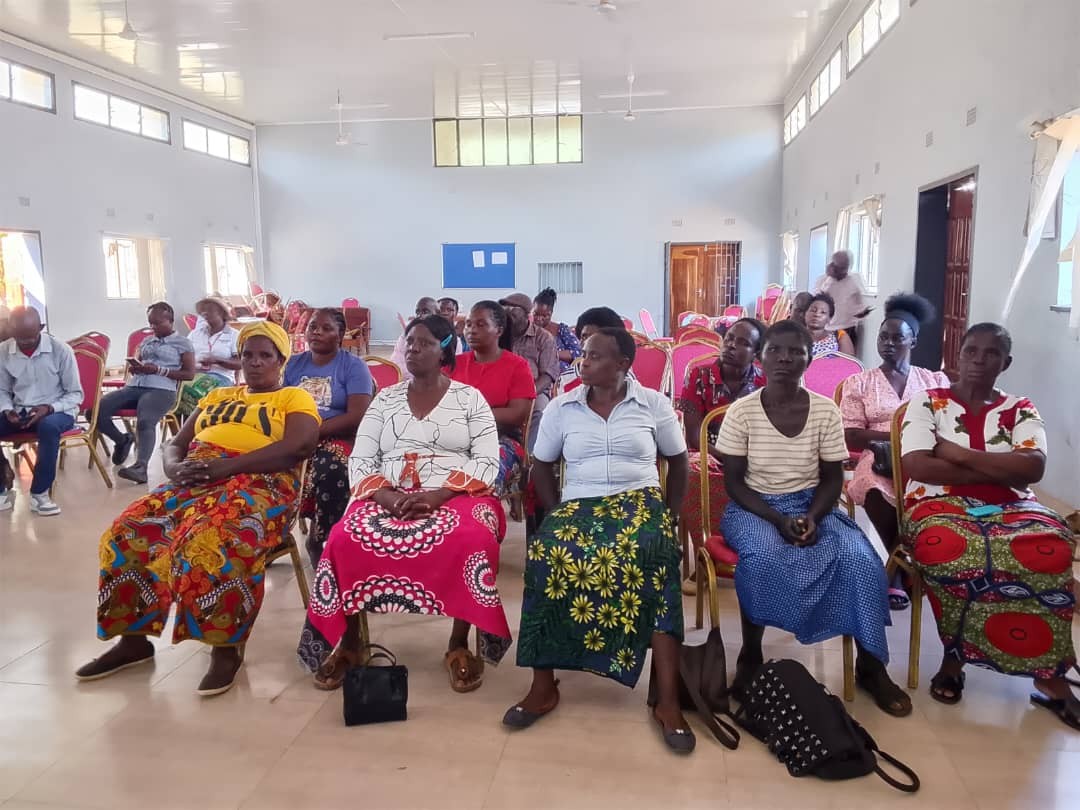
Custodians of household water listen attentively to the debate at Lusumpuko Hall, Mazabuka.
By Gift N’gandu
Mazabuka’s three million Kwacha water project meant to deliver clean and reliable water under the Constituency Development Fund (CDF) is raising increased alarm.
Residents are warning that the water being supplied is putting lives at risk.
A public debate held at Lusumpuko Hall – organised by Mazabuka Community Radio and the MakanDay Centre for Investigative Journalism, heard how the Ben Mwiinga Ward Water Project exists more on paper than in reality.
Despite official claims that the project is over 90% complete, residents say they are still receiving dirty, inconsistent water – if any at all.
“We are being told the project is almost done, but that is not what we are seeing,” said one resident, Brain. “It is not okay to give people dirty water. This is dangerous.
Dirty, Unreliable Water Raises Health Risks
Multiple residents reported that water supplied through Southern Water and Sewerage Company (SWASCO) is often dis-coloured and only flows once a week, leaving households exposed and desperate.
“The whole ward can go a week without water, and when it finally comes, it is dirty,” said Sylvester Luyaba. “We don’t even know the source. Yet money was allocated for this project.”
Health concerns are already mounting. Residents warned that the situation could trigger disease outbreaks, particularly during the rainy season when waterborne illnesses such as cholera are more prevalent.
“We are likely to see cholera if this continues,” one participant warned. “People are already getting sick.”
Tests Reveal Water ‘Unfit for Consumption’
Those fears are backed by independent testing. Christopher Manyepa, Director of the Centre for the Protection of Human Rights and Advancement of Democracy (CEPHRAD), revealed that water samples collected from the area failed safety standards.
“The water is not fit for human consumption,” Manyepa said. “This is a violation of people’s right to safe water.”
Transparency Questions and Missing Accountability
Beyond quality concerns, residents are also questioning the transparency of the project itself. Many say they have received no clear updates, inspections, or explanations despite repeated claims of near-completion.
“When they say 90% complete, what exactly has been done?” asked one resident. “We should be connected to clean water by now. Instead, there is silence.”
The debate brought together a panel that included representatives from the Centre for the Protection of Human Rights and Advancement of Democracy (CEPHRAD), a Ward Development Committee member from Ben Mwiinga Ward and community representatives.
Critically, both Mazabuka Municipal Council and SWASCO – key institutions responsible for implementing the project – failed to attend the public forum, despite their invitations, raising further questions about transparency and accountability.
SWASCO cited lack of internal authorisation, while the council requested a postponement to prepare – requests that left residents without answers.
Access Inequality Leaves Some Behind
Even where infrastructure exists, access remains uneven. Ward Development Committee member Wiseman Mayaba said entire sections of the community, particularly those in higher-lying areas, are effectively excluded.
“People in elevated areas cannot even connect because the system cannot reach them,” he said. “So who exactly is this project serving?”
The project, intended to address chronic water shortages in areas such as Highlanders, where over 1,000 residents previously depended on just two boreholes, was expected to transform sanitation and public health outcomes.
Residents Say Expectations Not Met
Instead, frustration is growing.
“Our expectation was clean, treated water that improves health,” said community member Florence Mulungu. “But what we have now is far from that.
Officials Defend Project Progress
Officials, however, insist the project is still underway. Chris Liwoyo, a member of the Mazabuka Central CDF Committee, said approximately K2.9 million has been allocated to SWASCO to connect four boreholes, with most materials already procured.
“The project is over 90% complete,” Liwoyo said. “If people are still complaining after completion, then we can hold SWASCO accountable. For now, it is still in progress.”
But that explanation has done little to reassure residents who say the lived reality contradicts official progress reports.
Public Funds, Public Questions
With nearly K3 million in public funds committed under the CDF – resources governed by law and subject to audit – the stakes are high.
For residents of Ben Mwiinga Ward, the issue is no longer about project timelines or procurement processes. It is about something more basic: access to safe water.
Until that is delivered, they say, the promises of development will remain exactly that – promises.
This report is the product of the Town Hall Debate by Mazabuka Community Radio & the MakanDay Centre for Investigative Journalism convened in Mazabuka.

Discover more from MAKANDAY
Subscribe to get the latest posts sent to your email.


