


By Charles Mafa
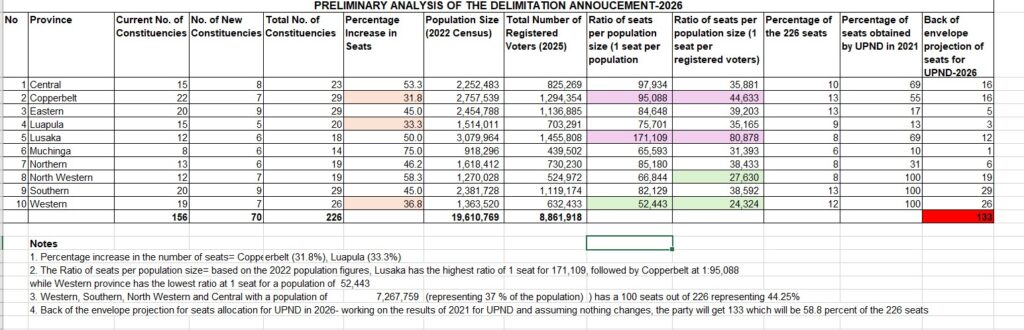
A preliminary analysis of Zambia’s 2026 constituency delimitation by policy commentator Rueben Lifuka suggests that the ruling United Party for National Development (UPND) could secure 133 out of 226 constituency-based parliamentary seats—equivalent to 58.8 percent of the national assembly—if past voting patterns hold.
“Of course, the emphasis is that this analysis is based on the assumption of past voting patterns, which could definitely change given new dynamics at play,” Lifuka said.
Lifuka is one of Zambia’s most prominent voices on governance, transparency, and anti-corruption, with decades of involvement in both national and international reform efforts.
The projection, based on a “back-of-the-envelope” model using the 2021 election results and applying them to the newly expanded constituencies, points to a structural advantage emerging from the delimitation exercise—raising fresh questions about the balance between representation and electoral equity.
Crucially, this projection by Lifuka, a former president of Transparency International Zambia, accounts only for constituency seats. It does not factor in the additional 40 proportional representation seats and a further eight nominated MPs, which will ultimately shape the final composition of the national assembly. While these additional seats could either reinforce or modestly rebalance the outcome, the core advantage arising from constituency distribution remains significant.
More seats, uneven weight
Zambia’s constituencies will increase from 156 to 226, a 70-seat expansion. But the distribution of those new seats reveals sharp disparities.
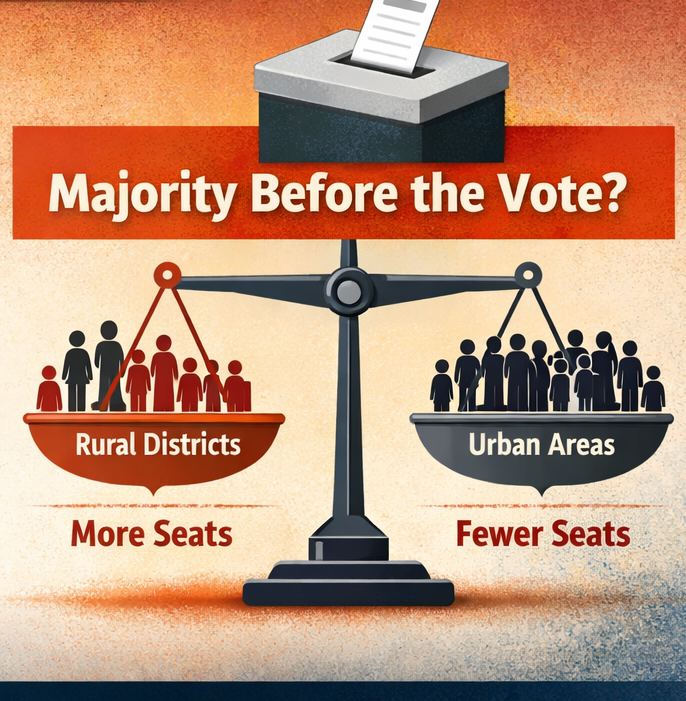
Provinces such as Central, North-Western, Southern, and Western, which together account for about 37 percent of the population, will collectively hold 100 seats—44.25 percent of the national assembly. These regions have historically leaned heavily toward UPND.
By contrast, more densely populated areas—particularly Lusaka and Copperbelt—show a different pattern. Despite large populations and voter bases, these provinces receive comparatively fewer seats relative to their population size.
Lusaka, for instance, has the highest population-to-seat ratio, with one seat representing about 171,109 people. In contrast, Western Province has the lowest ratio, where one seat represents just 52,443 people—effectively tripling the voting weight of individuals in less populated areas.
When equality becomes imbalance
On paper, each constituency elects one MP, giving equal voting power within the national assembly. But the path to that equality is uneven.
In practical terms, a voter in a sparsely populated constituency carries more influence in determining parliamentary composition than a voter in an urban centre. This is because fewer votes are required to elect an MP in smaller constituencies.
The implication is significant. Political parties with strong support in less populated regions can convert votes into seats more efficiently. That efficiency appears to favour UPND.
The geography of advantage
The analysis shows that provinces with smaller populations but higher seat allocations align closely with UPND’s 2021 electoral strongholds.
For example, Western, Southern, and North-Western provinces, where UPND previously secured overwhelming support, are projected to deliver a substantial share of the newly created seats. When these gains are combined with existing strongholds, the model suggests a pathway to a parliamentary majority well above the simple threshold of 114 constituency seats.
Even before proportional representation and nominated seats are added, the party appears positioned to cross the majority line comfortably.
Beyond numbers: A structural question
The Electoral Commission of Zambia (ECZ) has framed delimitation as a necessary step to improve representation, particularly in underserved rural areas. There is a strong argument that geographic size, accessibility, and service delivery challenges justify smaller constituencies in remote regions.
But the emerging data highlights a deeper tension.
Is delimitation correcting historical underrepresentation—or creating a new imbalance where the weight of a vote varies significantly depending on where it is cast?
The answer may lie in how Zambia reconciles two competing principles: equal representation by geography, and equal value of each vote.
An election before the election?
If the projections hold, the implications are profound. A projected 133 constituency seats would already place UPND in a dominant legislative position. Once the 40 proportional seats and eight presidential nominations are incorporated, the final parliamentary balance could shift further—but the foundation of power would have already been laid through constituency outcomes.
In effect, the numbers suggest that a significant portion of the parliamentary outcome may be shaped not only by voter choice in August, but by the structure of representation itself.
What is being established is that as Zambia heads toward the elections, the question is no longer just who will win—but how the design of the electoral map may already be influencing the result.

Discover more from MAKANDAY
Subscribe to get the latest posts sent to your email.