


Why is the government allowing millions of kwachas in overseas assets to decay while domestic services face funding shortages, and who is responsible?
By Gibson Zulu.
While Zambia struggles to fund schools, hospitals and public infrastructure at home, government-owned properties abroad, some worth millions of dollars, are quietly crumbling due to neglect, weak oversight and administrative failures.
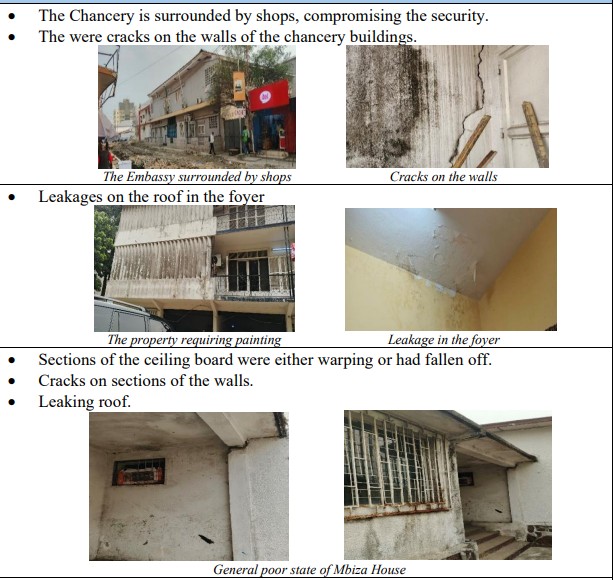
A MakanDay review of the 2025 Auditor General’s Report, supported by interviews with former diplomats, reveals widespread deterioration of Zambia’s foreign mission properties across Africa. Many have been declared unsafe, structurally compromised, or in urgent need of rehabilitation.
The audit findings suggest Zambia is sitting on deteriorating overseas assets worth millions of dollars, with no clear plan to protect, rehabilitate or replace them.
“The maintenance allocation was usually inadequate,” a former Zambian envoy told MakanDay in an interview. “At one point, I had to surrender rental income from a property in Lisbon just to maintain the chancery in Germany.”
Legal obligations ignored
The decay persists despite clear legal obligations. Section 108(i) of the Foreign Service Rules (2022) requires housing committees at foreign missions to maintain government properties and submit regular inspection reports.
Morgan Sitwala, Member of Parliament for Kaoma Constituency in Western Province and a member of the parliamentary committee on national security and foreign affairs, confirmed the existence of the committee overseeing such matters. He said it operates under the oversight of the Ministry of Foreign Affairs and International Cooperation, with technical support from the Ministry of Infrastructure, Housing and Urban Development.
In a phone interview with MakanDay, Sitwala acknowledged the challenges facing Zambia’s foreign missions abroad. He said that while the issues are complex and cannot be resolved all at once, there are “notable efforts being made” to address them. He disclosed that renovation works are currently underway at Zambia’s embassies in Namibia and Zimbabwe.
Beyond dilapidated properties, inadequate funding and transport constraints, the committee’s 2022 parliamentary report, chaired by Sitwala, highlighted additional challenges facing foreign missions. These include the absence of a professional cadre of staff, inadequate staffing levels, and difficulties in the procurement of goods and services, many of which remain unresolved.
Earlier reports paint a similar picture. In 2013, the committee flagged persistent problems affecting foreign missions abroad, including deteriorating infrastructure and a lack of adequate and timely funding.
Despite repeated recommendations by successive parliamentary committees, and acknowledgements by the executive, the reports show that little action has been taken to address the long-standing management and operational challenges facing Zambia’s foreign missions.
A pattern of neglect across the continent
The Auditor General’s findings reveal consistent decay across multiple countries.
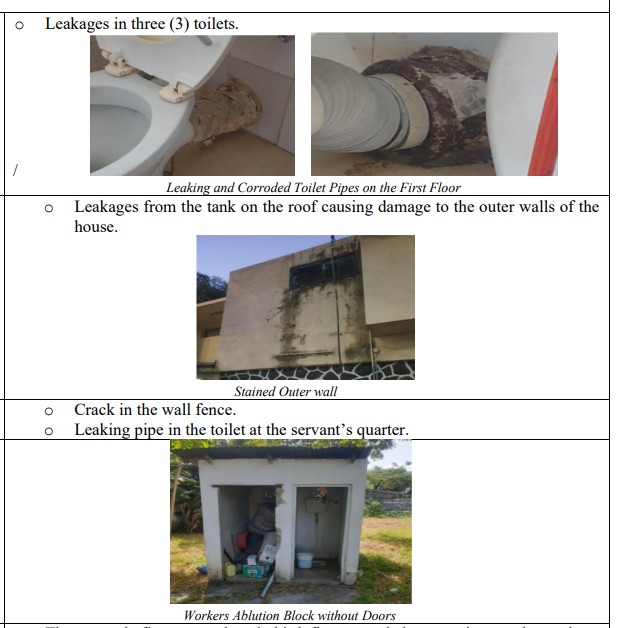
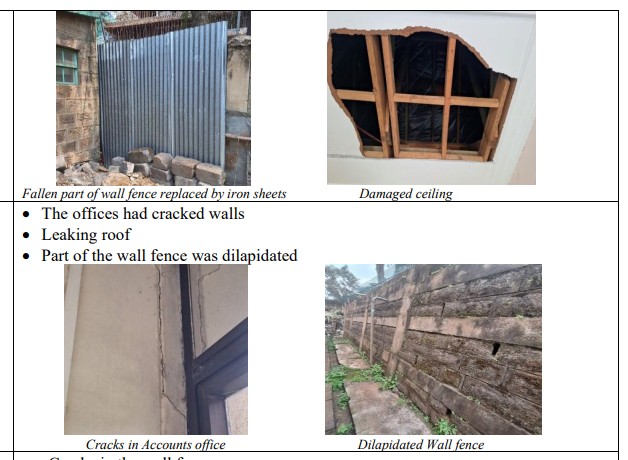
In the Democratic Republic of Congo, the Consul General’s residence in Lubumbashi was found with a cracked perimeter fence, a leaking roof, and a generator housed in an unsecured structure. Other government houses in the city had damaged ceilings and bathrooms with peeling tiles. In Kinshasa, cracks were observed in the ambassador’s residence, while the chancery is now surrounded by shops, posing serious security risks.
In Kenya, a vacant double-storey government property on Ngong Road in Nairobi had a collapsed wall fence, temporarily replaced with iron sheets. The building also showed roof leakages and damaged bathrooms, even as it sat unused.
In Tanzania, the High Commissioner’s six-bedroom residence in Dar es Salaam had multiple leaking toilets. A separate four-storey government building in the city’s central business district had an entire floor lying vacant, while parts of the ground floor and annex were rented out to private institutions, raising questions about asset utilisation and revenue management.
In Malawi, the official residence of the High Commissioner in Lilongwe remains vacant and damaged. The Auditor General described broken ceilings in the ambassador’s office and servant quarters as “dilapidated”.
Similar concerns were documented in Namibia, Zimbabwe, Ethiopia, Botswana and Mozambique, painting a picture not of isolated lapses, but of systemic failure.
Assets decaying, risks mounting
Beyond visible damage, the neglect has resulted in mounting financial losses as valuable state assets deteriorate without clear rehabilitation or disposal plans. It has also heightened security risks from poorly secured or encroached properties, while undermining Zambia’s diplomatic image abroad.
“Most of Zambia’s chanceries were purchased in the late 1960s,” the former envoy explained. “They are now too old and too expensive to maintain, yet there is no decisive policy response.”
He added that while funding comes from the Ministry of Foreign Affairs, assessments are conducted jointly with the Ministry of Infrastructure and embassy staff, raising further questions about why repeated warning signs have gone unaddressed.
A question of accountability
The Ministry of Foreign Affairs and International Cooperation is responsible for the management of all foreign missions abroad. However, despite multiple requests for comment, the ministry did not respond to MakanDay.
Efforts to obtain comment from the ministry’s Permanent Secretary, Margaret Miyoba, after referral by Minister Mulambo Haimbe, were unsuccessful by the time of publication.
The silence leaves critical questions unanswered:
Who is responsible for enforcing compliance with the Foreign Service Rules?
Why are inspection reports not triggering remedial action?
And how much public money has already been lost through prolonged neglect.
Sell, rebuild—or keep losing millions
According to the former envoy, the government now faces a clear choice.
“The government should sell these old properties and buy new ones, while ensuring that adequate funding is allocated,” he said.
The 2023 report of the parliamentary committee on defence and foreign affairs made a similar recommendation.
Gibson is an intern at MakanDay under the Free Press Initiative’s Journalism Graduate Internship Programme, which aims to promote excellence in journalism.

Discover more from MAKANDAY
Subscribe to get the latest posts sent to your email.