


By MakanDay Editor,
LUSAKA — An independent United Nations investigation has uncovered networks of agents and intermediaries allegedly luring foreign nationals with promises of lucrative civilian jobs in Russia, only for some to find themselves serving on the front lines of the war in Ukraine.
The findings raise questions for Zambia and other African countries about whether their citizens could be vulnerable to deceptive overseas recruitment and what safeguards exist for people accepting employment offers abroad.
The Independent International Commission of Inquiry on Ukraine said foreign nationals from countries across different continents had ended up serving in the Russian army after being deceived about the purpose of their travel.
According to the Commission, agents and intermediaries promised recruits lucrative civilian jobs and facilitated their travel to Russia, including providing tickets and visas.
The recruits were met by agents at Russian airports, but soon after arriving they were compelled to sign contracts with the Russian Ministry of Defence, the Commission said.
“The vast majority did not understand Russian or the terms of these contracts and found themselves serving on the frontlines in Ukraine,” Commission Chair Erik Møse told the UN Human Rights Council on September 21.
The Commission did not identify the nationalities of the affected foreigners in its latest public statements and did not say whether any Zambian citizens were among those it investigated.
That leaves an important question for Zambian authorities, whether any citizens have travelled to Russia expecting civilian employment and subsequently found themselves involved in the conflict.
The Commission said some foreign nationals already living in Russia, including people serving prison sentences, had also been coerced by Russian authorities into joining the armed forces.
Zambia has already experienced one such case. MakanDay previously documented the case of Zambian student Lemekani Nyirenda, who died while fighting for Russia in Ukraine. Nyirenda had been serving a prison sentence in Russia when he was recruited by the Wagner Group, the Russian private military organisation whose fighters were deployed in Ukraine.
But military recruitment is not the only way the war has drawn young Africans to Russia.
In a separate investigation published in 2025, MakanDay examined the recruitment of young African women, including Zambians, to the Alabuga Start programme in Russia. The women were attracted by promises of relatively well-paid employment and skills training, but the programme has faced scrutiny over conditions at the Alabuga Special Economic Zone and its links to the production of drones used in Russia’s war against Ukraine.
MakanDay spoke to a young African woman working at Alabuga who described strict controls, unexpected deductions from her salary and restrictions on movement within parts of the sprawling industrial complex. She said some recruits had left the programme because they could not cope with the workload and workplace culture.
The investigation also found that recruitment for the programme had been promoted in Zambia through social media and Russian-linked organisations. At the time, MakanDay sought answers from the Zambian government about what it knew of the programme and whether authorities had investigated the recruitment of Zambians. A source within Zambia’s Department of Anti-Human Trafficking later confirmed that the unit had been asked to look into the programme.
The consequences for recruits and their families have been severe.
According to the Commission, many recruits died shortly after reaching the front lines, while others went missing, were injured or were captured by Ukrainian forces.
Families have subsequently struggled from their home countries to establish what happened to their relatives, the Commission said, adding that recruiting agents often block their calls.
The Commission acknowledged that not every foreigner fighting in Ukraine had been deceived. It said many foreign nationals had knowingly and voluntarily joined both Russian and Ukrainian armed forces.
Its current investigation is focusing particularly on foreigners it says were deceived or coerced into joining Russian forces.
The findings could put greater attention on how overseas employment opportunities are advertised and monitored in countries whose citizens seek work abroad.
The Commission also disclosed that several states, including members of the UN Human Rights Council, had not responded to questions connected to its investigation into foreign recruitment.
It did not name those countries in the statement. Beyond the recruitment of foreigners, the Commission raised fresh concerns over the effects of the continuing war on civilians, particularly as Ukraine approaches another winter.
It said Russian forces continued systematic waves of attacks against Ukraine’s critical energy infrastructure during the severe winter of 2025–2026, when temperatures fell to minus 20 degrees Celsius.
Power installations, transmission lines, heating facilities and gas infrastructure were damaged or destroyed, leaving millions of civilians facing prolonged electricity cuts and shortages or complete loss of heating for extended periods.
One 74-year-old woman living on the 18th floor of a building in Kyiv told investigators that electricity cuts frequently stopped the lifts, leaving her trapped in freezing conditions.
“There was no way to go in or out. I lay cold and hungry, without medicine, without anything,” she told the Commission.
Ukrainian authorities recorded cold-related deaths and injuries, according to the investigation.
The Commission said it had also followed reports of Ukrainian attacks on infrastructure inside Russia and Russian-controlled areas of Ukraine, with reports indicating civilian casualties and damage to civilian property. It said, however, that a lack of access and information had prevented it from investigating those incidents.
Another strand of the investigation concerns Ukrainian children living in Russian-occupied territories.
The Commission said Russia had extended its patriotic education curriculum into occupied Ukrainian areas, with programmes promoting Russia made compulsory even for young children.
It said children from the age of 14 were receiving mandatory practical military training that included handling weapons and conducting military drills.
Some children had found the system unbearable and fled, sometimes alone, to Ukrainian government-controlled territory, exposing themselves to significant security risks and hardship, according to the Commission.
Four and a half years after Russia’s full-scale invasion, the Commission said more than 17,000 civilians had been killed and almost 54,000 injured in Ukraine, citing figures from the Office of the UN High Commissioner for Human Rights.
It said civilian casualties increased by 55% between January and September 2026 compared with the corresponding period in 2025 amid an escalation in Russian long-range attacks on populated areas.
The Commission said it continues to investigate alleged violations on both sides of the front line and reiterated the need for judicial and non-judicial accountability and support for victims.
Its findings from the continuing investigations are expected to be presented to the UN General Assembly’s 81st session in October.
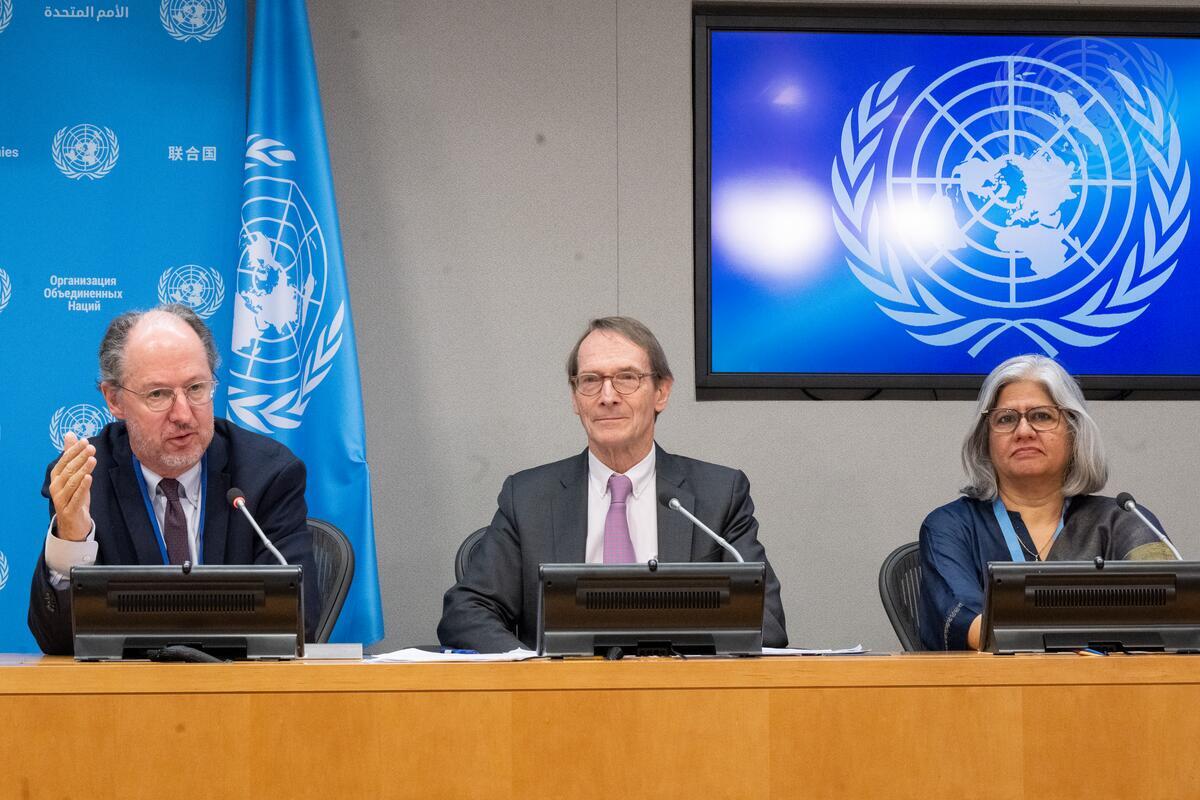
Members of the Independent International Commission of Inquiry on Ukraine brief reporters at UN Headquarters on 31 October 2024.
At left is Pablo de Greiff, in the centre is Erik Møse, Chair of the Independent International Commission of Inquiry on Ukraine, and at right is Vrinda Grover.
Photo Credit: UN Photo/Eskinder Debebe |

Discover more from MAKANDAY
Subscribe to get the latest posts sent to your email.