


“There was no other country aside from the United Kingdom and South Africa that had so many citizens in Zambia”
In the Bulletin & Record
Following closure of the Netherlands Embassy In Lusaka in 2014, a book entitled From Idealism to Realism. A Social History of the Dutch in Zambia, 1965?2013, by Anne-Lot Hoek was published to record the Dutch presence in Zambia. The book seeks to portray a social history of the Dutch in Zambia. In this article, historian Marja Hineflaar focuses on the first part of the book: what is the origin of (Dutch) development aid?
Over almost five decades, many Dutch men and women were involved in Zambia’s development: from merchants and missionaries in the 1950s to the arrival of an embassy with its staff in Lusaka in 1965, to development workers and Dutch doctors throughout Zambia after independence.
Development cooperation in the Netherlands was awakening at the end of their colonial involvement in Asia while at the same time international organisations were taking the lead in guiding developing countries into modernity.
The many Dutch development workers sent to Zambia during these very active decades were involved in a dynamic relationship with the country and its many peoples. This was particularly true of the Dutch presence in Western Province, which jokingly became known as “the thirteenth province of the Netherlands”.
The Dutch contribution is considered modest, especially when compared with the contribution of international organisations or impressive infrastructure projects like those of the Chinese.
The Dutch shift from idealism to a more economic perspective (“Aid to Trade”) is paralleled on a micro?level by Dutch development associates. They remained in Zambia after their development adventure and today make a living as entrepreneurs. Former volunteers who initially arrived to help Zambia develop are now availed of opportunities and witnessed Zambia’s evolution into today’s society. After Chiluba took office and privatised the economy, a new wave of Dutch adventurers came to set up businesses.
How did it start?
“It is considered that the sort of people we need are the type of young volunteers, such as yours, who have enthusiasm, initiative, ability to get on with the people, and willingness to work and to rough it.”
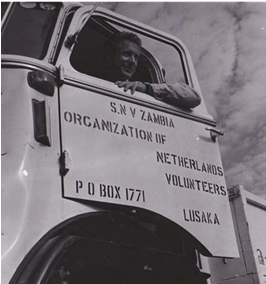
This was the formal request for Dutch volunteers made by the Zambian Permanent Secretary of National Development and Planning in 1966 that paved the way for the Dutch?Zambian relationship. It was no coincidence that Kenneth Kaunda, the first Zambian president, asked for the assistance of Dutch volunteers two years after independence. This was in line with his optimistic vision of the future of Zambia.
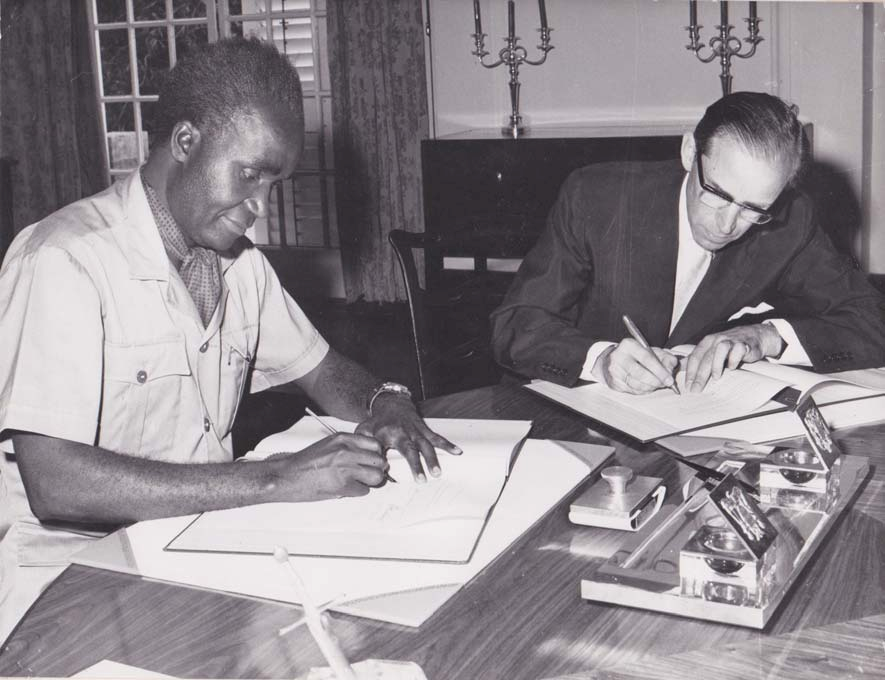
Kaunda, the former freedom fighter and leader of the United National Independence Party (UNIP), was a strong believer in development support. Like the Dutch, he assumed that development would be a matter of transferring knowledge in order for Zambia to become a ‘normal market economy’ within a short period of time. It was clear from the start that Zambia took the lead: Kaunda signed an agreement with the Netherlands concerning the employment of Dutch volunteers “at the disposal of the Zambian government upon the request of the latter”.
Development aid in Western Europe was until then a concept that was tightly intertwined with the work of missionaries and colonialism. They were the first pioneers in what we would later call development cooperation. The missionaries engaged in education and health and agricultural projects. Their influence in the field of development was widespread and considerable. The Netherlands was in fact one of the largest “suppliers” of missionaries. In 1940 there were almost 6,300 Dutch missionaries worldwide, reaching a peak in the 1960s, when the numbers mounted to 8,860.
After World War II, Dutch motivation for participating in development aid was closely tied to colonial heritage. From a diplomatic point of view, development was meant to improve Dutch?Indonesian relations and provide job opportunities for former colonials who returned from overseas. The Dutch initially focused primarily on their former colonies.
Aside from the colonial context, the principal motivation behind development work was economic: development aid could benefit Dutch trade and industry and Dutch export possibilities. Above all, it could boost the Dutch international profile. As Dutch Prime Minister Drees argued in 1953, technical assistance “was of importance to the whole world, but above all to the Netherlands”. The political context of the Cold War also played a role. According to an internally discussed memo of the Ministry of Foreign Affairs in 1954 and later in a memo of 1956, the fight against Communism formed an important motive for development aid.
After World War II, the concept of development cooperation came to be used by the West in a new institutional context, namely that of the United Nations. The first formal form of Dutch development aid was therefore financial support for the multilateral aid programme of the United Nations in the late 1940s. Dutch experts were sent out to provide technical assistance – the transmission of knowledge and skills – in United Nations organizations.
In the 1960s there was a shift towards a bilateral approach in the form of programme aid: general financial support for development policy. Because of the rapid growth of welfare in the Netherlands, society became more aware and interested in development aid. The budget for aid increased from 4.5 million Dutch guilders to 328 million in 1972. A new ministerial post was set up within the Ministry of Foreign Affairs: the Minister without Portfolio, in Charge of Aid to Developing Countries.
The Zambian request for Dutch volunteers did not arise accidentally: Zambian–Dutch relations had already been established outside the development context as a result of Dutch presence in Zambia before independence. According to the first Dutch ambassador in Zambia, Junker Matthias Beelaerts van Blokland, “there was no other country aside from the United Kingdom and South Africa that had so many citizens in Zambia”. Immediately after independence, there were approximately 1,200 Dutch residents in Zambia, the majority of whom were mineworkers or specialists working in the Copperbelt in the 1950s. There were also farmers and Dutch businessmen working for food and liquor companies such as Bols and Honig. Some had a colonial background and knowledge of coffee or tobacco; others came from northern Holland (Friesland) to work with cattle.
Diplomatic relations
Because of the presence of numerous Dutch citizens working in Zambia, the decision was taken to establish a Dutch consulate in 1961 in Ndola, the capital of what was then called the Western Province. The vice?consul was Dutch war veteran Willem Van der Elst, who was working for Rhodesian Industries Company, a Rhodesian company. The consulate was set up not just for administrative convenience but rather for reasons of safety with regards to the upcoming independence of Northern Rhodesia (Zambia), as demonstrated in a letter from the Dutch Consul General in Salisbury (formerly Harare) to the Minister of Foreign Affairs:
“Indeed, the transition of the colonial rule to a black government will be a fact in a small number of years in Nyasaland, while this development will be postponed for as long as possible in Southern Rhodesia. Northern Rhodesia takes a middle position; there are 70,000 whites against 2.5 million blacks. The white community is therefore too large to just give up the fight for hegemony, but is not large enough to offer resistance to the rise of African nationalism for long (…). The transition to self-regulation in Northern Rhodesia will be accompanied by heavy shocks. Those who speak of a second Congo may be pessimistic, but problems of that scale are certainly among the possibilities. If these eventualities occur, Dutch nationals should be able to rely on active support from the official Dutch side, which from Salisbury could be provided only occasionally.”
After Zambian independence the consulate was moved from Ndola to Lusaka, because the Zambian government demanded that diplomats be based in the capital. The Dutch Consul General of Salisbury, however, who was accredited with Zambia, pleaded for an embassy instead of a consulate, because the Dutch community strongly resisted authority coming from Rhodesia:
“Under the present circumstances, it would be highly objectionable and indefensible if the consulate in Lusaka did not have their own powers at their disposal and would therefore have to rely on the Consulate?General of Salisbury. Anyone who is familiar with the intensity of reaction in Zambia to the companies that operate from Salisbury and with how much favour there is for establishment in Zambia cannot but plead for the swift exclusion of the countries of Zambia and Malawi from the operational area of the Consul General of Salisbury.”
The Royal Netherlands Embassy was therefore opened in Lusaka in 1965. Kaunda received the verification of credentials of the first Dutch ambassador during an official ceremony in 1967. The ambassador remembers it as follows: “The president responded to my speech with kind words and stated that there were no problems with the 1,200 Dutchmen – I omitted to mention that there is a Dutchman in prison in Ndola…”
This story was first published in the July 2015 edition of the Bulletin and Record Magazine.

Discover more from MAKANDAY
Subscribe to get the latest posts sent to your email.