


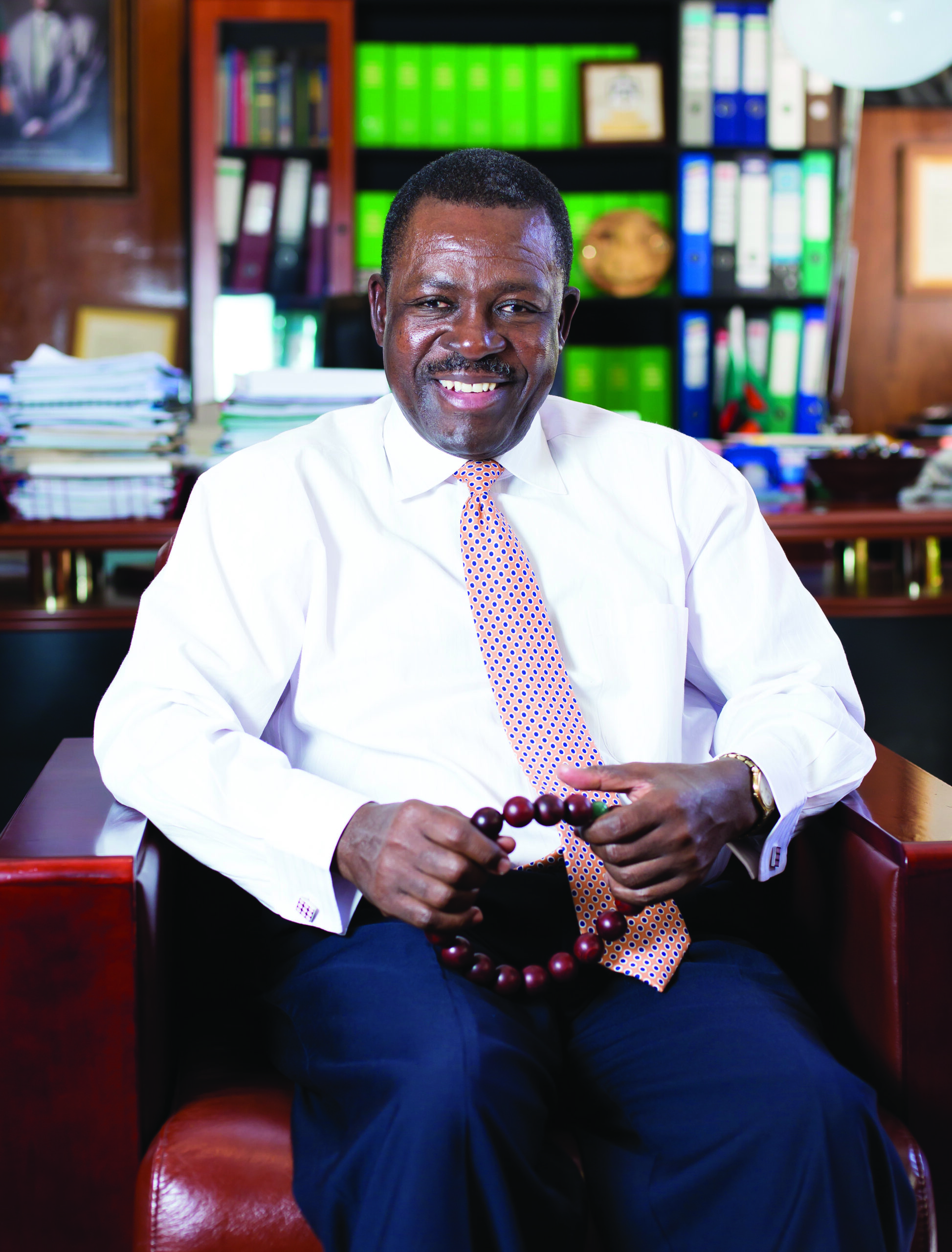
Johan Rahm* talks to Wynter Kabimba
Wynter Kabimba greats me with a big smile and asks me to sit down in an armchair in his office. The walls of his small ministerial office are covered in crowded bookshelves. On the desk too, are piles of books and documents. “I never sit behind that desk, I always use one of the visitors chairs,” he says. “I´m more comfortable working from there, not looking like a big man.”
Wynter Kabimba holds two important offices in Zambia. As Secretary General for the Patriotic Front party and as Minister of Justice he is very influential. Many people argue that he is one of the architects of the PF. But is he aiming even higher, to the top political office of the country? His answer to that is enigmatic.
“My mindset,” he says, ” is that I will serve this country now and for as long as people want me to serve it. Don’t forget that before I came here I was in private practice as a lawyer. I became senior lawyer in the profession. So for me, this is just about service.”
Mr Kabimba studied law and graduated from UNZA, and has worked as a lawyer for many years. What made him choose to go in to politics and public service?
“After graduating from law school I joined a political organisation, Lusaka City Council, as a youngster in the legal department. My first contact with the world, so to say, after the academic world was with politicians. At the time I worked with that group of elected representatives of the people and I think it is that contact got me interested in politics. These were very humble men and women. Not highly educated, but entrusted with the responsibility of resolving the problems of the local people in the townships, dealing with issues of water and road infrastructure. I think I started to share their passion of public service.”
The Patriotic Front has been in power for almost three years and Mr Kabimba has been in the inner circle of the party from the beginning. When I ask him if he is happy with what they have achieved in Government this far, the reply comes immediately.
“Yes, but we can do more”
What achievements is he most proud of?
“Firstly, the fact that we kicked out MMD. That was a major success and it continues to make me happy today. Secondly, the fact that we have mounted a very strong and vicious crusade against corruption in public office, which had become a common feature if not a culture under MMD. Thirdly, the fact that we are now able to restore confidence in our major public institutions, such as the judiciary.”
You said you have a lot more work to do. What are the priorities?
“The transformation of the lives of our people is paramount. I do not think that in the last two years our people have seen a drastic change in their livelihood. They are still expecting more from this government. The challenge is that we are coming from a background of the MMD and have inherited a public service, which itself must be an engine to drive our social and economic programme, that is still stippled in to this “devil do it” attitude. But I think we are getting somewhere.”
Mr. Kabimba fingers a band of big braids that he has been holding in his hands. It is for stress relief. After the interview his press aide, who sits in on the interview, says that the braids has gotten him in to problems. Some people have accused him of using it for witchcraft.
We start talking about another of the issues on top of the agenda for the PF Government; the education system.
“We should ensure that every child must have the opportunity to be enrolled in primary education. Not only enrolled, they must have the opportunity to go up to tertiary level. The challenge we had in the past is that the system is like a pyramid, as you go up the number of students is getting smaller and smaller. That means you are running an educational system that is targeting to produce an elitist group of people in society. Immediately you do that you cannot fight poverty.
“The gap between the poor and the small group at the top is only widening. What we ought to do is to turn that pyramid, so that every child who gets in to primary school must have an opportunity to get a diploma. That is why we heard the President make pronouncements that we should build a university in at least every province. Here we are 50 years after independence with basically two universities. I don’t want to express my opinion about the private universities that are mushrooming, but I can tell you that they are not up to the standard of what the 21st century is looking for. We need to build more public universities. We need to produce citizens that understand their social conditions, their regional conditions and their international, globalized conditions. “
In the background a TV is running, giving us the latest news around the world as a backdrop to the interview. The air conditioner is humming, adding to the background noise. When Mr. Kabimba starts to talk with a low voice about the challenges in the health sector it becomes difficult to hear him.
“We have a dualistic way of life in our country. A good number of our people, especially in the countryside, still believe in traditional medicine, against conventional medicine. One of the tasks we have is to move these people from this end to the other end. Because doing so is actually improving their way of life. But you can only do so if they can have access to health facilities. If for example the nearest health facility they have is a traditional healer then certainly that is where they will go.
“We want the clinic with the conventional medicine, with trained doctors and nurses, to be the nearest place for them. Now, people in my village, have to choose between going to the clinic, which is 15 to 20 km away and going to see a traditional healer in the village. They will go to the traditional healer and even believe that the traditional healer can cure AIDS. They are being put in that situation not out of their own choice, but because of a lack of accessibility. What we want to do now is to cut down on those distances to health centres so that they become their first point of call.”
An expansive politic on both health and education is costly. How would these reforms be financed?
“It will not take a short period of time. But the longest journey starts with the first step. We are taking a first step and we have no illusions that this is going to be a short journey. But that should not dissuade us, or prevent us, or discourage us from taking the first step. Initially it will be costly, but ultimately it will be less costly because we are going to have a citizenry that is educated and healthy.”
Talking about costs and planning. Zambia has had enormous growth over the last ten to 15 years. But poverty does not seem to move in proportion to those figures. Why is that?
“I am not an economist, but a lawyer. As a citizen, I have never understood that contradiction. On one hand you have all these flamboyant figures, that sound very good in the ears of economists, that this country is growing with between five and eight per cent every year. On the other hand you have levels of poverty that are growing. So I don’t understand from a common sense perspective how high growth can lead to more poverty. This contradiction just shows that there is something wrong with the policy implementation. But also what it means is that that growth is just for a small group of people. Again I go back to the issue of the elite. Growth must be people centered. I don’t think that the growth in the last 10 to 15 years have been people centered.”
In a global capitalistic world, is it possible to make that change? There are a lot of foreign investors in Zambia now. Could it be that the growth is just leaving the country?
“The emerging school of thought now is that even capitalism itself has to mutate. Because if it doesn’t it will lead to social unrest that we have seen in other countries. If social unrest becomes the norm then investment is at risk, be it foreign or local. I think if capitalism is going to be the world economic order then it must be a system that drives people-centered economics, not profit-centered economics. If it doesn’t, it will meet the Marxist theorem and kill itself. It will sow its own seeds of destruction. If the social unrest around the world because of the economic deprivation continues the situation will be such that nobody can go to sleep peacefully. So capitalism has a challenge in the 21st century.”
Then the role of government will then be to make sure to create a system in which the companies are forced to take social responsibility?
“Exactly, and that is why the argument that the government should disengage completely from economic activities has collapsed completely.”
What is your plan to tame the capitalism or big investors?
“It is very difficult to tame capitalism; it’s a tsunami of the world. The way you try to tame it is to ensure that you have leadership that is people centered and more insular before it becomes global. We have to look at our conditions before we can claim to be part of a global world and therefore we ought to ensure that the parameters of the economy become balanced between foreign investors and local investors. More and more Zambians should start participating in economic activities. The competition should be between foreign and local investors and not foreign to foreign investors, because the objectives of the foreign investors are basically the same, to make profit. We have to shift the parameters and encourage our citizens to be part of the economic activities.”
You mentioned social unrest. Do you think there is a risk in Zambia, if the elite continue to grow at the same time as there is no reduction in poverty, that we will see more social unrest?
“That is a common phenomenon in the world. It is a law of nature and Zambia can be no exception. We always have to be cautious of that, so that we end social unrest by ensuring that we create an eqalitarian or semi-eqalitarian society. The voices of the majority must become the voices that should influence and drive the economy.”
Would you like the Government to be more included in the economy, by, for example, running more businesses?
“Definitely! I think the phenomenon that the government should completely disengage from the state economic participation is wrong. And that has been proven.”
During the close to three years the PF has been in power a lot of public clashes between Government and foreign companies have been reported in media. For example, governmental representatives have warned foreign companies to not lay off workers. How does Mr. Kabimba see the responsibilities of foreign investors in Zambia?
“For example, we have to make sure that the extractive industry is regulated to create employment. One of the problems we face is that the extractive industry has become so mechanised that it is not contributing to employment creation. You see big excavators coming in to do a job that is supposed to be done by 200 or 300 Zambians. This is a third world country so the issue of employment creation is still fundamental. The multinationals argue that they need to maximize their profits. Yes, that is a rational argument, but that is not only what they come here for. The also come here to help create employment so that income distribution and buying power is enhanced. The minerals belong to the Zambians. We must have a win-win situation and we can only achieve that with a regulatory framework.
Many of the issues we have discussed have their basis in what ideology you choose to guide you. How would you describe the PF ideology?
It is very difficult today to describe a political party’s ideological formations. But whatever ideology you would like to put as a tag, the Patriotic Front philosophy is that we are a people-centered political party. Our major client, in whatever we do, is the ordinary person. The people that do not know how to play the role of the advocate to attend what they want to attend. Those are our clients. So whatever tag you want to give to that philosophical formation, that is what we are.
The interview is over. Mr. Kabimba hurries from his office. He is late for lunch with his wife.
* Johan Rahm is a Swedish media consultant who at the time was working in Zambia. He was co-founder of The Junior Reporter magazine.

Discover more from MAKANDAY
Subscribe to get the latest posts sent to your email.