

By Gibson Zulu
With just over 100 days before Zambia heads to the polls, questions about the independence of the Electoral Commission are no longer confined to political debate—they are now being raised by international observers and reflected in the country’s own electoral processes.
A high-level mission by the National Democratic Institute (NDI) has warned that the Electoral Commission of Zambia (ECZ) must move beyond assurances and demonstrate its independence through concrete actions. But a closer look at recent developments, from constituency delimitation to access to electoral information, suggests these concerns may already have a basis in practice.
A question of trust
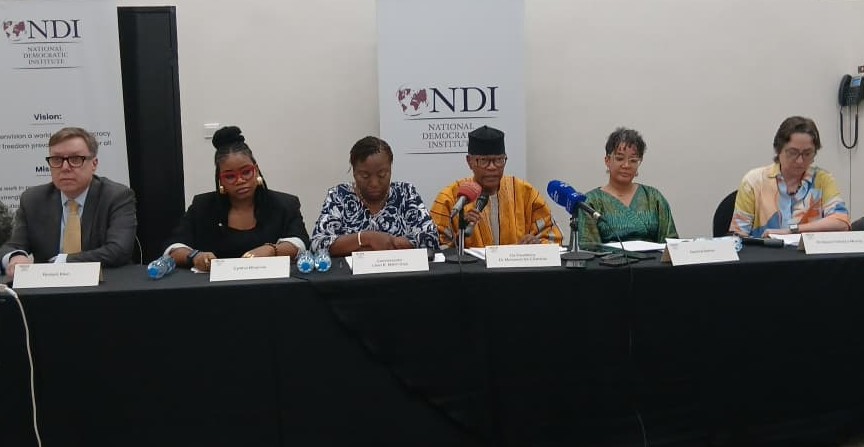
The NDI delegation, led by Mohamed Ibn Chambas, found that while ECZ is widely viewed as technically competent, concerns persist around transparency, stakeholder engagement, and access to critical electoral data.
“To address longstanding perceptions of political bias, the ECZ commissioners should demonstrate their independence and impartiality not only through words, but also through their actions,” said Richard Klein during a press briefing in Lusaka on April 30.
At the centre of the concern is a deeper issue of whether the structures governing Zambia’s electoral system allow the ECZ to operate free from political influence—or merely create the appearance of independence.
The process for appointing the ECZ chairperson, long criticised by stakeholders, remains unchanged. While the NDI stopped short of making formal recommendations, it acknowledged that the issue continues to raise questions about institutional autonomy.
Delimitation and unequal representation
One of the most significant electoral changes ahead of the 2026 elections is the creation of 70 new constituencies, increasing the number of elected Members of Parliament from 156 to 226.
The ECZ has defended the exercise, citing population growth and the need to improve representation. But the process has drawn criticism over limited consultation and lack of transparency.
NDI described the reform as having “mixed implications”—bringing representation closer to citizens on one hand, while raising concerns about cost and fairness on the other.
“While it may bring representation closer to citizens, stakeholders expressed concern over the financial burden associated with expanding parliament,” Chambas said.
The delegation further warned that the current distribution of constituencies does not adequately address inequalities in voting power, potentially undermining the principle of equal representation.
A review of Zambia’s 2022 census data further complicates the picture. MakanDay analysis shows significant disparities in the number of people represented per constituency across provinces—raising questions about whether the principle of equal representation has been fully achieved.
In some areas, constituencies carry far larger populations than others, effectively diluting the weight of individual votes.
Timing and transparency
Concerns are also mounting over delays in finalising amendments to the Electoral Process Act. Electoral reforms introduced too close to an election, experts warn, leave little time for implementation, voter education, and stakeholder adaptation.
“The electoral system must serve all parties and citizens,” Chambas said, warning that rushed reforms risk weakening confidence in the process.
Beyond legislation, stakeholders have raised concerns about delayed access to electoral information—an issue that directly affects the ability of political parties, civil society, and voters to prepare adequately.
Political space and law enforcement
The pre-election environment is another area under scrutiny. Stakeholders consulted by the NDI mission reported concerns over restrictions on political gatherings, citing the continued use of the Public Order Act and what some describe as uneven enforcement by the Zambia Police Service.
Lilian Mahiri-Zaja, a member of the delegation, said these concerns were consistently raised during consultations.
“All candidates and political parties should be able to freely hold political gatherings and campaign rallies across the country,” she said.
Reports that opposition parties struggle to hold rallies outside by-election periods point to what observers describe as an uneven political playing field. Concerns have also been raised over the use of cyber-related laws and other legislation to restrict freedom of expression during the campaign period.
The legal gap
Another structural weakness identified by the delegation is the absence of a comprehensive legal framework governing political parties. Zambia currently relies on the Societies Act—a law not designed to regulate modern political party activity—which treats parties as “ordinary clubs” under the oversight of the Registrar of Societies in the Ministry of Home Affairs and Internal Security.
According to NDI, this gap has direct consequences, particularly in campaign financing, which remains largely unregulated. Although Article 60 of the 2016 Constitution provides for oversight of campaign funds, the absence of a political parties law means there is no framework to enforce it.
The report notes that this places Zambia behind international standards, including the United Nations Convention against Corruption, which calls for greater transparency in political financing. Stakeholders consulted by the Institute also raised concerns about the high cost of participating in politics, which disproportionately affects women, youth, and persons with disabilities.
Without clear rules, questions around transparency, accountability, and fairness in political competition remain unresolved.
Who gets represented?
Despite new provisions in the electoral system, underrepresentation of women, youth, and persons with disabilities remains a persistent issue. NDI urged political parties to move beyond symbolic inclusion and ensure broader participation across all levels of political leadership—not just through proportional representation seats.
The church and neutrality
The role of the church, long seen as a stabilising force in Zambia’s democracy, is also facing scrutiny. Cynthia Mbamalu acknowledged concerns that some religious institutions are increasingly perceived as partisan.
“The church must continue to provide civic and voter education in a neutral manner,” she said, emphasising the importance of maintaining public trust.
A system under test
The NDI mission was based on consultations with a wide range of stakeholders across Zambia’s political and civic landscape. It was not a formal investigation—but its findings align with concerns already emerging within the country.
The mission itself was supported by the Foreign, Commonwealth and Development Office, although the Institute stressed that its conclusions are independent.

Discover more from MAKANDAY
Subscribe to get the latest posts sent to your email.