

By Linda Soko Tembo
Billions of kwachas are tied up in Zambia’s parastatals, in pensions, railways, power projects, and public assets meant to drive national development. Yet the Auditor General (AG)’s latest findings show that much of this public wealth is being eroded by weak governance, chronic losses, and unresolved audit failures, raising urgent questions about who is accountable.
Every year, the AG tells parliament the same story, public institutions are losing money, ignoring the rules, and leaving audit problems unresolved. The difference this time is the scale of the risk, and what it could mean for pensions, public services, and taxpayer confidence.
The latest report covers unresolved audit matters across many state-owned enterprises and statutory institutions, including issues in governance, accounting, budget performance, internal controls, and statutory compliance.
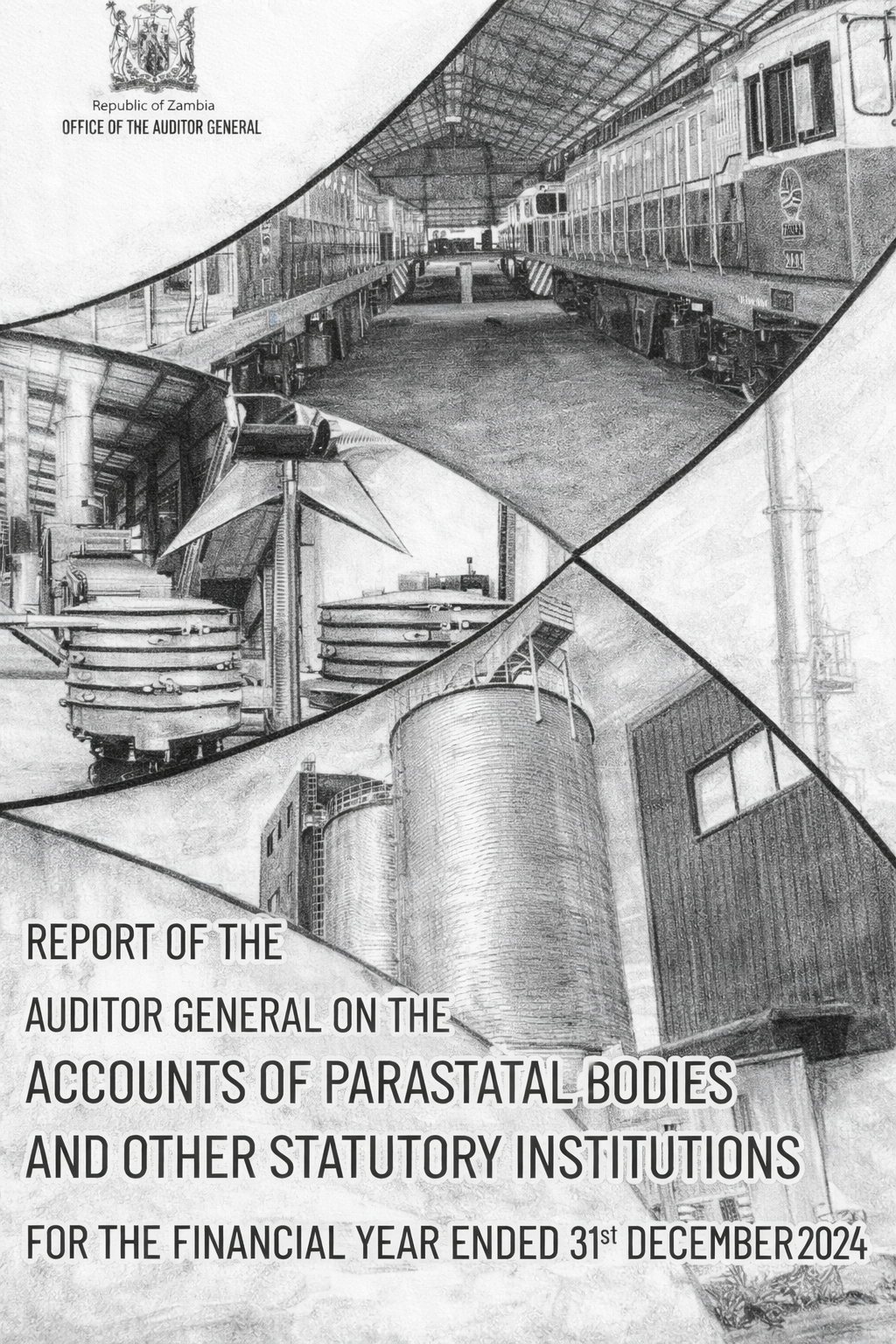
The Report on the Accounts of Parastatal Bodies and Other Statutory Institutions for the financial year ended 31 December 2024, released by Acting AG Dr. Ron Mwambwa, reveals systemic weaknesses in governance, accountability, and financial management across several state-owned enterprises and statutory bodies, many of which remain unaddressed as of 31 October 2025.
One of the most alarming cases is the Public Service Pension Fund (PSPF). Actuarial assessments show funding gaps of K50.42 billion in 2020 and K43.88 billion in 2023, with pension assets covering only nine percent of future obligations. The situation is worsened by delayed government remittances of K96.56 million for December 2024 and K14.9 million in outstanding rental income, threatening the long-term sustainability of public sector pensions.
The AG warned that government’s delayed remittance of K96.56 million in pension contributions for December 2024, coupled with K14.9 million in outstanding rental income, threatens the long-term sustainability of public sector pensions.
The report also paints a bleak picture at Zambia Railways Limited, which recorded operating losses totaling K315.4 million over 2023 and 2024. The company continues to face negative working capital exceeding K1.17 billion, largely due to an ageing fleet and high operating costs. In addition, rolling stock valued at K447.5 million remained uninsured, exposing the company to significant financial risk.
In the regional transport sector, the Tanzania Zambia Railway Authority (TAZARA) incurred maintenance costs of US$7.04 million and revenue losses of US$3.3 million following 405 accidents, most of which were attributed to operational and infrastructure deficiencies. The absence of audited financial statements for three consecutive years and failure to collect K71.03 million in rental income further weakened accountability at the Authority.
Incomplete REA projects mean electricity is promised but not delivered.
At the Rural Electrification Authority (REA), weaknesses in contract management exposed public funds amounting to K22.5 million through unrecovered advance payments, missing guarantees and failure to charge liquidated damages. The report further notes that 23 projects valued at K88.46 million remained incomplete beyond agreed timelines, delaying the provision of electricity to rural communities.
The audit also cited Indeni Energy Company Limited, where failure to dispose of decommissioned refinery assets resulted in an impairment charge of K147 million, in addition to K4.84 million spent on care and maintenance. The company also paid US$521,857 for materials that were not delivered, while its working capital declined to a negative K298.2 million in 2024, raising concerns about its financial viability.
CCPC’s failure to collect fines weakens consumer protection and emboldens offenders.
Meanwhile, the Competition and Consumer Protection Commission (CCPC) failed to collect K32.77 million in fines imposed on non-compliant entities and K9.4 million from settlement agreements, a situation Dr. Mwambwa said weakens regulatory enforcement and consumer protection.
Infratel Corporation Limited was also faulted for incurring penalties of K1.08 million due to operational downtime and failing to recover K3.62 million from insurers owing to non-compliance with insurance conditions.
Overall, Dr. Mwambwa warned that the persistence and scale of the unresolved audit findings point to material fiscal risks, inefficient use of public resources and weakened oversight.
He called for urgent corrective measures, including recovery of outstanding amounts, stronger oversight by boards and controlling officers, improved contract and asset management, and strict compliance with statutory reporting requirements. Failure to act promptly, he cautioned, could erode public trust and undermine accountability in the management of public funds.
The image used is AI-generated and is used for illustrative purposes only.

Discover more from MAKANDAY
Subscribe to get the latest posts sent to your email.