

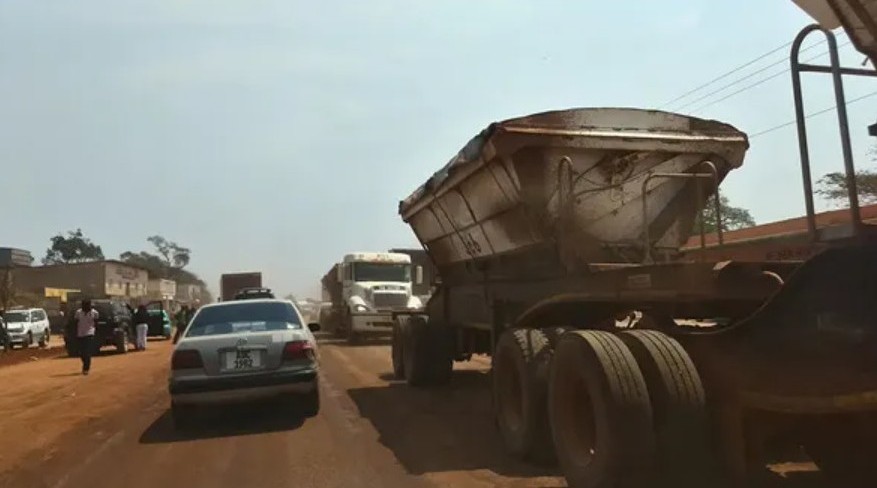
The roads-for-rates deal between Solwezi municipality, and its biggest ratepayer has trebled in value over five years.
By Charles Mafa
KEY FINDINGS
- Between 2021 and 2025, Kansanshi’s property-rates bill to Solwezi Municipal Council totalled K417.74 million. Instead of settling the entire amount in cash, 17.8% was settled through roadworks carried out by the mining company under its roads-for-rates arrangement with the council..
- Under the arrangement, Solwezi Municipal Council proposes and approves the road projects, while Kansanshi prepares the costings and carries out the roadworks, with the cost offset against the mining company’s property rates.
- Kansanshi says the work is done at cost. But, the company and council have not shared crucial documents to verify the terms and conditions of this work.
Solwezi, the capital of Zambia’s North-Western Province and the hub of the country’s copper belt, draws up a list of the roads it wants built and its biggest ratepayer does the rest. Kansanshi Mining draws up the costings, wins the job, builds the roads and then deducts the bill from the property rates it owes the town council.
This is a small but telling window into a wider dynamic. Solwezi has grown rapidly alongside the copper boom driving it. Its urban population rose from 96,725 in 2010 to 305,027 in 2022, according to Zambia’s census — more than tripling in 12 years. That growth has put increasing pressure on the town’s roads, water and other services. And the gap between that growth and the resources available to the council is reshaping how the town is run.
Kansanshi Mine is the country’s biggest copper and gold producer. When asked about this arrangement with the Solwezi town council, the company confirmed to MakanDay that it did build roads to offset against its municipal rates bill. The arrangement, the company statement confirmed, accounted for K74.36 million or 17.8% of its total property rates bill between 2021 and 2025. Information supplied by the company also revealed that the value settled through roadworks rather than cash more than tripled over the five-year period, rising from K8.5 million in 2021 to K29.86 million in 2025.
The arrangement gives Kansanshi two roles in the same system. It is a major property-rate payer to the council. But when part of those rates is converted into infrastructure, the company can also become the contractor carrying out the work used to settle that obligation. When asked about this, the company stated that the municipality is free to shop around for other quotes and contractors which, it claimed, the municipality had done on “numerous occasions”.
According to Kansanshi, the process begins with the council. The council sends the company a list of roads it wants constructed. Kansanshi prepares a bill of quantities and costs each road. The company told MakanDay it quotes the council at cost and does not add a profit margin. Once work begins, stated the company, the municipality supervises the work, and the finished road is inspected by state’s Road Development Agency.
MakanDay was unable to verify this. Journalists asked to see the agreements that govern this arrangement but the mining company refused to give MakanDay the agreements or saying that the council had to hand them over. The council has yet to respond to a request for the agreements and neither company or town council are responding to further questions on the matter. Solwezi’s new mayor, Evans Lubelenga, who was elected in August, told journalists that he needed time to understand council systems and projects before responding.

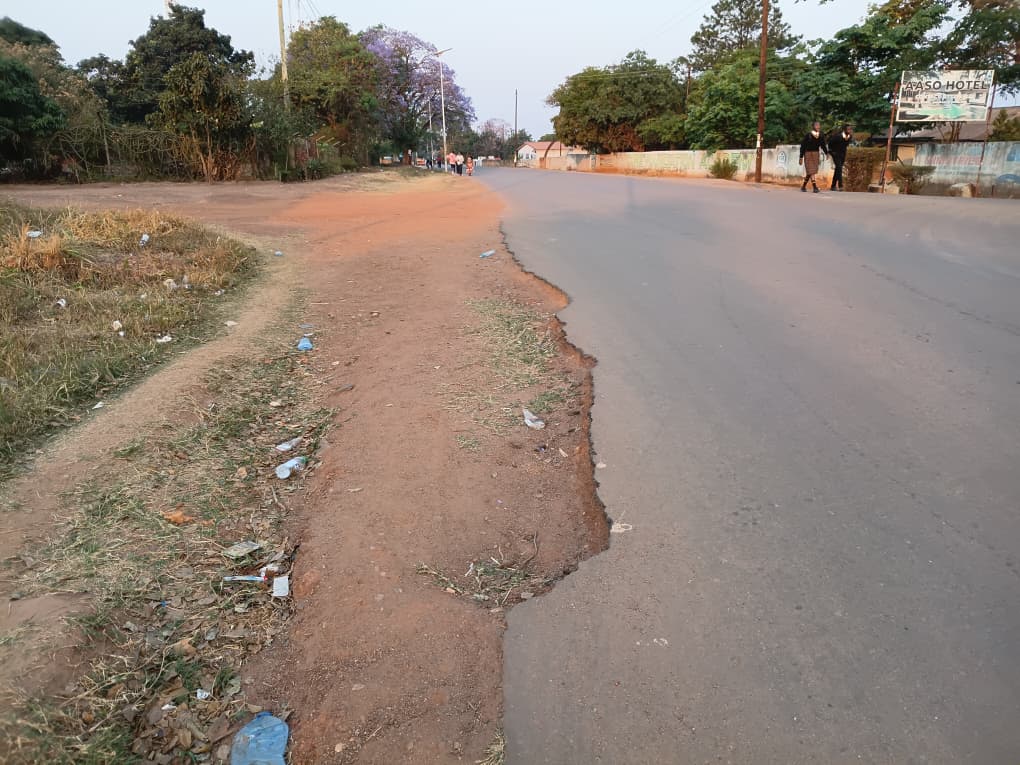
Over eight years at least K80 million in rates has been “paid” in road construction
Most of Kansanshi’s property-rate liability is still paid to the council in cash.
But the proportion accounted for through infrastructure has grown.
The amounts involved have increased consistently and substantially and it appears that the arrangement started earlier than 2021. MakanDay has seen council documents that confirm that this roads-for-rates deal was in place in 2018. Journalists were unable to confirm any rates deal for 2019 or 2020.
- 2018: It’s not clear how much was Kansanshi’s total property-rate bill, but the company confirmed that K6.63 million (US$349,000) was settled through road works represented. The arrangement covered maintenance or gravelling of College Road, the FRA-Rodwell Mwepu Road, Kimasala Clinic Road, Golf Road, the Mitech-Kimale School-T5 Road and several others.
- 2021: Of Kansanshi’s total property-rates bill of K63.98 million (about US$3.37 million), K8.5 million (about US$447,000) was settled through roadworks on Kankankwa Road.
- 2022: Kansanshi’s total annual property rates bill K63.98 million (US$3.37 million). Of this K10 million (US$526,000) was settled through road works including the Signal, Zambezi, Urban and Messenger’s roads. This is recorded in council financial statements as township road works.
- 2023: Kansanshi’s total annual property-rates bill was K82.31 million ( US$4.33 million). Of that K10 million (about US$526,000) was settled through road works on ABSA, Police and Bishop Potani roads.
- 2024: Kansanshi’s total property-rate bill was K82.31 million (about US$4.33 million). Of that 19% or K16 million (about US$842,000) was settled through road works on Market, United Church and Medical roads.
- 2025: Kansanshi’s total annual property-rate bill was K125.16 million (US$6.59 million). Of that 24% or, K29.86 million (about US$1.57 million) was settled through road works on Chisomo, Magrade and Golf roads.

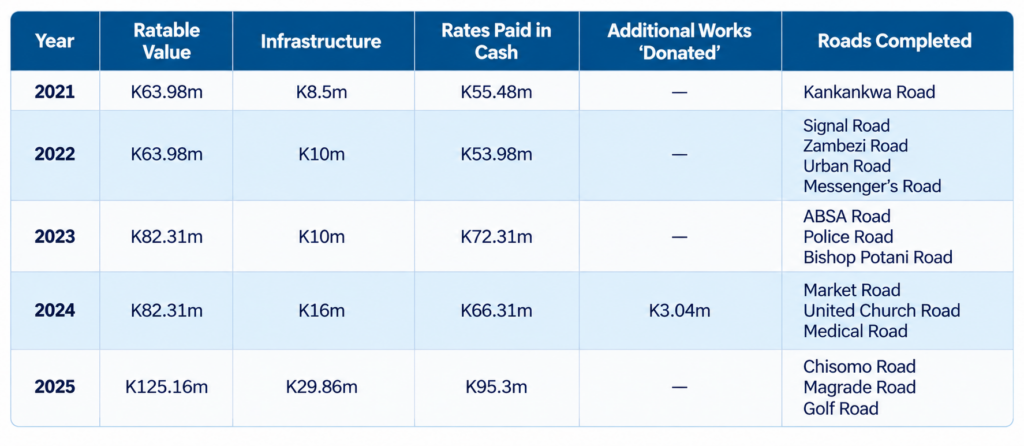
Cash versus roads
Not every road project funded by Kansanshi forms part of this system. The company says some roads are voluntary projects like the one leading to the mine and others form part of its annual corporate social responsibility spending.
In 2024 for example, it spent K3.04 million (about US$160,000) on road works over and above its roads-for-rates obligation for work on the Mukhuba Road and the road from Kansanshi Golf Estate to Mukhuba. This was allocated as CSR spend, the company told MakanDay.
An example of the voluntary road projects it finances, the company said that it paid K52 million (about US$2.74 million) towards the Boom-Gate to Mitech Road which goes to the Kansanshi Mine. This was also not deducted from rates or taxes.
Why this matters in Solwezi
The roads-for-rates deal has delivered roads in and around Solwezi, but it has made a bigger problem worse. Solwezi, which is the capital of Zambia’s Northwest Province, can’t keep up with the pace of growth that is driven by the region’s mineral wealth.
The Kinsanshi mine generates substantial revenue in taxes but not all of it goes to the local municipality which is responsible for dealing with the consequences of the rapid growth that is driven by the mine and its operations.
For example, a source at the mine told MakanDay that the company’s total annual taxes, other statutory payments, including municipal rates and taxes, in 2025 was nearly US$450 million. Of this total the rates and taxes paid to Solwezi are 1.2% of the total tax bill. Zambia central government gets 98.8% of the total.
The 2023 figures from the ZEITI report show the same pattern. Kansanshi paid K4.39 billion to the Zambia Revenue Authority and K826 million in royalties to ZCCM Investment Holdings, the Zambian government’s investment vehicle for mining. By comparison, it paid K72,79 million to Solwezi Municipal Council in business fees and rates.
The figures show that for every K1 (US$0.053) paid directly to Solwezi Municipal Council, about K71.50 (US$3.76) went to the two national institutions.
The comparison does not mean Solwezi should have received more of Kansanshi’s total tax payments. They serve different purposes. But, it highlights a cjalleneg for a rapidly growing mining town.
Research by anthropologist Rita Kesselring found that the expansion of Kansanshi Mine and the growth of Solwezi placed new pressures on the council and contributed to an increasingly close relationship between the municipality and the mining company.
Those pressures extend beyond roads. MakanDay has documented residents in Kimakolwe struggling to access piped water, while at Kyawama Market more than 2,000 traders were operating without running water or drainage almost two years after the groundbreaking ceremony for a K53.5 million (US$2.82 million) modern market.
These examples do not establish that Kansanshi’s property rates have been poorly spent or that the council has enough revenue to meet all of Solwezi’s needs. Rather, they illustrate the tension at the heart of the city’s growth: mining provides significant revenue and infrastructure support, while the growth it helps drive increases demand for the roads, water, markets and other services the council must provide.

Discover more from MAKANDAY
Subscribe to get the latest posts sent to your email.


