

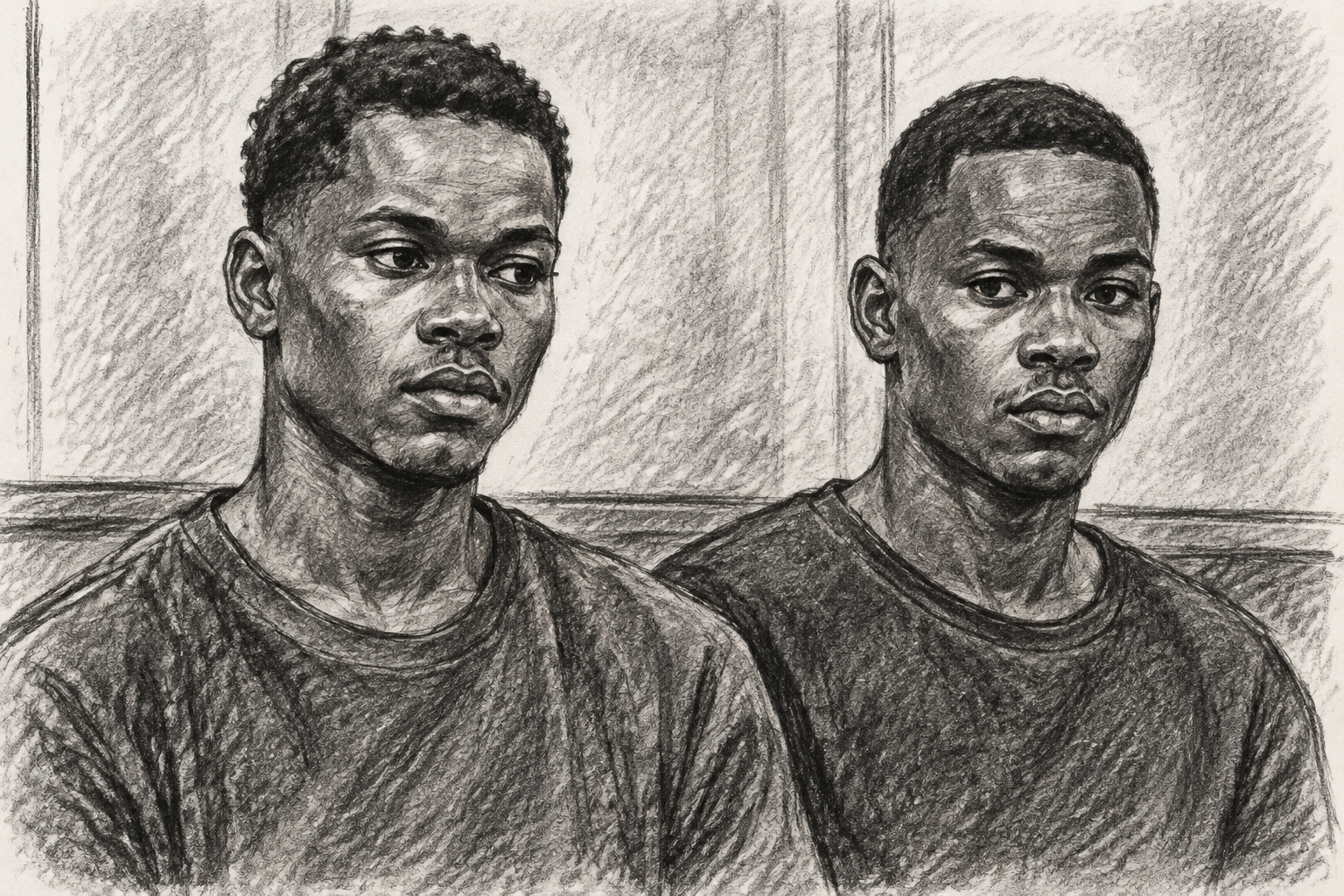
Questions mount over disputed identification evidence and police conduct as families say two men accused of aggravated robbery remain in custody despite the discontinuance of their prosecution.
By Gibson Zulu
Two young men accused of aggravated robbery remain in custody nearly a week after prosecutors discontinued their case, raising fresh questions about their continued detention and the handling of an investigation marked by disputed identification evidence.
Solomon Mbewe, 26, and Felix Chipili, 22, have been detained for more than eight months over a robbery they deny committing.
On 23 October 2026, the National Prosecution Authority (NPA) discontinued proceedings against them through a nolle prosequi, but a family source has confirmed to MakanDay that the two remain in custody.
According to the source, neither man has been informed of fresh charges. MakanDay has not independently established the legal basis for their continued detention.
Under Section 81(1) of Zambia’s Criminal Procedure Code, a nolle prosequi requires an accused person to be discharged and released from custody in relation to the discontinued proceedings. However, it does not prevent fresh prosecution on the same facts.
Why, then, do Mbewe and Chipili remain in custody despite the discontinuance of their prosecution and no reports of fresh charges?
Police have neither explained the circumstances of their continued detention nor responded to MakanDay’s request for comment, submitted on 17 March 2026.
Identification under scrutiny
The case arose from a robbery at Mulobela Village in the Ten Miles area of Lusaka on 3 February 2026.
The complainant, Michael Kalebwe, reported that masked intruders broke into his home at night, attacked him and his wife, and stole K9,000.
However, Kalebwe later told MakanDay that he had not clearly seen the attackers’ faces.
“Truth be told, I never saw the attackers’ faces. I couldn’t recognise them by their faces during the attack,” he said.
Kalebwe also disclosed that a community member had shown him photographs of Mbewe and Chipili, identifying them as suspects before he attended a police identification parade.
This raises questions about the reliability of the identification process because prior exposure to suspects’ photographs can influence a witness’s subsequent identification.
During cross-examination at the Lusaka High Court on 21 October, Inspector Bridget Katongo, who supervised the identification parade on 7 February, acknowledged differences in height, clothing and other physical characteristics among the participants.
She also agreed that parade participants should have similar physical characteristics.
Kalebwe’s wife reportedly identified Chipili during the parade but did not identify Mbewe. Her identification remains a separate piece of evidence requiring scrutiny.
Although these circumstances do not establish that the identifications were false, they raise questions about whether investigators adequately tested their reliability before pursuing aggravated robbery charges.
Police officer warned complainant against changing account
MakanDay’s investigation also uncovered evidence of a conversation on 8 October 2026 between Kalebwe and the officer who arrested the two men.
During the exchange, which MakanDay independently verified, the officer advised Kalebwe against telling the court that Mbewe and Chipili were not responsible for the robbery.
Instead, the officer suggested that Kalebwe tell the court he had forgiven them.
The officer expressed concern that telling the court the men had been wrongly identified could expose police to compensation claims.
This raises questions about whether concern over potential police liability influenced the advice given to a key prosecution witness. It does not establish that the officer fabricated evidence or that other investigators shared his position.
However, the distinction between forgiveness and mistaken identification is significant.
A complainant who forgives an offender is not necessarily disputing the offence or the offender’s identity. A complainant who says the wrong people were arrested is directly challenging the evidence connecting the accused to the crime.
Kalebwe said he had sought to withdraw his complaint approximately three months after the arrests and subsequently wrote to the Director of Public Prosecutions.
The NPA confirmed receiving his second letter, dated 11 September 2026, following an inquiry from MakanDay. However, the Director of Public Prosecutions has not responded to MakanDay’s request for comment.
It remains unclear when prosecutors became fully aware of Kalebwe’s doubts about the identification of the accused and whether they reassessed the evidence before discontinuing the case.
Families describe arrests and alleged mob violence
The families have also challenged the circumstances surrounding the arrests.
Zetty Njobvu, mother of one of the accused, alleged that her son was attacked after attempting to intervene when community members assaulted the other suspect.
She further alleged that petrol was poured on him before a village headman intervened.
MakanDay has not independently verified these allegations, and police accounts of the arrests differ from those provided by the family.
According to the family’s account, community suspicion partly arose because one of the men was believed to resemble an attacker.
The allegations raise questions about whether police obtained sufficient independent evidence linking the suspects to the robbery beyond the disputed identifications.
Accused reportedly rejected plea bargain
During proceedings in court on 8 October, the prosecution and defence discussed the possibility of reducing the aggravated robbery charge through plea bargaining.
Njobvu said the accused had told her that Legal Aid lawyers proposed a lesser charge that could result in a shorter sentence.
She said both rejected the proposal, maintaining that they had not committed the robbery.
Plea bargaining is a recognised legal process and its consideration does not establish wrongdoing by prosecutors or defence lawyers.
However, the family’s account highlights the difficult choices facing accused persons who maintain their innocence while spending months in custody.
MakanDay has not established that either man was improperly pressured to accept a plea bargain.
Why are they still detained?
The NPA’s decision to discontinue proceedings on 23 October should have brought the men’s detention under that case to an end, unless another lawful basis exists for holding them.
A nolle prosequi is not an acquittal and does not prevent fresh charges. But the possibility of future prosecution does not, by itself, authorise continued detention.
The family maintains that Mbewe and Chipili remain in custody without fresh charges, although MakanDay has yet to establish whether any other detention order or proceedings exist.
The NPA has not responded to MakanDay’s earlier request for comment on the handling of the case. A further explanation is required concerning the discontinuance and the men’s reported continued detention.
The Police Public Complaints Commission also has yet to clarify the status and outcome of a complaint reportedly submitted by the family in July this year.
For Mbewe and Chipili, the consequences extend beyond the more than eight months they have spent in custody facing disputed criminal charges.
Chipili has already missed the opportunity to resit his grade 12 General Certificate of Education examinations because of his continued detention. Although he was taken to register for the examinations in handcuffs, he was not allowed to sit them, according to a family source.
Their case raises a more immediate question about the administration of justice in Zambia: what lawful authority, if any, is keeping two men in custody after the criminal proceedings against them were discontinued?


Discover more from MAKANDAY
Subscribe to get the latest posts sent to your email.


