

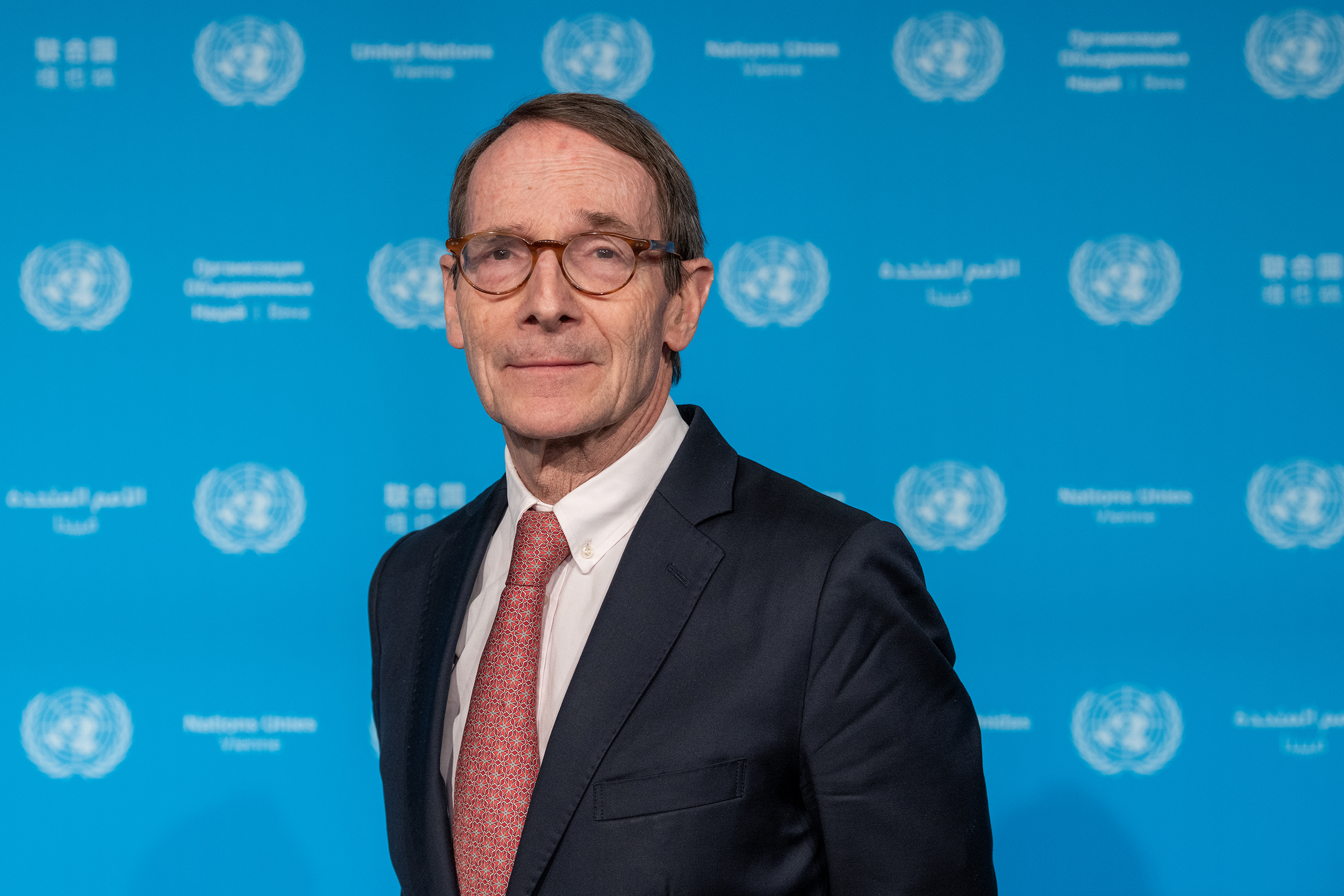
Erik Møse, a Norwegian jurist and Chair of the Independent International Commission of Inquiry on Ukraine, has extensive experience in international human rights and criminal law.
In this exclusive interview with MakanDay editor Charles Mafa, Erik Møse, Chair of the Independent International Commission of Inquiry on Ukraine, explains why Zambia was excluded from the commission’s latest findings on the trafficking of foreign nationals into Russia’s armed forces. He also discusses the role of recruitment agents, Russian authorities, African governments and the fate of Africans captured in Ukraine.
Read the full interview below.
Charles Mafa: Chair Møse, beyond the findings already presented in your latest report, what has your Commission established about the scale and organisation of the recruitment of foreign nationals into Russia’s armed forces, particularly from Africa?
Erik Møse: As you can see in the report, from the 29 countries we have found evidence of trafficking in persons, there are 11 countries from the African continent: Botswana, Cameroun, Ghana, Kenya, Morocco, Nigeria, South Africa, Somalia, Tunisia, Uganda and Zimbabwe.
Since 2024, there have been clear patterns of recruitment of foreign nationals from particular countries and geographic regions to serve in the Russian armed forces.
Men from the different countries have been deceived and lured to the Russian Federation with false promises of employment. Recruiting agents operating in different geographic regions have advertised fake jobs offering high salaries, have misled recruits as to the true nature of the work, and organised their travel to the Russian Federation. The Commission found similar methods of recruitment in different countries or regions, coordinated actions between recruiting agents and the Russian authorities, and a uniform approach once the recruits reached the Russian Federation. Soon after arrival, the men were forced to sign contracts with the Ministry of Defence of the Russian Federation to serve in the Russian armed forces.
Charles Mafa: When did your Commission start investigating these crimes?
Erik Møse: We started investigations of that topic earlier this year, 2026, and there is a relatively brief coverage of that in our report from March 2026. But it was the report we submitted to the General Assembly yesterday, the third committee of the General Assembly, where the issue of the trafficking of foreign nationals was one of our main topics together with another one, namely, Russian authorities’ attacks against Ukraine’s energy-related infrastructure. It follows from our published report that we have found 29 countries where there has been trafficking of persons. And there are 11 countries from Africa listed there.
We can generally say that we have found that since 2024, there have been clear patterns of recruitment of nationals from particular countries and geographic regions to serve in the Russian armed forces. It covers not only Africa but also some other parts of the world.
Charles Mafa: In 2022, for example, a Zambian student who had been imprisoned in Russia, died fighting in Ukraine after being recruited by the Wagner private military group. Did your Commission investigate, examine this case or similar cases involving foreign nationals in those circumstances?
Erik Møse: When it comes to this particular situation, in our report we have not referred to any individual cases.
With respect to Zambia, we have not been able to find evidence to corroborate the incidents brought to our attention, in order to find the necessary threshold to make a finding to include in the report. In connection with this, I want to first talk about the Commission’s findings more in detail.
The report describes how men from different countries have been deceived and lured to the Russian Federation with promises of employment. Recruiting agents operating in different geographic regions have advertised the fake jobs offering high salaries. They have misled recruits as to the true nature of the work.
They have referred to civilian work opportunities in the Russian Federation and then organised the travel to the Russian Federation. And we’ve seen that in several regions of the world. It was the same approach everywhere, namely that agents persuaded these persons and then assisted with tickets, visa, etc., and then assisted in travelling to the Russian Federation.
Once in the Russian Federation, they are then brought to the Ministry of Defence and are forced to sign contracts with the Ministry of Defence. The contracts are written in Russian so that they do not know what they are signing. And then they are sent to the front line, and many have been killed or wounded.
I would like to explain more about why Zambia is not on the list of countries mentioned in the report. According to our methodology, it is important that we have sufficient evidence which is corroborated, so that we can present it as a conclusion based on the factual investigations we are carrying on. We need a sufficient, solid basis.
That is why, although we have examined 48 countries, we have found enough evidence to make solid conclusions in the case of 29 countries. This does not mean that there was no trafficking in those other countries, including Zambia. It just means that at this stage of our investigations, we did not have enough evidence to make a conclusion.
Charles Mafa: You also mentioned in your report that you did send about 69 letters to countries asking for information about foreign recruitment, but only six countries were able to respond. Was Zambia among those countries that you contacted? And did our government respond?
Erik Møse: You are absolutely right. We did send 69 letters to countries seeking information about this kind of recruitment.
Based on the working methods of the Commission, I’m not in a position to identify which countries responded and which did not. But I think, this is an interesting point you are raising, because the fact that only six out of 69 countries replied underscores the need for greater engagement by states in addressing trafficking. And a stronger engagement by governments in efforts to prevent this and to investigate and to respond to trafficking, by investigating and prosecuting individuals or agents or entities involved in recruitment activities on a state’s territory, is an obligation under international law.
Charles Mafa: Did your work or investigation uncover evidence of African government officials or politicians or any other persons of influence knowingly facilitating these recruitment operations? If so, are you able to mention some of those countries where this is happening?
Erik Møse: We don’t name any particular specificities in connection with countries which are mentioned or listed in our report. We have decided not to mention such persons by name. But of course, information that is relevant can be shared upon request from prosecutorial authorities of a country.
Charles Mafa: So has this information that you gathered been officially communicated to these governments, in particular African governments?
Erik Møse: The system in the Commission is that we assemble evidence and then we publish our report. That is the way it works. And then it will be for judicial bodies of those countries concerned to contact us in case they want more information.
Charles Mafa: What about when it comes to the involvement of Russian diplomatic missions in African countries? Have any links been established that these missions, diplomatic missions in Africa, are facilitating the recruitment operations?
Erik Møse: In our report, we have noted that visas for recruits were issued by Russian embassies in the countries concerned. And often with applications being processed through recruitment agents, the local agents in these countries.
It was not part of our investigation to examine whether Russian diplomatic missions were actively involved in the trafficking process.
Charles Mafa: Is there any evidence that the Commission gathered that links some of the senior Russian military or government officials to these recruitments of foreign nationals?
Erik Møse: We have not identified any specific Russian military or government officials in the activities, naming individuals, etc. But we have noted that similar recruitment methods were used across different countries and regions, and there was coordinated interaction between recruitment agents and Russian authorities.
It was a consistent pattern of treatment, once the recruits arrived in the Russian Federation, together with the coordination between recruitment agents and Russian authorities, that point to a degree of involvement by Russian state authorities in the recruitment process.
Charles Mafa: Has the Commission, at this stage and from your findings, identified whether any of the African nationals are currently being held as prisoners of war in Ukraine? And if so, are there efforts to facilitate their repatriation?
Erik Møse: The Commission has interviewed a number of African nationals who are currently held as prisoners of war in Ukraine. Any measures taken with respect to these individuals must, of course, be carried out in contact between the state of origin and Ukraine and in accordance with the Third Geneva Convention.
Charles Mafa: Is this recruitment just happening on the Russian side or Ukraine as well has been recruiting? Are there any traces or evidence that you could say, even because this war involves two countries?
Erik Møse: We have not found any evidence of this kind of recruitment on the Ukrainian side. The Commission has interviewed people who were fighting for Ukraine, but that was not as a consequence of being lured into the Ukrainian armed forces. It was voluntary, and they were paid for their activities as armed soldiers in the conflict.
Charles Mafa: Is there a link with economies of the states where these countries, these men and women are coming from?
Erik Møse: Our report shows that many of those who decided to be enlisted in, for instance, African countries or in other parts of the world and then left for Russia, thinking they are going for civilian jobs, did not know that they would end up in the Russian armed forces fighting in Ukraine. We all know that there are mercenaries around the world, people wishing to join conflicts because of their knowledge about how to handle weapons or for other reasons such as economic considerations.
There can be many reasons, but that is a different situation. Our report investigated only the cases of recruitment through deception and coercion, with victims thinking they are going for a civilian work and ending up at the battlefield.
Charles Mafa: I know you did mention earlier in our discussion that it is not in the interest of the Commission to individually engage the African government. Is it the same also with, for example, the African Union, to share these findings and to see whether this is something that they need to start talking about at that level?
Erik Møse: We are willing to share that information. The entire purpose of our activity as a commission of inquiry is to assist states with ensuring accountability.
According to the UN established practice for investigative bodies, the Commission of Inquiry on Ukraine shares information about perpetrators with judicial authorities at the national or international level. Such information can be made available to relevant judicial authorities upon request.
Møse, a Norwegian jurist and Chair of the Independent International Commission of Inquiry on Ukraine, has extensive experience in international human rights and criminal law. He previously served as President of the International Criminal Tribunal for Rwanda, a judge of the European Court of Human Rights and a judge of Norway’s Supreme Court.
He also chaired the Council of Europe’s Steering Committee for Human Rights and the expert committee responsible for drafting the European Convention for the Prevention of Torture.

Discover more from MAKANDAY
Subscribe to get the latest posts sent to your email.


