


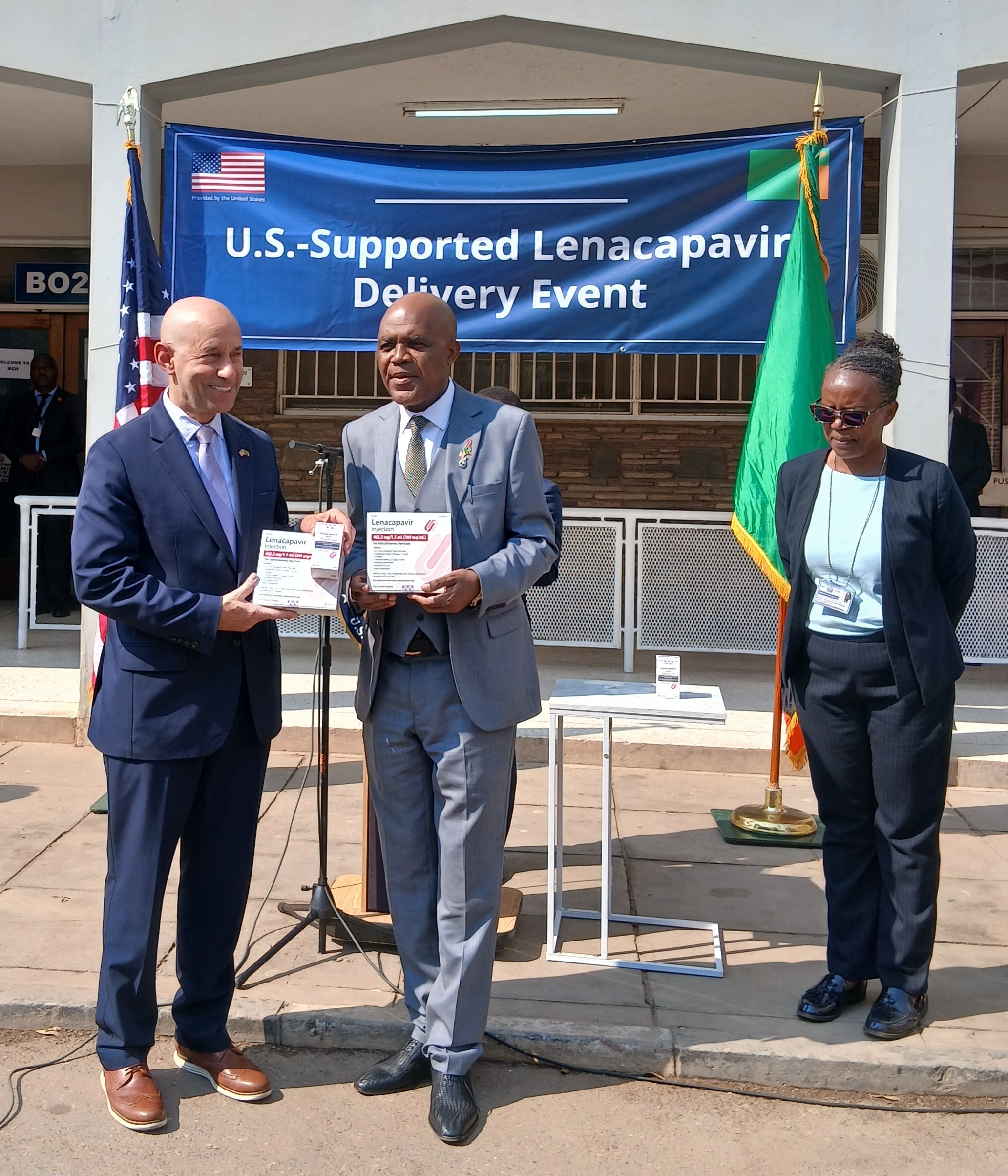
For Zambians at risk of contracting HIV, prevention may no longer mean remembering to take a pill every day or returning to a clinic every two months. A new injection being rolled out across the country can provide protection for six months at a time — and will be available free of charge at participating health facilities.
The United States has committed US$4.25 million through 2027 to support Zambia’s rollout of lenacapavir, the twice-yearly HIV prevention injection.
By Gibson Zulu
The new option, known as lenacapavir, is an HIV prevention injection administered twice a year. It is already available at more than 100 health facilities across nine provinces, with Luapula Province expected to be added as the programme expands.
The target is to make the injection available at 541 health facilities by 2027. That could make HIV prevention considerably easier for people who struggle with daily medication or frequent visits to health facilities.
Oral pre-exposure prophylaxis (PrEP), for example, is generally taken daily. The vaginal ring is used monthly, while another injectable prevention drug, cabotegravir, is administered every two months.
Lenacapavir stretches that interval to six months.
“So this one is special in that you only give it every six months. So a person doesn’t need to be coming frequently to get the shot,” Professor Lloyd Mulenga, Director of Infectious Diseases at the University Teaching Hospital (UTH), told MakanDay.
The injection does not replace the other prevention methods. Instead, it gives people another choice depending on what works best for them.
“It’s another choice. So it’s adding to the choice,” Mulenga said.
Who can get it?
The starting point is an HIV test.
Lenacapavir for prevention is intended for people who are HIV-negative but consider themselves at risk of acquiring the virus. Someone who is already HIV-positive should not receive it as a stand-alone prevention injection.
This means people seeking the injection must first have their HIV status confirmed.
Among those who could benefit are people in relationships where one partner is HIV-positive and the other HIV-negative, as well as other men and women who consider themselves at risk of infection.
Pregnant women at risk of acquiring HIV are another group health officials say could benefit from the longer-lasting protection.
“Anyone who comes to UTH or Chawama or Ndola Teaching, and as long as they feel that they are at risk, they are eligible for lenacapavir,” Musonda Musonda, Senior Public Health Adviser at the U.S. Embassy in Zambia, told MakanDay.
The injection will be provided free of charge at participating health facilities. For people who have previously faced the inconvenience of taking prevention medicine every day, the attraction is straightforward: two scheduled visits for injections could provide protection across an entire year.
Zambia has surpassed global HIV treatment targets, yet recorded about 30,000 new infections in 2024. Now a twice-yearly injection being rolled out free across the country could give people at risk another way to protect themselves — without taking a pill every day.
But six months does not mean forget about it
The convenience comes with an important condition: people must return for their next injection on time.
Mulenga said clients have a window of about two weeks before or after their scheduled six-month date to receive the next dose.
After that, the amount of medicine in the bloodstream continues to fall. If someone is exposed to HIV during this period, their protection may be reduced.
There is another concern.
If a person contracts HIV while low levels of lenacapavir remain in the body, the virus could potentially develop resistance to the medicine.
“If you miss, you’re exposed to HIV, and you get HIV, it’s likely that you may have resistance because the drug is still in reduced quantities in blood,” Mulenga said.
The practical message for people choosing lenacapavir is therefore simple. Two injections a year may be easier than taking a pill every day, but keeping the six-month appointment matters.
Reported side effects have largely involved reactions around the injection site, including pain, redness and, in some cases, small nodules. Mulenga said cold compresses and painkillers could help manage discomfort where necessary.
Why a twice-yearly injection matters
One of the challenges with HIV prevention medicine is not simply whether it works, but whether people continue using it as prescribed. A daily medicine only provides its intended benefit if people consistently take it.
Mulenga said early programme data showed about 80 percent of people returning for reinitiation, compared with a reported 25 percent return rate for oral PrEP.
He cautioned that the figures were preliminary.
“It’s initial data which is really promising, but we hope that even the long-term data will be as good,” he said.
If that pattern holds as the programme expands, the longer interval between doses could become one of lenacapavir’s most important advantages: reducing the number of times people need to think about, collect or take their HIV prevention medicine.
19,200 people covered by first shipments
The rollout is being supported by the United States, which has committed US$4.25 million through 2027 specifically towards Zambia’s lenacapavir programme.
The first U.S.-funded shipment arrived in August with enough doses for 9,600 people. A second shipment covering another 9,600 people has since arrived, potentially providing the new prevention option to 19,200 people.
The two shipments are worth more than US$1 million, according to U.S. officials.
U.S. Assistant Secretary of State for African Affairs Frank Garcia visited UTH during a trip to Zambia in which he also attended President Hakainde Hichilema’s September 1 inauguration for a second term.
“Administered just twice a year, lenacapavir offers women, mothers, and at-risk populations across Zambia a new and powerful tool to stay ahead of this virus,” Garcia said.
He particularly highlighted pregnant and breastfeeding women, arguing that preventing HIV infection among mothers also has implications for the health of their children.
The U.S. has supported Zambia’s HIV response for more than two decades, including through the U.S. President’s Emergency Plan for AIDS Relief (PEPFAR).
Ministry of Health Permanent Secretary for Donor Coordination Dr George Sinyangwe described the United States as Zambia’s largest external supporter of HIV prevention and treatment and said the partnership had contributed to reductions in HIV-related deaths.
But for people deciding how to protect themselves from HIV, the significance of the latest programme is much more immediate.
There is now another choice alongside daily oral PrEP, the monthly vaginal ring and two-monthly cabotegravir: an HIV prevention injection taken only twice a year.
For those who choose it, the trade-off is equally clear — test HIV-negative before starting, receive the injection every six months and return on time for the next dose.

Discover more from MAKANDAY
Subscribe to get the latest posts sent to your email.