

Record public funding was supposed to accelerate development in Solwezi. Instead, residents are still waiting for classrooms, clinics and markets promised years ago, while unfinished projects raise fresh concerns about oversight and value for money.
By Sanjimba Kanganja | Solwezi
SOLWEZI – In a district that receives some of the highest levels of public funding in Zambia, unfinished classroom blocks, incomplete clinics and market shelters are raising uncomfortable questions about whether taxpayers and local communities are getting value for money.
Across Solwezi district, projects funded under the Constituency Development Fund (CDF) and Ward Development Fund (WDF) remain stalled months and, in some cases, years after they were approved and financed.
Some structures have never progressed beyond foundation level. Others stand roofed but incomplete, lacking windows, doors, flooring, plastering and other essential works needed to make them usable. Around several sites, overgrown grass has replaced the construction activity communities once expected.
The delays come at a time when government has committed unparalleled resources to decentralised development.
Since 2021, CDF has increased from K1.6 million to K25.7 million per constituency before rising further to K36.1 million and eventually K40 million in 2026. The expansion was promoted as a cornerstone of President Hakainde Hichilema’s decentralisation agenda, intended to bring development closer to communities and allow local people greater control over projects affecting their lives.
Yet in Solwezi, a district that also benefits from substantial local revenue generated by mining activities, residents are increasingly asking why so many projects remain unfinished despite the availability of funds.
A council with more money than most
Beyond the enhanced CDF allocations, Solwezi Municipal Council enjoys a financial advantage that many local authorities can only dream of. According to the Zambia Extractive Industries Transparency Initiative (ZEITI), the council received nearly K64 million in property rates from extractive companies in 2022, reflecting the significant contribution of the district’s mining sector, led by Kansanshi Mining Plc.
Yet despite these considerable financial resources, a field investigation conducted by Radio Kabangabanga between May and June 2026 found that at least seven CDF and WDF projects funded between 2022 and 2024 remain delayed or incomplete.
These include a 1×3 classroom block at Kakombe funded under the 2022 CDF, a staff house at Kabulobe Primary School funded under the 2023 CDF, the Kazomba Market Shelter funded under the 2023 WDF, a classroom block at Kaweya Primary School funded under the 2023 WDF, Kamatete Clinic funded under the 2023 CDF, a computer laboratory at Mitukutuku Secondary School funded under the 2023 CDF, and a 1×3 classroom block at Kawama Primary School funded under the 2023 CDF. Despite being allocated public funds and earmarked to improve service delivery, many of these projects remain unfinished years after their approval.
The Projects
- A 1×3 classroom block at Kakombe funded under the 2022 CDF.
- A staff house at Kabulobe Primary School funded under the 2023 CDF.
- Kazomba Market Shelter funded under the 2023 WDF.
- A classroom block at Kaweya Primary School funded under the 2023 WDF.
- Kamatete Clinic funded under the 2023 CDF.
- A computer laboratory at Mitukutuku Secondary School funded under the 2023 CDF.
- A 1×3 classroom block at Kawama Primary School funded under the 2023 CDF.
Collectively, the projects were intended to improve access to education, healthcare and economic opportunities. Instead, many communities are still waiting.
The Kazomba Market shelter
Frustration over delayed projects recently spilled into the public arena during a full ordinary council meeting when former Tumvanganai Ward Councillor Kelvin Kayombo Saviye staged a protest and walked out of proceedings over the delayed Kazomba Market Shelter project.
According to information gathered during this investigation, the project was awarded with a completion period of three months. The contractor reportedly took possession of the site on 28 November 2024, meaning completion was expected by February 2025.
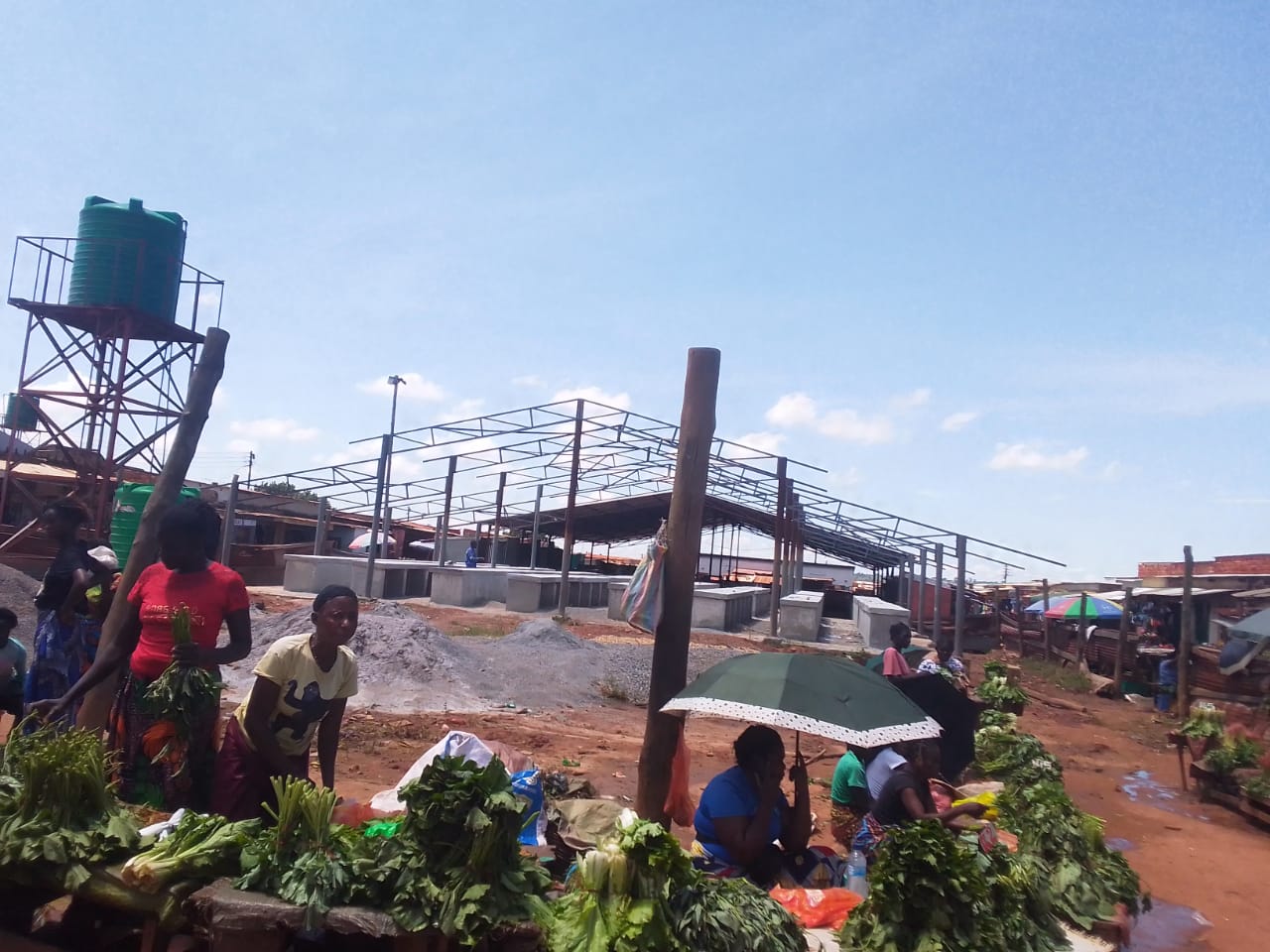
More than a year later, the structure remains unfinished. When visited in June 2026, the market shelter was found without a roof while traders continued conducting business nearby under less favourable conditions.
Kayombo told Kabangabanga Radio that his concerns eventually attracted the attention of the Attorney General’s Chambers, which reportedly recommended termination of the contract.
According to him, legal officers identified several shortcomings in documentation submitted by Solwezi Municipal Council, including the absence of the original contract, missing records confirming site possession and insufficient information supporting proposed contract variations. The Council later terminated the contract.
In a response to questions submitted by Kabangabanga radio, Solwezi Municipal Council acknowledged that delays had affected the project.
Assistant Public Relations Manager Esther Chirwa said the Attorney General’s office did not approve proposed contract variations because of procedural issues and time lapses.
“The contract was terminated and the project is now undergoing a fresh procurement process,” Chirwa said.
Kakombe classroom block
A similar pattern emerged at Kakombe, where a classroom block funded under the 2022 CDF remains incomplete years after work commenced.
When inspected in May 2026, the structure had been roofed and fitted with door and window frames. However, critical works remained outstanding, including plastering, painting, flooring, electrical installation, window panes, door fittings and classroom blackboards.
The Council confirmed that the contractor failed to complete the project within the agreed timeframe and that the contract was subsequently terminated.
According to Chirwa, the Council has since taken over the project and commenced procurement of materials required to complete the remaining works, with completion targeted for June 2026.
Questions about oversight
Construction specialist and traditional leader Senior Chief Museli said project delays often point to deeper problems in project management.
According to the traditional leader, delayed projects may indicate poor supervision, weak contract management or financial challenges affecting contractors.
He also expressed concern about quality control, revealing that his own palace under construction had reportedly developed structural cracks before completion.
The experience, he said, highlighted the need for stronger oversight and quality assurance mechanisms.
Governance concerns
The investigation also uncovered concerns from several sources familiar with local authority operations, who alleged that procurement processes remain vulnerable to political and administrative influence.
Although these claims could not be independently verified, they mirror broader governance concerns that have surrounded the Council in recent years.
In January 2023, the High Court ordered Solwezi Municipal Council to pay K1.2 million in damages after illegally allocating plots on privately owned land belonging to Solwezi Dairy Farm.
Around the same period, North-Western Province Minister Robert Lihefu publicly disclosed allegations that more than K100 million in public funds may have been embezzled at the council.
Residents interviewed during this investigation said they are still waiting for public updates regarding the outcome of those allegations.
Beyond bigger budgets
The findings suggest that Solwezi’s challenge may no longer be access to funding.
With enhanced CDF allocations and substantial local revenue, the district possesses financial resources that many councils can only aspire to.
The greater challenge appears to lie in implementation: ensuring that procurement systems, contract management, project supervision and accountability mechanisms keep pace with the money available.
For residents, the promise of decentralisation was never simply larger budgets. It was visible development.
This article was produced by MakanDay’s Local Reporting Network. Subscribe through our website and follow our Facebook page to receive stories like this one as soon as they are published.

Discover more from MAKANDAY
Subscribe to get the latest posts sent to your email.