

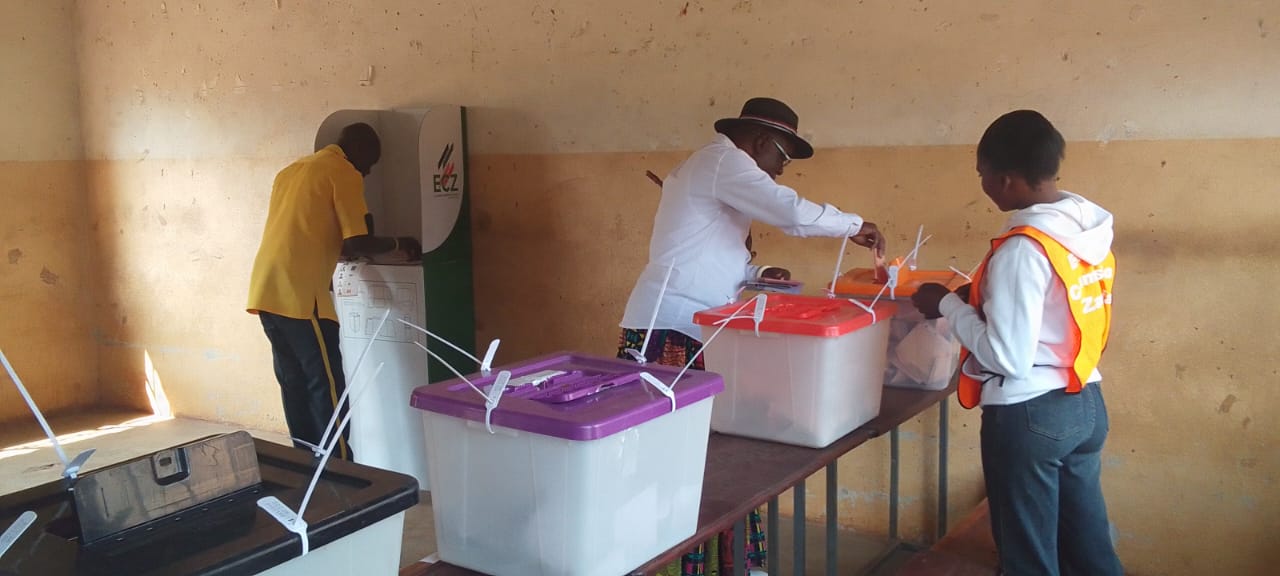
Journalists reporting across Zambia described a largely peaceful vote that became more difficult to scrutinise once counting and totalling began. Their accounts of suspended counting, restricted access and questions over some figures echo concerns subsequently raised by independent election monitors about the official result that gave President Hakainde Hichilema 60.5% of the vote.
By Charles Mafa
Zambia’s election delivered a clear winner. President Hakainde Hichilema was re-elected for a second five-year term with 60.5% of the vote, comfortably ahead of his closest challenger, Brian Mundubile, who secured 37.9%.
But for journalists reporting from different parts of the country, some of the most difficult moments came after voters had cast their ballots.
Reporters interviewed by MakanDay described voting as largely peaceful in the areas they covered. Several said that changed during the counting, totalling and announcement of results, when some encountered restrictions on access, difficulties obtaining information and growing tensions following the nationwide suspension of counting on 14 August.
Their accounts do not establish what happened nationally. But taken together, they repeatedly point to the same stage of the electoral process: what happened to the vote after polling ended.
Ordered to stop recording
In Ndola, the administrative capital of Copperbelt Province, a journalist covering his first election said access to information varied considerably between election centres. At some, officials readily answered questions. At others, obtaining information was difficult.
At one totalling centre, he said a combined team of security personnel, including police officers and soldiers, ordered journalists to stop recording after tensions arose over the submission of presidential results.
He alleged that one journalist’s device was seized, footage deleted and the reporter ordered to leave.
The same reporter encountered another problem earlier in the day: voters struggling to locate their names at polling stations.
He said the problem was particularly difficult for people who could not read and who, at some centres, relied on fellow voters or police officers for assistance.
One woman told him she had arrived at around 06:00 but, three hours later, had still not found her name or voted. The journalist left without knowing whether she eventually cast her ballot.
A peaceful vote, then counting stopped
In Petauke Central in Eastern Province, another first-time election reporter described voting as calm, with rival candidates greeting each other as they moved between polling centres.
“The environment was calm,” she said.
But the nationwide suspension of counting and the announcement of results on 14 August caused concern among those at the centres, although the journalist said the situation remained peaceful.
In Chingola on the Copperbelt, a journalist who had also covered the 2021 election said voting was more peaceful this time and reporters were generally able to work freely.
That changed when counting was suspended.
She said journalists and other groups present were told to leave, while election officials and a church representative remained.
“Why would they suspend the counting of ballots?” she asked.
She said this differed from her experience in 2021, when journalists had been able to observe counting throughout.
“Protect our vote”
Further north, in Kawambwa and Pambashe constituencies in Luapula Province, another journalist said the suspension had more serious consequences.
Opposition supporters who believed their candidates were leading became suspicious and vowed to remain and “protect our vote”, she said.
Tensions escalated, shops closed and security personnel intervened. The journalist said some political supporters threw stones at police officers and soldiers, while reporters were accused of spreading false information and helping others to “rig elections”.
“When the situation became very hostile, that’s when we left,” she said.
The journalist also said some election officials became reluctant to provide information, at times making it difficult for reporters to obtain even basic figures such as the number of registered voters.
The accounts differ in detail and severity. But the recurring concern was not primarily about voting itself. It was about what happened afterwards, as ballots were counted, totalled and results announced.
“So, where did it come from?”
In Solwezi, North-Western Province, a journalist who had also covered the 2021 election initially noticed something different: fewer voters.
“There was voter apathy,” he said. “People didn’t turn out in numbers compared to how it was in 2021.”
His concern deepened when he heard the numbers being announced.
He recalled a returning officer saying about 29,900 people had voted, before later encountering a figure of more than 50,000 in relation to the presidential vote.
“So, where did it come from?” he asked.
It is an observation that subsequently became more significant.
An independent assessment by the Christian Churches Monitoring Group (CCMG) identified Solwezi among a number of constituencies where its estimates differed substantially from the official figures.
And its broader analysis raised a much bigger question about the presidential result: Hichilema won, CCMG concluded, but it estimated that he won by considerably less than the official 60.5%.
What the independent count found
CCMG, a coalition of faith-based organisations, deployed 1,500 observers to a nationally representative sample of polling stations covering every province, district and constituency.
Using a method known as Process and Results Verification for Transparency (PRVT), it compared results independently recorded at sampled polling stations with the presidential outcome.
CCMG estimated Hichilema’s share at 56%, with a margin of error of 1.7 percentage points, putting its expected range between 54.3% and 57.7%.
The official Electoral Commission of Zambia (ECZ) result of 60.5% fell outside that range.
For Mundubile, CCMG estimated 42.3%, also with a margin of error of 1.7 percentage points. His official result of 37.9% was below the expected range.
CCMG was nevertheless unequivocal about the winner: its independent analysis showed that Hichilema received the most votes and crossed the 50% threshold required to avoid a run-off.
The question raised by its findings was therefore not whether Hichilema won, but whether the official figures accurately reflected the scale of his victory.
CCMG identified 30 constituencies where official turnout was significantly higher than its estimates. It said votes had been added in those constituencies, “artificially increasing turnout and undermining the integrity of the process”.
In Solwezi Central, where the MakanDay journalist had questioned the figures he encountered, CCMG estimated turnout at 47%, plus or minus three percentage points. ECZ’s official turnout was 88.86%.
In Solwezi North, CCMG estimated turnout at 46%, plus or minus four percentage points, compared with an official figure of 93%.
CCMG said the differences went beyond statistical estimates.
It compared results recorded by its observers at 24 sampled polling stations with figures subsequently recorded at constituency tally centres. All candidate figures matched at 13 stations, but CCMG reported differences in UPND figures at 10.
At Lumpuma Primary School-02 in Lufwanyama East, for example, CCMG said its observer recorded 186 presidential votes for UPND at the polling station. The tally-centre figure was 486.
At Chantete Primary School-01, it reported a change from 198 to 376, while at Chibanga Primary School-01 the figure went from 158 to 258.
CCMG has called on ECZ to publish constituency records and images of results forms from all 13,529 polling stations so the figures can be independently checked.
EU observers saw problems after the suspension
The experiences described by journalists also intersect with observations by the European Union Election Observation Mission.
ECZ suspended counting and the announcement of results nationwide for six hours on 14 August, citing violence against election staff and reports of ballot box theft.
EU observers were monitoring tabulation at 64 totalling centres.
Before the suspension, they assessed tabulation as “very good” in 43% of their observations, with party agents and citizen observers present at almost all centres.
After counting resumed, the EU mission said the “overall conduct of tabulation deteriorated significantly”.
Its observers reported delays in recording announced results on tally sheets and discrepancies between some figures on paper and those entered into the digital results system.
The EU mission said digital and paper figures corresponded in all its observations before the suspension. Afterwards, that fell to 81%.
It also reported extended breaks in almost half its observations, with returning officers appearing to wait for instructions from ECZ headquarters before announcing results, as well as a heavier military presence that some interlocutors found intimidating.
The mission also received reports of attacks on some totalling centres.
Its findings were preliminary, and the EU EOM stressed that critical stages of the electoral process, including the adjudication of petitions, were still outstanding when its assessment was issued.
But its observations are significant when placed alongside what MakanDay’s journalists independently described in Ndola, Chingola, Petauke, Kawambwa, Pambashe and Solwezi.
A clear winner, unanswered questions
Mundubile has rejected the presidential result and said he intends to challenge it in court, alleging voting irregularities.
The dispute has unfolded against a tense post-election security backdrop. Former minister and opposition MP Mutotwe Kafwaya was killed during a security raid on a Lusaka property linked to Mundubile a day after the election.
Police said Kafwaya was fatally wounded after officers encountered gunfire and returned fire during an operation in which 11 people were arrested.
Authorities have accused Mundubile’s National Reconciliation Party for Unity and Prosperity (NRPUP) of involvement in “insurgency” and “militia activity” and of storing high-grade weapons — allegations Mundubile has rejected as “total fabrications”. He has since gone into hiding.
None of the accounts gathered by MakanDay establishes that problems identified at individual centres determined the national result. CCMG’s own analysis concludes that Hichilema won the election and crossed the threshold required for a first-round victory.
What remains in question is the accuracy and transparency of the figures that produced the official 60.5%.
Both CCMG and the EU mission have called for greater transparency.
The EU mission noted that ECZ did not publish disaggregated polling-station results and called for “maximal transparency”. CCMG has called for the publication of constituency records and images of results forms from every polling station.
MakanDay has put the concerns raised in this report to the Electoral Commission of Zambia and invited it to respond.
The commission was asked to explain why a nationwide suspension of counting was necessary and what safeguards were in place during the interruption. MakanDay also sought its response to CCMG’s findings in the 30 constituencies, including the specific discrepancies it identified between polling-station and tally-centre figures, as well as the concerns raised by EU observers about tabulation after counting resumed.
MakanDay also asked whether ECZ would publish presidential results broken down by polling station, together with signed results forms and constituency records, to allow the figures to be independently scrutinised.
At the time of publication, ECZ had not responded.


Discover more from MAKANDAY
Subscribe to get the latest posts sent to your email.


