

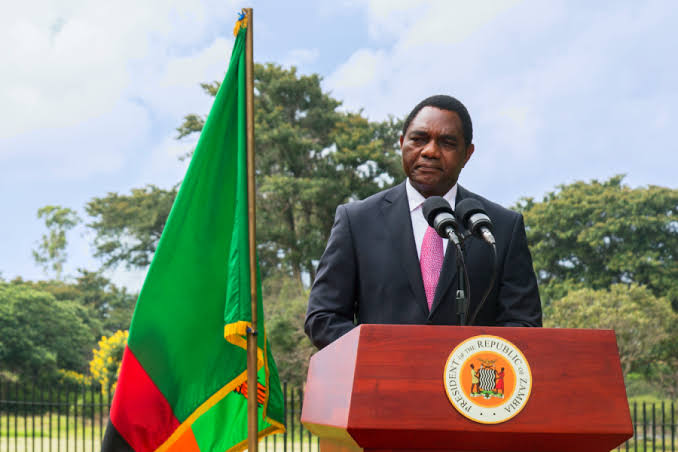
Governance and rights expert Blessing Vava spent the month before Zambia’s election moving through a country preparing for one of its most consequential votes. He was struck by how quickly a complicated contest was reduced to competing absolutes: clean or stolen, democrat or dictator. He writes here, that the reality is much more nuanced than that.
Zambia’s post-election debate has collapsed two separate claims into one. The first is that Hichilema is governing as an authoritarian leader and the election shows state capture — a sweeping judgment requiring evidence of sustained institutional deterioration. The second is that constituency-level turnout data reveal localized anomalies warranting investigation — an empirical question that can be tested against the record. Treating them as one lets each side dismiss the other’s strongest point by association.
The baseline data: the Electoral Commission of Zambia (ECZ) declared Hakainde Hichilema president-elect with roughly 2.96 million votes, or 60.5%, against Brian Mundubile’s 1.85 million, or 37.9%, a margin of about 1.1 million votes. That is a substantial mandate, but it does not make every question about the results irrelevant.
Independent statistical examinations cross-referencing presidential and parliamentary tallies flagged at least 27 constituencies with presidential turnout above 80%, concentrated in Hichilema’s ruling-party strongholds, including North-Western, Western, and Southern provinces. Within a 16-constituency sample, estimated discrepancies ranged from 350,000 to 550,000 votes overall.
Two later, independent domestic exercises point the same way. The Christian Churches Monitoring Group’s (CCMG) Parallel Vote Tabulation put Hichilema at 56.0% (±1.7%) and Mundubile at 42.3% (±1.7%), confirming that he crossed the 50% threshold to win outright, while flagging 30 constituencies with results it judged artificially inflated. CCMG leadership called on ECZ to publish all 226 collation records and GEN-20 images from all 13,529 polling stations. Transparency International-Zambia’s (TI-Z) findings are also instructive: early spot-checks of 16 and 53 constituencies scored 100% and 96.9% on its Integrity Index. Its final assessment, covering 221 of 226 constituencies, scored just 61.73%, citing process incidents in 32 named constituencies.
Reassurance came first; concern came once the fuller picture was in.
The 27-constituency finding, CCMG’s 30, and TI-Z’s 32 use different methods to examine overlapping questions. That they land in roughly the same neighbourhood and provinces makes the pattern credible. What matters is the difference between “anomalies need forensic examination” and “the election was stolen.” The first is now backed by three independent sources; the second requires much more.
Hichilema is not a ‘dictator’
Hichilema cannot credibly be called a dictator on the evidence before us, despite the claims made by some concerned activists. He came to power in 2021 by defeating an incumbent in a competitive election — the outcome authoritarian systems exist to prevent — and has now won a second constitutional term, with term limits intact. Opposition parties were not banned; the main opposition, NRPUP, and the affiliated Tonse Alliance campaigned nationally, and their leaders have since taken notably different positions. Sean Tembo has conceded, Dan Pule has called for dialogue, and Brian Mundubile is reportedly pursuing legal avenues. The press, civil society, and observer groups have freely reported on and challenged the government’s conduct, including the concerns raised here.
None of that means Zambia has no democratic problems, or that the playing field was completely level. But there is a difference between institutional weakness, authoritarian tendencies, and consolidated dictatorship. A localized irregularity, even one now corroborated three ways, is a serious integrity question. It is not, however, evidence of the opposition bans, judicial capture, and disappearances that define dictatorship.
Both the opposition and state deserve scrutiny
The opposition’s conduct — until recently, that of the ruling party — is a separate factual question, not a character defense. Its leading figures are seasoned veterans of Zambia’s long-governing infrastructure who understand state machinery and the evidentiary hurdles an election petition faces. Some have amplified legitimate questions to build leverage and sustain relevance. Brian Mundubile declared victory while collation was still underway — a claim that preceded, and arguably helped trigger, attempts by aligned cadres to forcibly reclaim market spaces in urban centres. But the opposition is not a single actor: Sean Tembo conceded, Dan Pule stepped back from litigation, and lawyer Linda Kasonde has cited insufficient evidence for a citizen-led petition. Those divisions cut against any single narrative of bad faith.
State conduct deserves equal scrutiny. Cordoning off the superior courts on the final day of the election petition window was a serious disruption. Security forces blocked access, citing unspecified security concerns and creating uncertainty when contestants and citizens needed clarity. Whether electronic filing remained technically possible is not the real question; the question is whether the state did everything reasonable to guarantee access to justice. This followed the ECZ’s earlier vote-count suspension on Election Day, which left an information vacuum quickly filled by the most alarming interpretations.
Transparency and open communication are the remedy here, not government defensiveness.
How Zambia emerges stronger
If President Hichilema is as confident in his mandate as the election results suggest, the better response is to resolve the lingering questions, not dismiss them outright. First, publish complete constituency-level results and GEN-20 forms for every flagged seat. Second, back an independent forensic review of those constituencies with opposition and civil-society observers present — prioritising evidence over accusation. Third, explain the court closures plainly: who ordered them, what security threat was cited, and whether any contestant’s filing was affected. Fourth, advance ECZ commissioner-appointment reform, where critics and observers already agree. Finally, keep the ruling party’s response to integrity questions separate from its response to the opposition. Full transparency, not rebuttal, is the strongest move.
None of this requires conceding the election was stolen. The evidence does not show that it was. The vote margin is real, and three independent sources still fall short of showing an outcome-determining problem. But that should not excuse avoiding harder questions. Zambia does not need another argument between “everything was perfect” and “everything was fraudulent.” It needs institutions confident enough to open the books and safeguard the integrity of future elections.
Indeed, the safety of Zambia’s next election depends on how confidently the current government answers present doubts about this one. A government that treats scrutiny as the price of a mandate, not a threat to manage or sidestep, will emerge stronger. And in five years, that may matter more than the size of any electoral victory.
Dr. Blessing Vava is a governance and human rights expert with nearly two decades of experience working in civil society leadership. He is currently the Executive Director of the Southern Africa Coalition for Democracy and Accountability (SACDA).

Discover more from MAKANDAY
Subscribe to get the latest posts sent to your email.


