

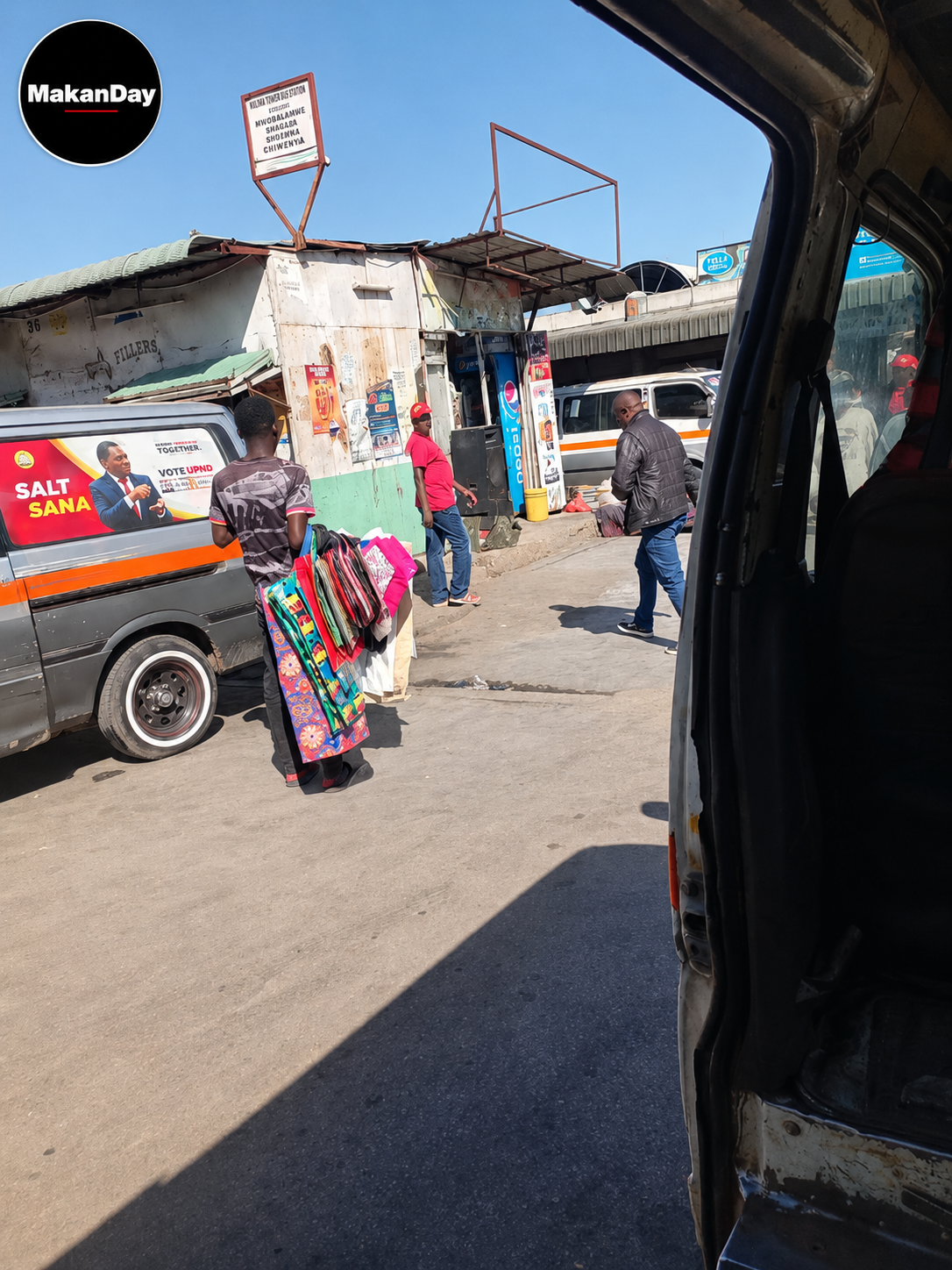
Clara Chisenga reports that drivers at some Lusaka bus stations allege pressure to wear ruling party regalia and preferential treatment for operators perceived to support the UPND, reviving concerns that political influence remains embedded in Zambia’s transport hubs.
Every Friday, a bus driver at Lumumba Bus Station says he faces a choice: wear a red beret associated with the ruling United Party for National Development (UPND) or risk paying a penalty and losing valuable loading time.
The driver, who asked not to be identified for fear of victimisation, is among several operators who told MakanDay they are experiencing increasing political pressure at some Lusaka bus stations ahead of Zambia’s August 2026 general elections.
The allegations are strongly disputed by the UPND. The party says there is no evidence that political caderism has resurfaced in Lusaka bus stations and describes the claims as attempts to generate political debate ahead of the elections.
“We cannot react to what drivers are saying,” said UPND Media Director Mark Simuwe. “We need evidence that caderism has resurfaced, especially considering that bus stations accommodate people affiliated with different political parties.”
However, interviews conducted with drivers operating on the Chongwe route and at Lumumba and Kulima Tower bus stations, supported by independent observations by MakanDay, revealed consistent accounts of individuals claiming authority at the stations allegedly encouraging operators to wear ruling party regalia and favouring those perceived to be aligned with the UPND.
At Kulima Tower Bus Station in the centre of the city, this journalist waited more than 40 minutes to meet the overall station chairperson, commonly known as “Faza”, who was reportedly attending what appeared to be a mobilisation meeting. Despite waiting, she was unable to speak with him.
During the visit, several route leaders clad in UPND regalia were observed entering the station office. UPND campaign materials, including berets, caps, T-shirts, overalls and wrappers, were openly displayed for sale near the drivers’ office. A vendor was heard encouraging drivers entering the station to purchase the items, saying it would make identification easier.
The observations appeared consistent with drivers’ claims that party activity has become increasingly visible at some stations ahead of the August elections.
President Hakainde Hichilema pledged to end political caderism when he took office in 2021. Nearly five years later, several drivers who spoke to MakanDay alleged that individuals commonly referred to as “Ba Committee” encourage operators to wear ruling party regalia on Fridays and penalise those who refuse.
“If you are not wearing the regalia associated with the ruling party, you are charged K100. If you do not pay, you may not be allowed to load your vehicle on that day,” one driver alleged.
Drivers also claimed that operators perceived to be aligned with the ruling party are sometimes given priority when loading passengers.
“Sometimes some buses are given preference while those already in the queue wait for their turn. When you ask why, you are told, ‘niba chipani’ meaning they are from the ruling party,” another driver said.
Several drivers said they were reluctant to speak publicly for fear of victimisation or losing access to operating spaces at the stations.
Historical Concerns Over Caderism
Political caderism became a major public concern during the Patriotic Front administration, when political cadres controlled markets and bus stations, collecting illegal levies, intimidating traders and transport operators, and in some cases engaging in violence.
The issue became a prominent campaign theme during the 2021 elections, with then-opposition leader Hichilema promising to restore order and remove political influence from the management of public facilities.
Bus and Taxi Owners Association of Zambia Deputy Secretary General Peter Phiri said caderism remains a concern in some stations and singled out Kulima Tower as one of the locations where political influence is most visible.
“I will give you an example if I start with Kulima Tower. Kulima Tower is one picture that has been very visible. It has become more political in terms of its operation,” he said.
Phiri said operators had repeatedly complained of political interference and alleged that drivers perceived to oppose the ruling party struggled to operate freely at some stations.
“They have dominated these stations in such a way that anyone who is anti their party cannot survive and cannot operate in these stations,” he alleged.
He further alleged that buses are sometimes selected to transport people to political events and that operators who decline risk being sidelined.
Phiri said bus stations should remain places of business, not political mobilisation.
“These are places where people earn a living and contribute taxes to government. They should be free from political interference,” he said.
He called on authorities to enforce the law fairly and investigate complaints raised by operators.
One driver who requested anonymity also urged authorities to investigate what he described as illegal activities occurring at some stations.
Council Rejects Allegations
The Lusaka City Council, which is responsible for regulating and managing markets and bus stations in the capital, dismissed the allegations, saying it has intensified patrols through its police unit to maintain order at the facilities.
“I therefore refute the claims that caderism has resurfaced in Lusaka bus stations,” said Public Relations Manager Chola Mwamba. “The call boys present are there to facilitate business for transporters, and that cannot be termed as caderism.”
Mwamba said the council’s constitutional and statutory mandate requires it to ensure order, safety and smooth operations in markets and bus stations across the city.
Police Yet to Receive Complaints
Zambia Police Service Spokesperson Godfrey Chilabi said the Police had not received any formal complaints regarding allegations that individuals linked to the ruling party were collecting illegal payments from bus drivers or exerting political pressure at bus stations.
“We have not received any complaints relating to such incidents in bus stations,” Chilabi said.
He noted that the law is clear regarding the collection of levies in markets and bus stations.
“When it comes to revenue collection and payments in bus stations, bus stops and markets, such levies are supposed to be paid to the local authority,” he said.
However, Chilabi said the police would be prepared to investigate the matter should evidence or formal complaints be presented.
“We can investigate the matter to establish what is happening on the ground,” he added.
RTSA Distances Itself
The Road Transport and Safety Agency (RTSA) said allegations of criminal activity at bus stations fall under the jurisdiction of the Zambia Police Service, not the agency.
“The people who are supposed to deal with criminal activities are the police,” said RTSA Head of Public Relations Chilufya Mwelwa. “Our mandate is to regulate the transport sector and penalise non-compliant motor vehicles and drivers.”
Mwelwa urged public service vehicle operators to comply with the Road Traffic Act and other transport regulations throughout the election period.
UPND Dismisses Claims
Simuwe said the ruling party could not act on allegations alone without evidence that drivers were being forced to wear party regalia or pay money at bus stations.
He maintained that both President Hakainde Hichilema and the UPND remain opposed to caderism.
“Anyone found engaging in caderism will face the law. The position of both President Hakainde Hichilema and the UPND has not changed,” he said.
Clara Chisenga is a journalist from Radio Icengelo in Kitwe. She is currently undertaking a three-month internship at MakanDay after earning third place in the 2025 MakanDay Awards for Investigative Journalism.


Discover more from MAKANDAY
Subscribe to get the latest posts sent to your email.


