

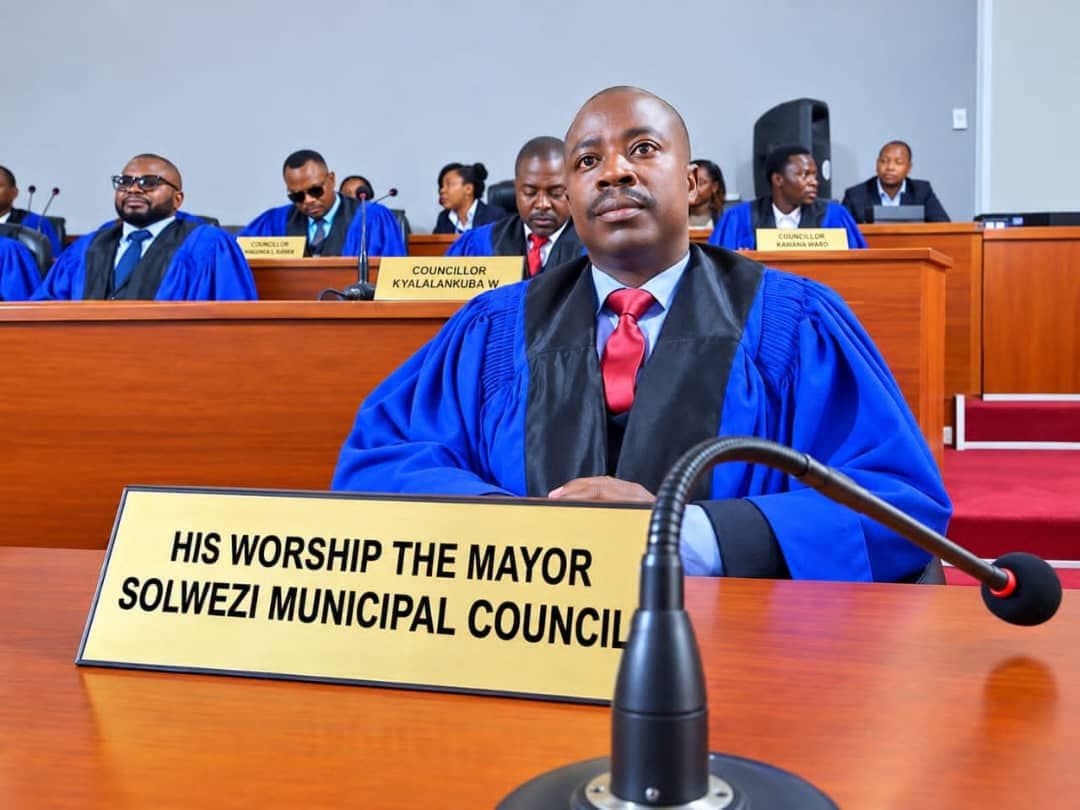
PART ONE: Evans Lubelenga spent years as a journalist asking why Solwezi’s mineral wealth had not translated into better services. Now, as the city’s newly elected mayor, he inherits another question: why has one of Zambia’s fastest-growing mining towns become so dependent on the industry for its property-rate revenue?
By Charles Mafa
When Lubelenga campaigned to become mayor of Solwezi, a mining town in north-western Zambia, he carried with him questions he had spent years asking as a journalist: why had the mineral wealth generated around the town not translated into better roads, reliable water and improved public services?
Now that he has won the mayoral seat, those questions have followed him into office. Lubelenga takes charge of one of Zambia’s most important mining towns at a time when MakanDay’s examination of Solwezi Municipal Council’s finances reveals another challenge beneath the city’s visible development problems: a property-rate revenue base that has been overwhelmingly dependent on mining.
In 2021, for every K1 Solwezi Municipal Council collected in residential property rates, it collected more than K51 in mining rates.
Council financial statements show that the local authority collected K63.98 million in mining rates that year, compared with K3.5 million from industrial and commercial properties and just K1.24 million from residential properties.
Mining therefore accounted for about 93% of the K68.7 million collected across those three property-rate categories.
Four years later, the scale of Solwezi’s financial relationship with mining remained striking.
Kansanshi Mining Plc paid K95.3 million in property rates directly to Solwezi Municipal Council in 2025 — the largest payment identified in MakanDay’s earlier examination of mining rates paid to six local authorities, based on figures reported by the Zambia Extractive Industries Transparency Initiative (ZEITI).
But the K95.3 million was not Kansanshi’s entire property-rate obligation for the year.
In response to questions from MakanDay, Kansanshi said its total rates liability for 2025 was K125.16 million. Of this, K95.3 million was paid directly to the council in cash, while the remaining K29.86 million was settled through road construction carried out for the municipality.
For Lubelenga, the figures turn an old question into a governing challenge.
As a journalist, he could ask why a city surrounded by mineral wealth continued to struggle with poor roads, inadequate water supply and other basic services. As mayor, he now sits at the head of a council confronting a related financial problem: how to secure greater benefit from the mining economy while building a municipal revenue base that is not overwhelmingly dependent on it.
MakanDay asked Solwezi Municipal Council what it was doing to reduce its dependence on mining rates, expand its property-rate base and prepare for the eventual loss of mining revenue. The council acknowledged the questions and promised to respond, but had not done so by the time of publication.
An examination of council financial records and research into Solwezi’s rapid expansion suggests that this dependence has been years in the making.
Mining dominates the rates
Kansanshi says the K63.98 million recorded as mining rates that year represented its rateable value rather than an entirely cash payment. According to the company, K55.48 million was paid in cash and K8.5 million was accounted for through construction of Kankankwa Road.
The pattern continued the following year. In 2022, the council reported collecting K53.99 million in mining rates, compared with K3.79 million from industrial and commercial properties and K1.20 million from residential properties.
Kansanshi’s figures put its total 2022 rates liability at K63.98 million, comprising K53.98 million paid in cash and K10 million settled through road works. Again, more than 90% of the property rates collected across those categories came from mining.
The figures reveal an extraordinary feature of the finances of one of Zambia’s most important mining towns.
While Solwezi has expanded rapidly around the copper industry, its municipal property-rate collections have remained heavily dependent on that same industry.
Kansanshi, 80% owned by Canada-based First Quantum Minerals and 20% by ZCCM-IH, was also the largest mining ratepayer identified in MakanDay’s earlier examination of six councils. Its K95.3 million cash payment represented about 40% of the more than K238.5 million in property rates mining companies reported paying across those councils.
But Kansanshi has now told MakanDay that its total 2025 rates liability was considerably higher, at K125.16 million, once K29.86 million worth of road infrastructure provided under its arrangement with the council is included.
A town transformed by mining
The scale of Solwezi’s transformation is closely tied to the expansion of mining.
Kansanshi’s growth attracted workers, contractors, businesses, property developers and jobseekers. As the population expanded, so did demand for housing, roads, markets, drainage, sanitation, waste collection and water.
Those demands remain visible across Solwezi today. Residents continue to contend with poor roads and gaps in basic services, including water supply — problems Lubelenga inherited when he took office.
But the figures examined by MakanDay do not establish how mining-rate revenue was spent, whether it was sufficient to meet Solwezi’s infrastructure needs or whether shortcomings in service delivery resulted from a lack of revenue.
What they do show is that, as demand for municipal services grew, the council remained heavily reliant on mining for the property-rate revenue examined in this investigation.
Research into Solwezi’s development suggests that the council’s ability to capture revenue from the growing town did not always keep pace with that growth.
Social anthropologist Professor Rita Kesselring spent years studying Solwezi, including time inside Solwezi Municipal Council’s planning department observing how the local authority operated and made decisions.
In her 2025 book, Extraction, Global Commodity Trade, and Urban Development in Zambia’s Northwestern Province, Kesselring examines the relationship between the expanding mining economy, Kansanshi and the local authority.
Her research describes a council struggling to govern a town being transformed by mining investment and rapid population growth.
One comparison is particularly revealing.
Following changes to district boundaries, Kesselring writes, the valuation roll used by the new Solwezi district contained 4,415 entries. Another study, the Solwezi Urban Baseline Study, had identified approximately 29,750 plots within the proposed new township boundary.
The two figures are not directly comparable. A plot is not necessarily a rateable property and not every property should necessarily appear on a valuation roll.
But Kesselring argues that the comparatively small number of properties captured by the valuation system pointed to a wider problem.
Development was taking place faster than the council’s revenue system was capturing it. Properties created through subdivisions were among those that could remain outside the council’s effective revenue net.
For a rapidly expanding municipality, that matters. Property rates are one of the ways councils finance local government. If large numbers of eligible properties are absent from, inadequately valued by or otherwise not captured within the rates system, urban growth can increase demand for services without producing a corresponding increase in municipal revenue.
Solwezi, however, had another major source of property-rate income: Kansanshi.
That historical weakness makes the current state of Solwezi’s valuation and collection system particularly important for Lubelenga’s new administration.
MakanDay asked the council whether its valuation roll has since been updated, how many residential properties are currently captured for rates, what proportion of billed residential rates it collects and what steps it is taking to bring eligible properties into the rates system.
The council had not provided answers by publication.
The mine fills the gap
Kesselring records that when the council approved new rates during the period she examined, the only increase was imposed on mining property. The multiplier for mining property increased from 0.025 to 0.04.
Under the resulting estimates, property-rate revenue was projected at approximately K38.6 million. Kansanshi alone was expected to contribute 65%.
In other words, roughly two-thirds of projected property-rate revenue was expected to come from one mining company.
The problem was not simply identifying other potential sources of revenue.
The council also struggled to collect money it expected to receive.
In 2014, according to figures cited by Kesselring, Solwezi Municipal Council collected only 52% of its estimated total revenue. By December 2016, it was owed about K15.7 million in rates and another K32 million from other revenue sources.
The significance of those figures is not that Kansanshi was paying too much. Rather, Kesselring’s research suggests that the mine’s contribution compensated, at least in part, for weaknesses elsewhere in the council’s revenue system.
Council financial statements from several years later show that this dependence persisted into the 2020s.
First Quantum Minerals acknowledges that the council’s dependence on mining revenue is a concern.
“Yes, this is a reality and a concern,” the company said in response to MakanDay. “Mines often act as economic anchors in previously undeveloped areas while other industries develop around them.”
Kansanshi said it was trying to encourage economic diversification through local-content initiatives, its Small and Medium Enterprise Incubator programme and other social-development programmes.
From asking questions to answering them
For Lubelenga, the figures turn an old question into a governing challenge. As a journalist, he could ask why a city surrounded by mineral wealth continued to struggle with poor roads, inadequate water supply and other basic services. As mayor, responsibility for confronting some of those problems now falls partly on the council he leads.
After taking office, the former journalist told MakanDay that he wanted to bring greater openness to the local authority.
“The council belongs to the people and should therefore not operate with secrets,” he said.
His administration now inherits a broader financial challenge: how to broaden the revenue base of a city whose growth was driven by mining, but whose property-rate system has remained heavily reliant on the industry.
The issue is particularly significant because Lubelenga has also argued that Solwezi has not received a fair return from the mineral wealth extracted from the district.
That leaves his administration confronting two related challenges: securing what it considers a fair contribution from mining while building a broader local revenue base that is less dependent on a single industry.
MakanDay asked the council whether it has assessed the long-term risks associated with its dependence on mining revenue and whether it has a strategy to diversify its revenue base. It had not responded by the time of publication.
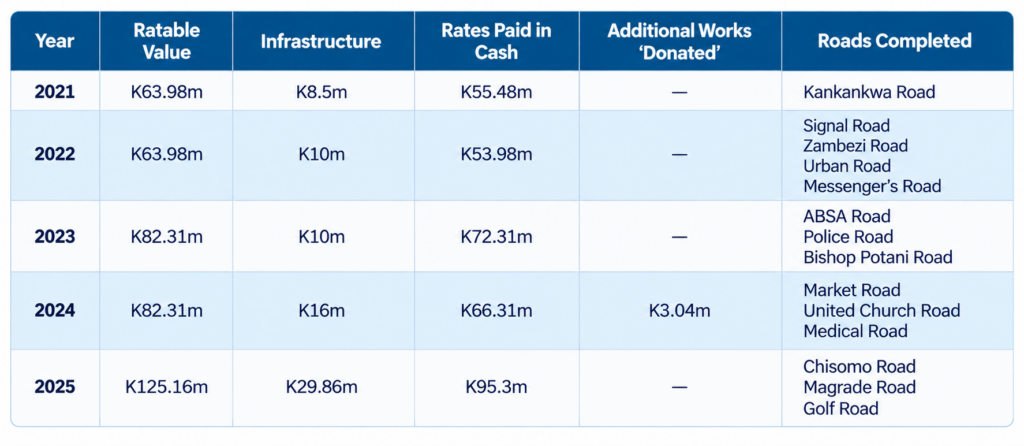
Photo Credit: Facebook

Discover more from MAKANDAY
Subscribe to get the latest posts sent to your email.