


By MakanDay Reporter
When patients visit government hospitals and clinics in Zambia, they expect to receive the medicines prescribed by health workers. But behind the supply of those medicines is a government agency facing serious questions about procurement irregularities, political interference and the dismissal of most of its employees.
The Zambia Medicines and Medical Supplies Agency (Zammsa), responsible for storing and distributing medicines and medical supplies to public health facilities, is undergoing a major restructuring following a forensic audit that reportedly uncovered inflated procurement prices, missing records, unaccounted-for stock and the alleged diversion of medicines.
Health Minister Professor Roma Chilengi announced the restructuring on October 2, saying the changes were intended to address longstanding problems at the agency.
However, interviews conducted by MakanDay with a former Zammsa chief and a well-placed Ministry of Health source reveal conflicting accounts of what went wrong, who should be held responsible and whether the mass dismissals will address the agency’s underlying problems.
While the ministry source alleges that some employees used their positions to benefit from medicine supply contracts, the former agency chief argues that inadequate funding and political interference contributed to Zammsa’s difficulties.
Both have called for the forensic audit report to be made public, raising questions about the evidence used to justify the dismissals and whether responsibility for the agency’s problems extends beyond its employees.
The restructuring has also raised concerns about Zammsa’s future, including unverified claims that the government is considering involving international logistics company DP World in its operations.
Questions over unpublished forensic audit
At the centre of the controversy is a forensic audit commissioned by the Office of the Auditor General, whose findings have been cited in connection with the restructuring of Zammsa.
The audit reportedly identified irregularities involving medicine procurement, stock management and record-keeping. However, MakanDay has not obtained the report and has been unable to independently establish the full extent of its findings or whether it implicated individual employees in wrongdoing.
The former Zammsa chief and the health ministry source, despite their opposing views on the dismissals, both believe the report should be made public.
The former official questioned whether the audit adequately considered the circumstances surrounding procurement and management decisions.
The absence of a publicly available audit report leaves important questions unanswered, including what evidence was established against employees, whether individual responsibility was assessed before their employment was terminated and whether the audit identified failures involving senior management or political officeholders.
MakanDay asked the health ministry to provide a copy of the audit or indicate when its findings would be made public.
The ministry was also asked to confirm the number of affected employees, the procedures followed in terminating their employment and whether individual assessments of wrongdoing had been conducted. It had not responded by the publication deadline.
Employees accused of benefiting from medicine contracts
A well-placed health ministry source defended the mass dismissals, alleging that some ZAMMSA employees had established or were involved in companies that benefited from contracts to supply medicines.
The source claimed that some suppliers were awarded contracts but failed to deliver the medicines they were contracted to provide.
“There is a political cartel, but there was also a cartel of young people within ZAMMSA who had established companies and awarded themselves supply contracts,” the source alleged.
However, the source did not identify the companies or employees allegedly involved, nor provide contract records establishing that employees had improperly benefited from procurement decisions.
The source also questioned a procurement order reportedly worth more than K53 million but did not provide documentation showing what the order covered, which company was involved or what irregularities had occurred.
According to the source, only 14 employees were retained to keep the agency operating following the dismissals. MakanDay has not independently confirmed that figure or established the total number of employees whose contracts were terminated.
Despite defending the restructuring, the source acknowledged that some employees who had committed no wrongdoing might have lost their jobs.
“It is unfortunate that some innocent people have been fired, but that is the only way the cartel can be dismantled,” the source said.
The admission raises questions about whether the restructuring distinguished between employees suspected of wrongdoing and those who were not implicated.
MakanDay was shown an employment separation letter, but the document did not establish that the employee concerned had been involved in any misconduct.
The allegations that employees owned companies benefiting from ZAMMSA contracts, or that suppliers received payments without delivering medicines, have not been independently verified.
On November 10, MakanDay wrote to Zammsa’s interim management seeking clarification on the alleged employee-linked companies, the K53 million procurement order and whether any investigations had established wrongdoing by individual employees.
The agency was given until November 17 to respond but had not done so by the publication deadline.
Former Zammsa chief challenges dismissals
While the Ministry of Health source portrayed the dismissals as necessary to dismantle alleged corrupt networks, a former Zammsa chief offered a different explanation for the agency’s problems.
He described the mass dismissals as harsh and ill-advised, arguing that ZAMMSA’s difficulties could not be attributed solely to employees.
Instead, he pointed to inadequate operational funding and political interference in procurement decisions, which he alleged had undermined the agency’s ability to function effectively.
According to the former official, Zammsa was expected to manage medicines and medical supplies worth approximately US$400 million without adequate resources to support its operations.
He alleged that an eight per cent treasury authority allocation intended to support procurement and supply-chain activities had been withdrawn, leaving the agency struggling to finance essential functions such as warehousing and transporting medicines to health facilities.
The former official argued that replacing employees would not necessarily resolve problems caused by funding constraints and interference in management decisions.
His account raises a separate question about the restructuring: whether removing employees will improve the agency’s performance if the financial and institutional problems he describes remain unresolved.
The Ministry of Health was asked to clarify Zammsa’s operational funding arrangements, including the alleged withdrawal of the eight per cent allocation, but had not responded by the publication deadline.
Allegations of political pressure over procurement
Beyond funding constraints, the former Zammsa chief alleged that political figures had attempted to influence decisions about which companies received contracts to supply medicines.
He recalled receiving a telephone call from a former State House official during an international tender process.
According to his account, the official wanted to know whether a particular pharmaceutical supplier could receive preferential treatment.
In another incident, the former agency chief alleged that a former health minister wanted international drug company removed from a list of accepted bidders during a mop-up procurement exercise.
A mop-up procurement exercise is an additional round of purchasing intended to address outstanding supply requirements.
The former official claimed that he resisted attempts to influence supplier selection where there was no lawful justification for doing so.
The allegations raise questions about the extent to which procurement decisions at Zammsa may have been subject to pressure from outside the agency.
They also introduce a further dimension to the debate over accountability, particularly whether investigations into procurement irregularities have examined the possible role of political officeholders as well as agency employees.
The health ministry was asked whether political officeholders had attempted to influence procurement decisions and what safeguards were in place to prevent such interference. It had not responded by the publication deadline.
Questions over Zammsa’s future and possible DP World involvement
The restructuring has also raised questions about how Zammsa’s operations will be managed in the future, including whether the government intends to involve private companies in medicine storage and distribution.
Both the former Zammsa chief and the health ministry source expressed concern about possible private-sector involvement in the agency’s operations.
The ministry source alleged that the government was considering engaging DP World, a United Arab Emirates-based logistics company.
The source further claimed that the company had close links to a senior ministry official but provided no evidence of such a relationship or any improper conduct.
MakanDay has not independently established that the government has held discussions with DP World or that any agreement concerning Zammsa’s operations exists.
On November 10, MakanDay wrote to DP World seeking clarification on whether it had held discussions with the Ministry of Health or Zammsa, submitted proposals or signed agreements relating to medicine storage and distribution.
The company was also asked about its alleged links to a senior ministry official and whether it intended to take over any Zammsa functions.
DP World did not respond by the November 13 deadline.
The health ministry was separately asked whether any discussions or agreements involving DP World had taken place and whether any relevant conflicts of interest had been declared. It had not responded by publication time.
MakanDay has found no verified evidence that DP World has been awarded a contract or that the government has decided to transfer Zammsa’s operations to the company.
The former agency chief warned that introducing private management without addressing weaknesses in procurement and oversight could leave the underlying problems unresolved.
What does the restructuring mean for medicine supplies?
Beyond the competing allegations, the restructuring raises questions about Zammsa’s ability to continue supplying medicines and medical products to public health facilities.
The agency plays a central role in Zambia’s public health system, managing the storage and distribution of medicines and medical supplies needed by hospitals and clinics.
Disruptions to procurement, warehousing or distribution could affect the availability of medicines, particularly for patients who depend on government facilities for treatment.
However, MakanDay has not established whether the dismissals have caused interruptions to medicine deliveries or shortages at health facilities.
The reported retention of only 14 employees, if confirmed, would also raise questions about how the agency intends to maintain its operations and which functions will be performed by the remaining workforce or other service providers.
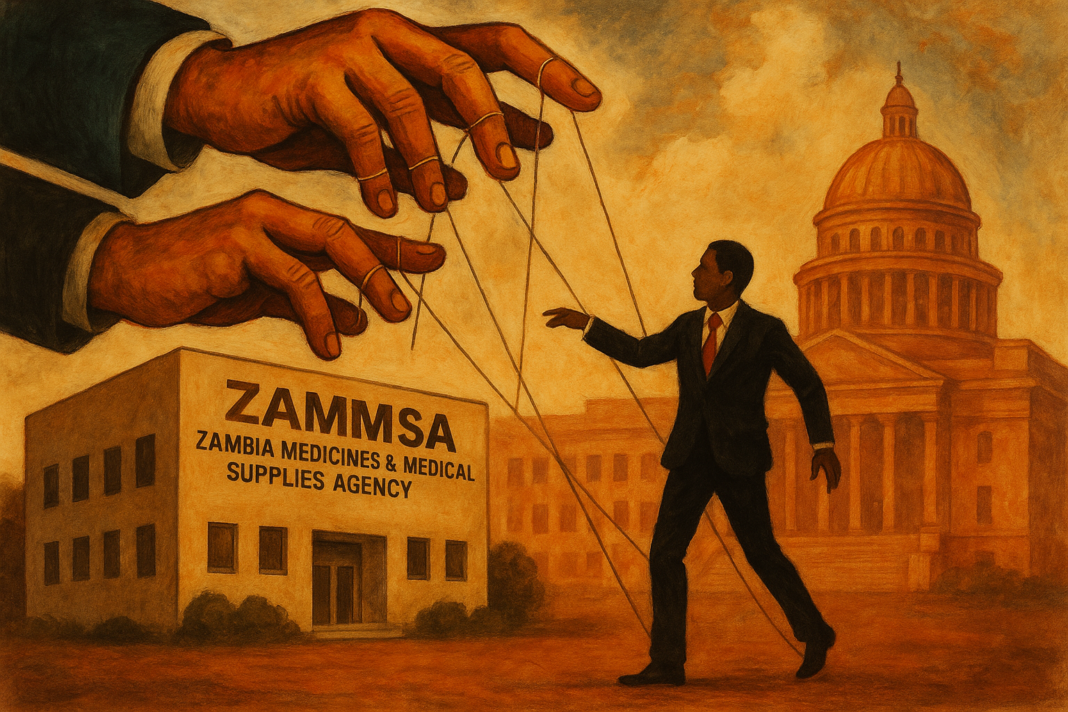
Photo Credit / The AI-generated image is an artistic symbol of political interference and institutional manipulation within Zambia’s medical supply system. At the centre, a man in a suit stands as a puppet figure, his movements controlled by large hands holding puppet strings descending from above. The hands symbolise powerful political forces exerting control over Zammsa, represented by the building in the foreground.
Discover more from MAKANDAY
Subscribe to get the latest posts sent to your email.