


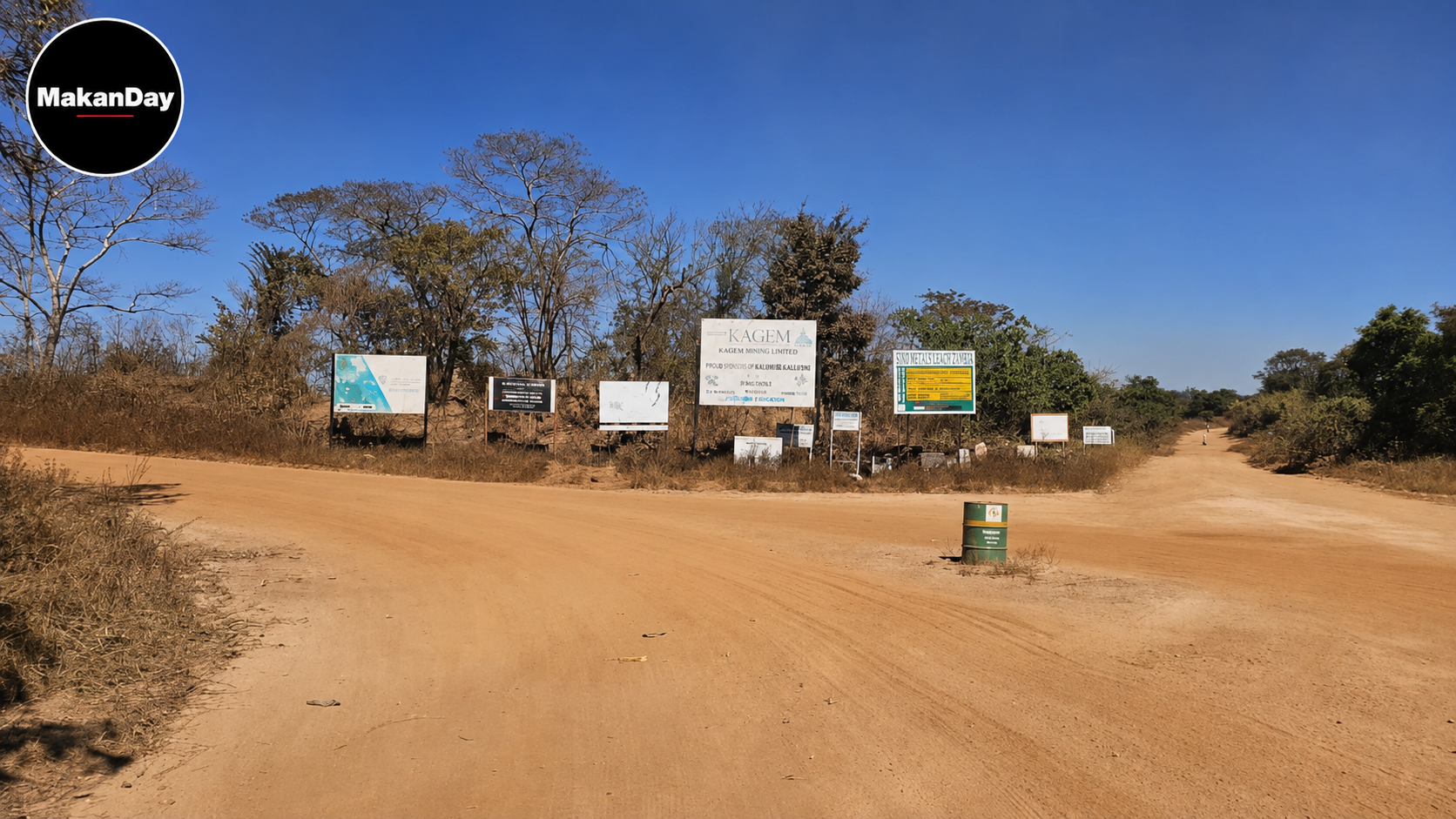
Employees at Kagem and Grizzly mines claim expatriate workers receive significantly higher salaries and better conditions than Zambians performing comparable work. Kagem rejected the allegations, but labour authorities and trade unions acknowledge that unequal pay for work of equal value remains a persistent challenge in Zambia’s mining sector.
By MakanDay Reporter
Zambia has long promoted its emerald industry as one of the country’s mining success stories, attracting foreign investment and strengthening its position as one of the world’s leading emerald producers.
But interviews conducted by MakanDay with workers at two of the country’s largest emerald mines suggest that beneath the industry’s success lies growing concern over alleged disparities in pay and conditions between expatriate and Zambian employees.
Workers at Kagem Mining Limited and Grizzly Mining Limited allege that expatriate employees earn substantially more than local workers performing comparable roles, despite labour laws requiring equal pay for work of equal value.
The workers, labour unions and government officials interviewed for this investigation say complaints about unequal remuneration have persisted for years.
Kagem disputes the allegations. In a written response, the company said remuneration is determined by qualifications, experience, expertise, performance, level of responsibility and prevailing market conditions—not nationality.
The company said expatriates are recruited only when the required specialised skills, technical expertise or level of experience are not available locally. It added that 93% of its workforce is Zambian.
“Due to the nature of its business and operational requirements, Kagem needs – from time to time – to turn to the international job market for roles where skill/technical proficiency and prior experience of the level of responsibility is not available in Zambia, as well as for operational reasons,” the company said in a statement. “Kagem hires expatriates in accordance with local laws and subject to the requisite work permits.”
Kagem also highlighted its investment in skills development and community programmes. It cited the recent handover of the US$2.5 million Chapula Trades Training Institute in Lufwanyama, a vocational training centre that provides hands-on technical training aimed at improving young people’s employability and livelihoods. The company added that it also funds scholarships and supports the professional development of Zambian mining engineers and geologists through in-service training.
Grizzly Mining did not respond to detailed questions sent by MakanDay before publication.
Although MakanDay could not independently verify every salary figure provided by workers, interviews conducted separately with employees from both mines revealed strikingly similar accounts.
The Ministry of Labour and Social Security says employers must prioritise qualified Zambians and ensure expatriates performing work of equal value receive the same remuneration as local employees.
“If an expatriate is doing the same work as a Zambian employee, then they must receive the same salary,” Labour Commissioner Givens Muntengwa told MakanDay.
His remarks highlight the central issue explored in this investigation: whether Zambia’s labour and immigration laws are being consistently enforced.
Workers Allege Wide Salary Gaps
Employees interviewed by MakanDay alleged that expatriate workers receive significantly higher salaries than Zambians despite performing comparable duties.
At Grizzly Mining, workers alleged that local security officers earn about K7,000 (about US$ 390 at the current exchange rate) per month, while expatriate security personnel from Senegal and Nepal receiveK35,000 (US$ 1,945) or more. They also claimed that gemstone sorters performing similar work receive markedly different salaries.
“We sit in the same workspace for the same hours sorting emeralds, but our salaries are completely different,” one employee said.
“A Zambian may earn between K4,000 (US$ 222) and K6,000 (US$ 333) a month, while others doing comparable work receive K30,000 US$ 1,167) or more.”
Workers at Kagem raised similar concerns.
One employee alleged that Zambian professionals with qualifications comparable to expatriate colleagues earn between K14,000 (US$ 778) and K15,000 (US$ 833) per month, while some expatriate gemologists receive the equivalent of more than US$4,000 (US$ 222).
Employees also alleged that some expatriate specialists had been trained by experienced Zambian workers before assuming their positions.
Concerns Beyond Pay
Workers also alleged differences in working conditions under the mines’ “away-from-home” system.
While accommodation and transport are provided, employees claimed expatriates enjoy unrestricted internet access while local workers rely on limited Wi-Fi or purchase their own data.
At Grizzly, workers also alleged that local security officers work 12-hour shifts, compared with eight-hour shifts for expatriate colleagues.
Others described a workplace culture in which expatriate and local employees interact little, alleging that foreign staff often work within separate groups and that some expatriate security officers openly expressed distrust of Zambian employees handling emeralds.
Company Response
Kagem rejected suggestions that expatriate employees receive preferential treatment because of their nationality.
The company said remuneration is based on objective criteria, including qualifications, experience, expertise, responsibility and performance, while expatriates are recruited only where specialised skills are unavailable in Zambia.
It added that expatriate benefits are limited to relocation and travel arrangements and said it had not received formal complaints of discrimination through its grievance mechanisms.
Grizzly Mining did not respond to MakanDay’s questions before publication.
What the Law Says
Labour Commissioner Muntengwa said Zambia’s labour and immigration laws require employers to recruit expatriates only where suitably qualified Zambians are unavailable.
“The starting point is that priority should be given to Zambians,” he said.
He stressed that employing expatriates does not exempt employers from complying with anti-discrimination provisions.
“If an expatriate is doing the same work as a Zambian employee, then they must receive the same salary,” he said.
Muntengwa said his office has received complaints involving disparities between expatriate and local employees, including cases where Zambian supervisors allegedly receive less favourable remuneration than expatriates occupying comparable positions.
“If those positions can be occupied by qualified Zambians, then there is no need to go beyond our borders,” he added.
He encouraged workers who believe they are being unfairly treated to report their concerns to labour authorities.
Unions Call for Stronger Enforcement
Former Zambia Congress of Trade Unions (ZCTU) president Leonard Hikaumba said complaints about unequal remuneration between expatriate and Zambian employees have persisted for years.
“The problem of inequality between expatriate and local workers is real,” he said.
“It is a long-standing issue, and despite numerous efforts to address it, very little has changed.”
Hikaumba said Zambia’s Employment Code Act requires equal remuneration for work of equal value and that salary differences should be based on objective factors such as qualifications, responsibility and expertise—not nationality.
Current ZCTU president Blake Mulala said the challenge lies less with the law than with its enforcement.
“The challenge is not the law,” he said. “The challenge is enforcement.”
Mulala said many workers are reluctant to report discriminatory labour practices for fear of victimisation.
He also questioned whether some expatriates are being employed in positions that qualified Zambians could fill and alleged that, in some cases, expatriate employees receive significantly higher salaries after being trained by local workers.
Mulala said foreign expertise remains important where specialised skills are unavailable but argued that expatriate employment should be temporary and accompanied by meaningful knowledge transfer to Zambians.
The Accountability Question
The allegations raised by workers at Kagem and Grizzly highlight a broader question about how Zambia balances the need for foreign investment with its obligation to protect local workers from discrimination.
Kagem maintains that its remuneration policies are based on objective factors rather than nationality, while Grizzly had not responded by the time of publication.
Workers, however, continue to allege significant disparities in salaries, benefits and working conditions. Labour unions say similar complaints have persisted across the mining sector for years, while the Ministry of Labour acknowledges receiving reports of unequal remuneration and maintains that such practices, where they occur, violate the law.
Whether these complaints reflect isolated workplace grievances or broader weaknesses in the enforcement of Zambia’s labour and immigration laws remains an important question for regulators.
As Zambia continues to attract investment into its mining sector, ensuring that foreign expertise complements rather than disadvantages qualified local workers is likely to remain a key test of the country’s commitment to fair labour practices.

Discover more from MAKANDAY
Subscribe to get the latest posts sent to your email.