


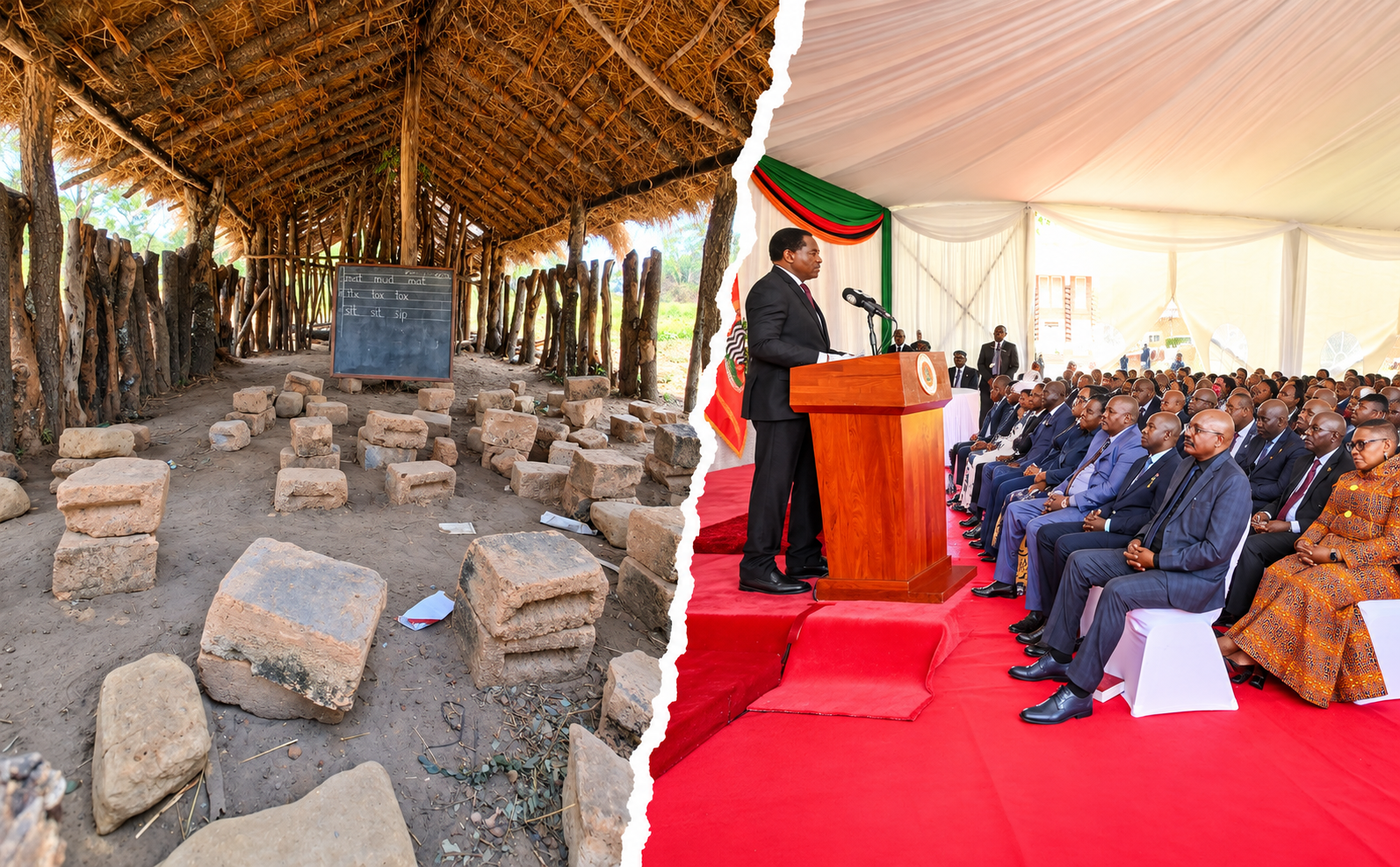
Two contrasting scenes this week tell a troubling story about Zambia’s development priorities, coming just days after the country celebrated its 62nd independence anniversary.
Sixty-two years after independence, the promise of a better life remains unfulfilled for many Zambians. The contrast between what is happening in a rural classroom and what is unfolding in the corridors of power in Lusaka could hardly be more striking.
The first scene is of children learning in dusty classrooms made of poles and mud, without proper desks or the basic facilities that should be available in any school. The second is from Lusaka, where President Hakainde Hichilema unveiled an expanded Cabinet, appointing more ministers to address the country’s development challenges.
These two scenes may appear unrelated, but they raise an important question: Are we putting our limited national resources where they are needed most?
At Makombo Community School in the Lukanga North Resettlement Scheme in Mpongwe district on the Copperbelt, more than 200 children attend classes in structures that barely resemble classrooms. The walls are made of mud, the roof is supported by wooden poles, and the floor is bare earth. Instead of desks, pupils have to make do with makeshift seating fashioned from blocks and logs.
The school was established by the community itself, after residents recognised the need for their children to have access to education. Rather than wait for the government to build a school, they took matters into their own hands, putting up the modest structures in which their children now learn.
This year, Makombo was gazetted as a government school, a development that should have brought renewed hope to the community. Official recognition is an important step, but it means little to a child who must continue learning in such conditions.
What makes the situation even more troubling is that Makombo is not in some remote, inaccessible corner of Zambia. The school is about a 45-minute drive from Mpongwe town.
Yet, despite being relatively close to the district’s main commercial centre, its pupils continue to learn in conditions that raise uncomfortable questions about how far development has reached, even 62 years after independence.
These children are no less deserving of a decent education than those attending well-equipped schools in Lusaka or other urban centres. They, too, have dreams of becoming doctors, teachers, engineers, journalists and leaders. Yet the environment in which they are expected to learn places them at a disadvantage from the very beginning.
Imagine being a child who walks to school every morning, eager to learn, only to spend the day sitting on a makeshift seat in a dusty classroom without a proper desk. This is the reality for more than 200 children at Makambo Community School. Their teachers face an equally difficult task: trying to give these children a decent education without the most basic facilities.
The assignment of two teachers to the school earlier this year is a welcome step, but two teachers alone cannot meet the needs of more than 200 pupils. These children deserve more than a place to sit and listen to lessons. They deserve proper classrooms, desks, learning materials and enough teachers to give them a fair chance at a better future.
Meanwhile, in Lusaka, the political establishment continues to grow.
We are at pains to understand how increasing the number of Members of Parliament and Cabinet ministers will, by itself, translate into better living conditions for ordinary Zambians.
The argument may be that a larger parliament improves representation and that additional ministers strengthen the government’s capacity to deliver services. These are arguments worth considering. But representation must be measured by what it delivers to citizens, not simply by the number of people occupying public office.
Every additional political office comes with a cost. There are salaries, allowances, vehicles, offices, administrative staff and other expenses that must be met from public resources.
These are resources drawn from the same national purse expected to finance classrooms, recruit teachers, equip hospitals, maintain roads and provide clean drinking water.
We are not suggesting that the country should have no ministers or that parliamentary representation is unnecessary. Government must function, and citizens deserve effective representation. But there must be a reasonable balance between the cost of governing and the resources available to meet people’s most pressing needs.
For a child at Makombo Community School, development is not measured by how many ministers are appointed or how many MPs sit in the national assembly. Development means having a proper classroom, a desk, textbooks and a qualified teacher.
For parents in Lukanga North, it means knowing that their children have a fair chance of succeeding in life, regardless of where they were born.
This is where our national debate about development must begin.
Too often, political decisions are celebrated in Lusaka without sufficient consideration of their consequences for communities far removed from the corridors of power. We discuss government appointments, political representation and administrative structures while children continue learning in conditions that should have no place in a country endowed with so much mineral wealth.
The irony is particularly striking in the Copperbelt, a province whose mineral resources have contributed enormously to Zambia’s economy for generations. Yet some communities still struggle to provide their children with the most basic educational infrastructure.
Makombo Community School is a reminder that the benefits of national development remain unevenly distributed.
The government deserves credit when it expands access to education and brings community schools into the public education system. But gazetting a school must be followed by meaningful investment.
Recognition should be the beginning of improvement, not the end of government’s responsibility.
There must be a clear plan to provide permanent classrooms, desks, teaching materials and adequate staffing. Without these, the promise of education risks becoming little more than an administrative achievement.
And this raises another question: where is the much-talked-about Constituency Development Fund (CDF) in all this? Why has it not been used to build decent classrooms for the children of Makombo Community School? Has the school been considered for CDF support, and if not, why not?
These are questions that political leaders in Lambaland must answer. After all, what is the purpose of increasing development funds to constituencies if children in communities such as Lukanga North must still sit in dusty, mud-walled classrooms to receive an education?
The children of Makombo Community School cannot wait indefinitely for development to reach them. Every year spent learning under such conditions is a year of their childhood that cannot be recovered.
As the government settles into its expanded political structures, we hope those entrusted with public office will remember the children sitting in dusty classrooms in Mpongwe and countless other communities across Zambia.
The true measure of a government’s commitment to development is not the size of its Cabinet or Parliament, but the difference it makes in the everyday lives of its citizens.
And perhaps the most important question we should be asking is this: If Zambia can find the resources to expand its political establishment, why should more than 200 children at Makombo Community School still have to learn in a mud classroom?

Discover more from MAKANDAY
Subscribe to get the latest posts sent to your email.