

In the run-up to Zambia’s 13 August general elections, democracy was exercised not only at rallies, campaign meetings and polling stations, but also on the screens of ordinary citizens’ phones and computers.
In this two-part series, Blessing Vava reports.
A young voter in Lusaka could move from a WhatsApp conversation about the election to a Facebook campaign video, then to TikTok commentary, before checking a candidate’s position on an issue.
A Yango driver could follow campaign developments between trips, while a small-business owner in Kitwe could receive political messages while processing mobile-money payments on Airtel.
On election day, citizens followed results, rumours and competing claims through their phones long before the official count had concluded.
Fourteen presidential candidates alongside hundreds of parliamentary and local-government candidates, fought not only through rallies, posters, television and radio, but across increasingly important digital spaces.
This was not accidental. It reflected a broader transformation in democracy itself.
Elections, constitutions, parliaments, political parties and courts remain essential. But democratic life is now also mediated through smartphones, social platforms, algorithms, digital identities and artificial intelligence.
The question is no longer simply whether technology can strengthen democracy. It is who controls and governs the technologies through which democratic participation increasingly takes place – a question at the heart of “geosociotechnopolitics.”
From the Ballot Box to the Digital Public Sphere: Zambia’s New Electoral Architecture
For much of Africa’s post-independence history, political communication was relatively centralized, with governments, newspapers, radio, and television being the principal gatekeepers of information.
My time in Zambia made these fundamental changes visible.
Campaign messages moved constantly between physical and digital spaces: a rally generated content for Facebook; a television interview became a TikTok clip; a speech circulated through WhatsApp groups within minutes.
Citizens were not simply consuming political messages; they were recording, remixing, and redistributing them.
Traditional broadcast media played a vital role in bridging this physical-digital divide. Established houses – the public broadcaster ZNBC alongside private networks such as Diamond TV, Muvi TV, Prime TV, and QTV – extended their reach well beyond television sets by live-streaming debates, breaking news, and interview clips on YouTube, Facebook, and X.
Citizens inside and outside Zambia followed events as they unfolded. In this sense, the gatekeepers of the broadcast era were not displaced by digital platforms so much as absorbed into them.
The 2026 electoral field – spanning from the governing UPND to the NRPUP, Socialist Party, Citizens First, and smaller parties – depended heavily on this expanded digital architecture. Political leaders actively shaped, and were sometimes trapped by it.
President Hakainde Hichilema’s camp and the UPND used digital platforms to communicate policy, project continuity, and mobilise younger voters while bypassing traditional media.
Opposition figures such as Brian Mundubile of the NRPUP adopted similar strategies to communicate directly with voters.
Yet the same platforms that expanded political communication also amplified volatility. This was starkly demonstrated when Mundubile claimed victory through online channels before the Electoral Commission of Zambia completed its official tally, accelerating competing claims of legitimacy and placing immense pressure on electoral institutions.
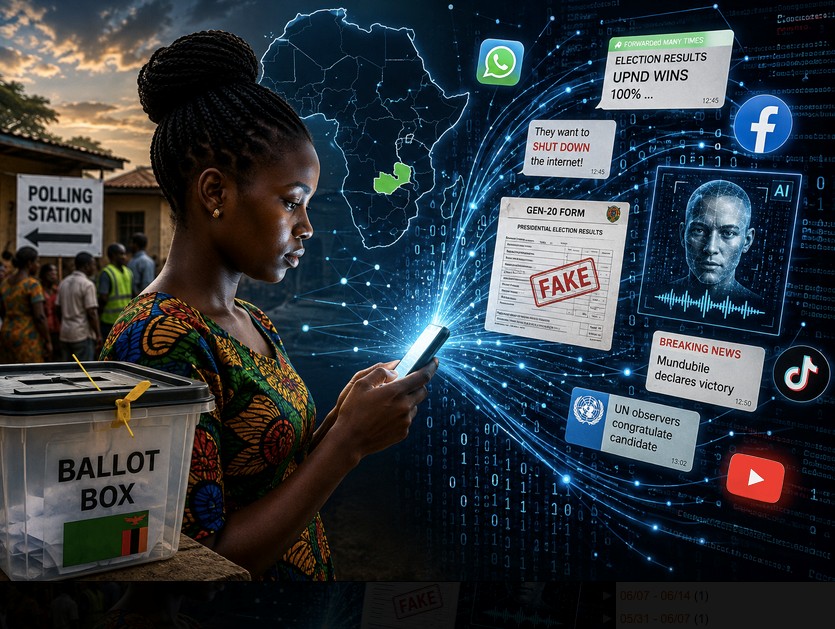
This volatility was compounded by the rapid circulation of unverified claims and synthetic disinformation. Fake GEN-20 forms purporting to show official election results spread across social media and messaging groups, giving misleading narratives a veneer of institutional authority.
In an environment where citizens anxiously awaited outcomes, fabricated documents often travelled faster than institutional corrections.
Similarly, a false communication circulated online alleging that State House had instructed the Zambia Information and Communications Technology Authority (ZICTA) to shut down internet access and target critics.
Although State House and fact-checkers quickly exposed it as a fabrication, the rumour generated deep anxiety. It succeeded not because it was true, but because it threatened the very digital infrastructure through which citizens were experiencing the election.
The episode revealed a new reality of democratic politics: political leaders and institutions are no longer required only to communicate policies or official decisions; they are increasingly forced to expend political capital responding to entirely fabricated mandates and false narratives attributed to them.
The combination of premature victory declarations, fake GEN-20 forms, and false shutdown claims illustrates a fundamental tension of democracy in the digital age.
Institutional procedures have deliberate timelines for establishing facts, but the digital public sphere refuses to wait for them.
Political narratives can be declared, fabricated, shared, and believed long before the institutions responsible for establishing the truth have completed their work.
When Information Becomes a Political Weapon
The events surrounding the counting process demonstrated one of the clearest lessons of the campaign: misinformation and premature political claims can shape public perceptions before verified facts catch up.
iVerify Zambia documented a number of false and misleading claims circulating during the election period, including manipulated political content, allegations concerning electoral officials and fabricated documents.
False claims about the outcome circulated before the Electoral Commission had formally completed the declaration process. The United Nations was itself forced to clarify its position after misleading social-media posts claimed that UN observers had congratulated a candidate.
The problem was not confined to one political camp, and that is precisely the point. Misinformation does not need to convince everyone to become politically significant.
If one voter believes the election has already been stolen, another believes a candidate has already won, a third fears that the internet is about to be shut down, and a fourth believes an international institution has endorsed a candidate, the common informational foundation on which democratic disagreement depends begins to disappear.
That may be digital misinformation’s most dangerous effect: not simply introducing false information, but weakening citizens’ ability to agree on what counts as evidence at all.
This is compounded by the emotional pull of political content. A claim that an election has been stolen or that the internet is about to be shut down generates far more urgency than a routine official announcement.
Algorithms do not necessarily reward what is true; they often reward what captures attention. In an election, what captures attention can quickly become what is believed.
Zambia had anticipated some of these dangers. In February 2026, UNDP and the Panos Institute Southern Africa relaunched iVerify Zambia 2.0 as a strengthened national mechanism to combat misinformation, disinformation and hate speech ahead of the general elections.
The initiative specifically recognised emerging threats associated with artificial intelligence, deepfakes, synthetic media, algorithmic amplification and coordinated inauthentic behaviour.
Connectivity alone cannot sustain a healthy democratic public sphere. Citizens need reliable information, not simply more information.
Electoral commissions need credible and timely communication. Journalists and fact-checkers need the capacity to respond at the speed of social media.
Political parties have a responsibility not to exploit uncertainty for partisan advantage, while technology companies must recognise that their platforms have become part of democracy’s infrastructure.
Citizens have a responsibility too. Forwarding a message is no longer an entirely private act. The first line of defence against digital manipulation is often not the state, but the citizen who pauses before pressing “forward.”
Dr. Blessing Vava is a “geosociotechnopolitics” scholar, governance practitioner and researcher. He spent a month conducting field research on elections and digital public spheres in Zambia.

Discover more from MAKANDAY
Subscribe to get the latest posts sent to your email.