

As Zambia reflects on recent events surrounding the arrest and charging of Lusaka Catholic Archbishop Alick Banda, an old question has returned to the centre of public debate: What role should the Church play in politics and in society more broadly?
Archbishop Banda has been charged with possession of property reasonably suspected to have been unlawfully obtained in connection with a Toyota Hilux allegedly originating from the Zambia Revenue Authority. He has pleaded not guilty, and the matter is now before the courts.
Without passing judgment on that case, the controversy surrounding it provides an opportunity to revisit the long history of Christian leaders speaking on questions of governance, human rights and social justice in Zambia.
For that reflection, we turn to the words of the late Cardinal Adam Kozlowiecki, SJ, who became the first Archbishop of Lusaka in 1959 and resigned from the position in 1969. He later became a cardinal.
His words are particularly instructive because they describe a Church that spoke out under very different governments and political systems — against discriminatory colonial laws, during the struggle for African self-determination, after independence and during Zambia’s one-party era, and later under the Third Republic.
For Cardinal Kozlowiecki, speaking out was not simply about supporting or opposing a particular government. He presented it as part of the Church’s responsibility to defend human rights, challenge injustice and speak on behalf of the people.
The passage below is his Foreword to the book The Social Teaching of the Catholic Bishops and Other Christian Leaders in Zambia. We reproduce it as published:
FOREWORD
“As Church leaders, we have always to speak out for human rights, for the rights of the people.” Cardinal Adam Kozlowiecki
“As a Church, we have the duty to say the truth. When something is unjust we should not hesitate to speak against it”. This has been our guidance whenever the Church has spoken out.
I came to this Country 57 years ago, just after the Second World War. From that time, I saw that the people were not treated well.
The British South African Company (BSA) had constructed the railway to the Copperbelt. The prospectors (BSA) did not have an idea about the people of the land in which they had come. All they were interested in was the copper.
Later, when the country became a British Protectorate before it became Northern Rhodesia, the people were still not being treated rightly. It was therefore not surprising that people (Africans) started thinking of independence.
We as Church leaders, at that time, stood for the self-determination of the Africans. We spoke about the rights of the African population to participate in the affairs of their land.
The question of the Federation of Rhodesia and Nyasaland was one example. It was an issue that was only between the settlers alone without the participation of Africans.
I was personally so outspoken that the Federal Government used to call me a “Polish mad-man”.
I remember the visit of Bishop Kiwanuka, from Uganda, when he came to bless the Church of the Martyrs of Uganda in Luanshya. He was the first black African to become Bishop. He arrived in Salisbury (Harare) and was put in a third class hotel because of a law they used to call “Land Apportionment Act”, famously known as the “colour bar”. Under this law, people were segregated according to the colour of their skin. I asked my secretary to call the Northern News (what is known as the Times of Zambia today). I said, “I want to protest the way an important guest was treated”. I was told, “That was the law”. I said, “then I want to protest against such laws”.
We as Bishops spoke against the colonial Government for some of their bad laws and policies. We still were very critical after independence, especially during the One Party rule of the Kaunda regime.
We are still speaking out today during the Third Republic during the rule of President Chiluba. We have always spoken on behalf of the people. This is the essence of the pastoral letters the Bishops have been writing since 1953!
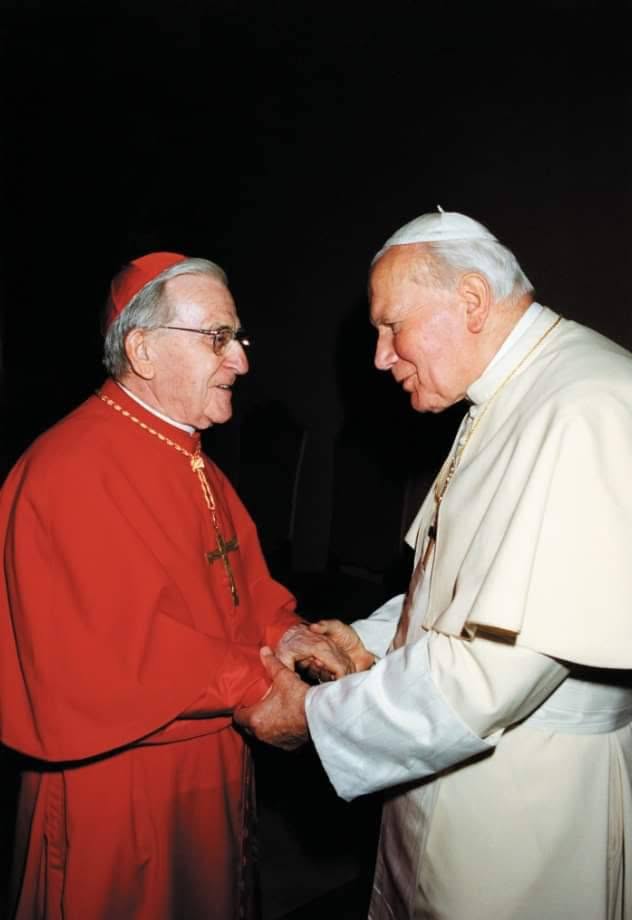
In the photo, Adam Cardinal Kozlowiecki, SJ (left), with the late Pope John Paul II.
Photo: Emmanuel Haambokoma’s Facebook Page


Discover more from MAKANDAY
Subscribe to get the latest posts sent to your email.


