

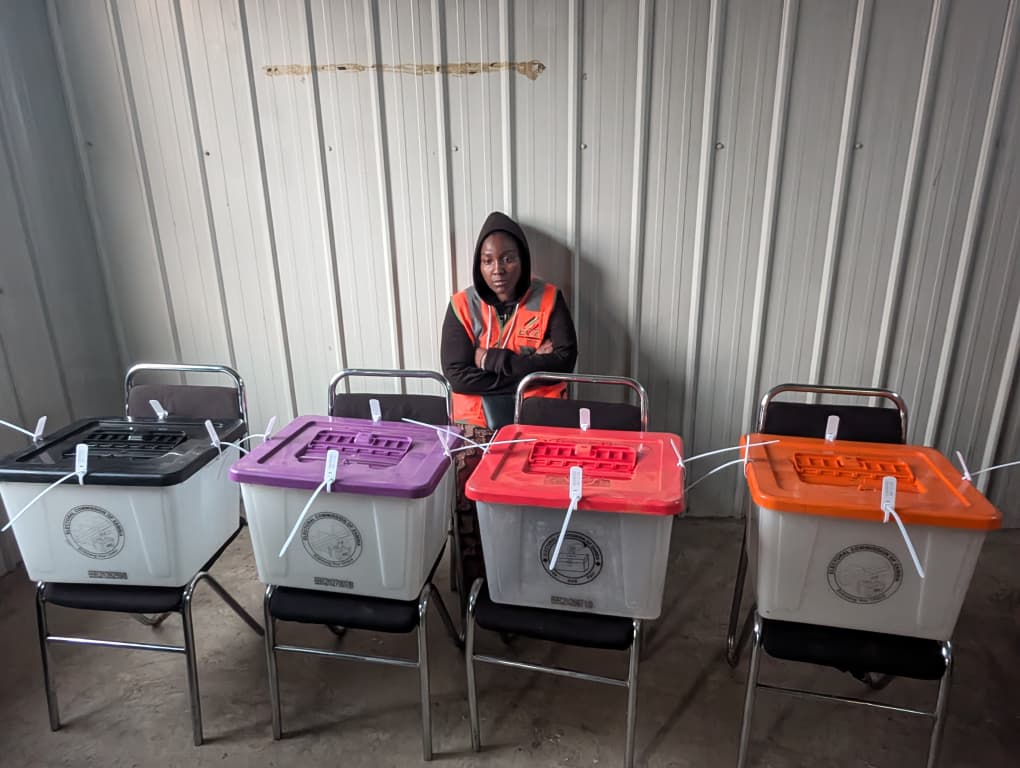
When Zambia's electoral commission suspended vote counting for six hours, Natasha Mulenga began questioning the process. An EU election observation report later documented a deterioration in transparency after counting resumed, raising questions about the decision and the safeguards that followed.
By James Mwape | Radio Icengelo
For Ms Mulenga, 27, voting in Zambia’s 2026 general elections was supposed to be a moment of pride. It was her first opportunity to participate in choosing the country’s leaders, an experience she had looked forward to.
But the excitement of casting her first ballot soon turned into anxiety.
As Zambians waited for election results, the Electoral Commission of Zambia (ECZ) ordered a nationwide six-hour suspension of vote counting and the declaration of results at polling stations and totalling centres.
For Ms Mulenga, the announcement raised troubling questions about what was happening to the votes that had already been cast, including her own.
“They gave us anxiety. We were living in fear at that particular moment,” she recalled.
Ms Mulenga’s fears were not evidence that her vote had been tampered with. But an independent assessment of the election would later reveal problems with the transparency of the results process.
In its final report on Zambia’s 13 August 2026 general elections, the European Union Election Observation Mission documented a deterioration in results tabulation procedures following a nationwide six-hour suspension ordered by ECZ.
The mission reported that observers witnessed reduced public scrutiny at totalling centres after the interruption.
What should have been a memorable introduction to democratic participation instead left Ms Mulenga questioning whether her vote mattered.
“My confidence was really affected in a way because, come on, how do I even vote? Because meaning my vote won’t even be necessary, looking at what happened last time in the just ended elections,” she said.
A report by Radio Icengelo examined the circumstances surrounding the suspension, drawing on interviews with voters, electoral stakeholders and observations made at polling stations in Ndola.
The report found that the interruption had raised questions about the legal basis for the directive, transparency in the counting process and the ability of election authorities to maintain public confidence.
However, the ECZ had not responded to questions submitted by the investigation team by the time the original report was prepared for publication.
The EU mission’s findings have added further questions for the commission.
Beyond explaining the circumstances that prompted the suspension, the ECZ needs to clarify why some results tabulation procedures became less transparent after the interruption.
A first vote overshadowed by uncertainty
For Ms Mulenga, the significance of the election went beyond the political contest between candidates.
Voting for the first time meant exercising a constitutional right and participating in a process intended to give citizens a say in how their country is governed.
She expected the counting and announcement of results to proceed without unexplained interruptions. Instead, she found herself waiting for answers.
“It should have run through smoothly, not what they (ECZ) did,” she said.
“I would really want to know why they did that.”
Her questions are central to understanding the effect of the suspension on public trust. The interruption did not, in itself, establish that votes were altered or that election results were compromised. But the uncertainty surrounding the decision left Ms Mulenga doubting the process.
Her experience experience illustrates what can happen when voters do not understand why an important stage of an election has been interrupted. She was not alone in finding the events unusual.
Six decades of voting, a different experience
At 84, Eli Chisanga Kayula has witnessed Zambia’s electoral history unfold since independence in 1964.
He says he has voted in every election since then, witnessing changes in political leadership and the country’s electoral system.
But the six-hour suspension of vote counting during the 2026 general elections stood out to him.
“In all my years of voting since 1964, I have never seen or heard of vote counting being stopped halfway across the entire country,” Mr Kayula said. “I have never witnessed such hostility surrounding the electoral process until this election.”
Unlike Ms Mulenga, who was voting for the first time, Mr Kayula had more than six decades of electoral experience against which to compare the events.
Both generations were confronted with questions about the interruption. Their accounts raise a wider issue: whether the electoral system had provided voters with sufficient information to understand the suspension and the measures taken to protect the integrity of the process.
Confusion at polling stations
While Ms Mulenga and Mr Kayula were waiting for election results, Radio Icengelo reporter James Mwapi was documenting challenges at polling stations in Chifubu Constituency in Ndola.
Voting was generally peaceful at the stations he visited, but his observations revealed difficulties that affected some voters’ ability to navigate the process.
At some polling stations, voters struggled to locate their designated polling streams. Some approached the reporter for assistance, apparently mistaking him for an election official.
The difficulties were particularly noticeable among voters who could not read.
At one polling station, the reporter observed a queue that appeared to have stopped moving. When he asked the presiding officer what measures were being taken to address the delay, the official declined to comment.
At Kalela polling station, the confusion was acknowledged by a presiding officer, Laskey Musoka.
“The issue is we haven’t indicated where the voter is supposed to come. So we are doing it now. So this has brought this confusion,” Mr Musoka explained.
Although these incidents were observed at individual polling stations and cannot be taken as evidence of nationwide failures, they raise questions about election-day preparedness and the provision of information to voters. They also highlight the importance of effective communication during an election, particularly when unexpected problems arise.
Lusaka-based political analyst and former lecturer in governance and African politics at the University of Zambia Dr Neo Simtanyi believes shortcomings identified during elections must be acknowledged and addressed to prevent their recurrence.
But while the difficulties at polling stations affected the voting experience, the subsequent suspension raised a more central question about who had the authority to interrupt the counting process.
Who had the authority to suspend counting?
The reported six-hour suspension has become a central issue in questions surrounding the administration of the 2026 elections.
The suspension was reportedly linked to incidents of violence in some parts of the country.
However, Mike Mushanga, vice president of the Foundation for Democratic Process (FODEP), questioned whether those circumstances justified suspending the process more widely.
“Of course, the explanation was weak to an extent that it refers to pockets of violence in certain areas,” Mr Mushanga said in an interview wity Radio Icengelo.
He also questioned the legal authority under which the ECZ acted.
“But if you look at the law that mandates the presiding officer to stop an election, it talks about a specific event, and that is the mandate of the presiding officer,” he said. “The Electoral Commission of Zambia took that mandate, which is ironic.”
Mr Mushanga’s interpretation raises a distinction between the authority of presiding officers to respond to incidents at individual polling stations and the powers of the Electoral Commission to issue broader instructions.
He argued that the decision created uncertainty in the electoral process.
“It led to a situation where it created a gap in the electoral process, which we are yet to fully understand as to why this was necessary. And if it was unnecessary,” he said.
The EU Election Observation Mission also questioned the explanation provided for the suspension.
In its final report, the mission stated: “While suspension was lifted after six-hours, the scale of security concerns stated to underpin the decision was insufficiently explained.”
The ECZ had reportedly cited violence against polling staff and alleged theft of ballot boxes as reasons for interrupting the process.
What changed after the six-hour suspension?
In its final report on Zambia’s 13 August 2026 general elections, the EU Election Observation Mission documented procedural weaknesses at totalling centres following the interruption.
The mission deployed 100 observers and monitored different stages of the electoral process, including results tabulation at 64 of the country’s 226 constituency totalling centres.
Before the suspension, EU observers assessed results tabulation positively in 93% of their observations.
However, after the ECZ lifted the suspension late on 14 August, observers reported a significant deterioration in procedures.
The proportion of observed tabulation processes assessed as bad or very bad for transparency increased from 7% before the suspension to 12% afterwards.
The mission also found that results were not immediately recorded on tally sheets after their announcement in 42% of observations following the suspension, compared with 30% beforehand.
Checks to ensure that figures entered into the digital results management system matched those on tally sheets also declined.
Before the suspension, such checks were recorded in 100% of observations, falling to 81% afterwards.
The observers further reported extended breaks during tabulation in almost half of their observations, with returning officers appearing to wait for instructions before announcing results.
According to the mission, a heavy military presence at totalling centres following the suspension was reportedly intimidating to many of those interviewed and contributed to fewer party agents and citizen observers being present.
These findings raise questions about the consistency of procedures used to verify results and the level of independent scrutiny permitted after counting resumed.
The EU mission did not observe proceedings during the six-hour suspension itself. Its findings therefore cannot establish what happened to election materials during that period or whether any results were altered.
Nevertheless, the deterioration documented after counting resumed raises questions about how the ECZ managed the interruption and ensured that electoral procedures were followed.
The mission recommended stronger transparency safeguards, including the projection of results during data entry and the prompt online publication of complete polling-station-level results.
For first-time voters such as Ms Mulenga, the findings add significance to concerns about whether the electoral process was sufficiently transparent.
Electoral Commission asked to explain
Radio Icengelo sought clarification from the ECZ about the suspension.
The station asked why counting and the declaration of results had been interrupted, what informed the decision and how the commission responded to concerns raised by electoral stakeholders.
The commission was also asked to address questions surrounding its authority to issue the directive.
By the time the report was prepared for publication, the ECZ had not responded.
The EU mission’s findings have added further questions for the commission.
Beyond explaining the circumstances that prompted the suspension, the ECZ needs to clarify why some results tabulation procedures became less transparent after the interruption.
The mission’s observations also raise questions about whether election officials received adequate instructions when the process resumed and what oversight mechanisms were used to ensure compliance with established procedures.
The commission also needs to explain what measures were taken to address the weaknesses documented by observers.
Without these answers, it remains difficult to establish whether the problems were isolated procedural failures or reflected broader weaknesses in the management of results.
A first-time voter left searching for answers
When Ms Mulenga cast her first ballot, she expected to participate in a process in which every vote would be counted and the results transparently declared.
Instead, the six-hour interruption left her questioning the reliability of the system.
The EU mission’s findings have given added significance to the concerns she expressed after the suspension.
The observers documented reduced transparency and inconsistencies in results tabulation procedures after counting resumed. They also questioned whether the security concerns cited to justify the nationwide interruption had been sufficiently explained.
None of these findings proves that Ms Mulenga’s vote, or anyone else’s, was altered.
But they raise questions that the ECZ has yet to fully answer in this investigation.
For Ms Mulenga, who entered a polling station for the first time believing that her vote would help shape the country’s future, the experience has left a lingering doubt.
“I would really want to know why they did that,” she said.
This article was produced for MakanDay’s local reporting network. Sign up to get stories like this one as soon as they are published.

Discover more from MAKANDAY
Subscribe to get the latest posts sent to your email.


