

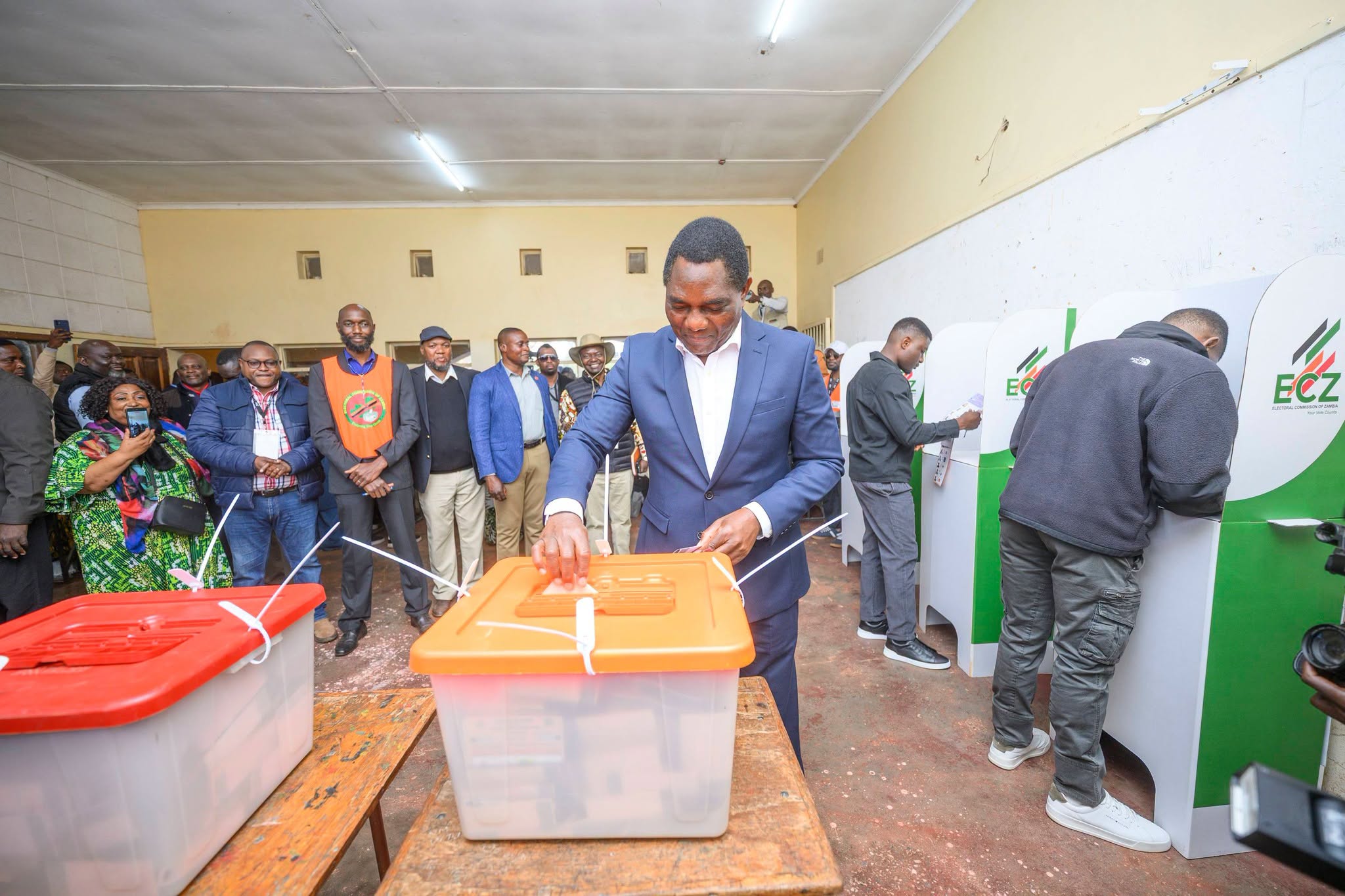
“What do Zambians want?”
We have been told that President Hakainde Hichilema has repeatedly asked this question within his inner circle ahead of the August 13 vote.
As partial results from the election emerge, perhaps it is a question the rest of us should be asking too.
What do Zambians want?
If Zambia’s choice were determined principally by political stability, order and the preservation of peace, Hichilema would have a compelling case for another term. Whatever criticisms can be made of his administration, Zambia today is markedly different from the country he inherited five years ago.
But the results of this election make one thing clear. Elections are not held to survey stability. They are expressions of frustration, identity, economic experience and expectations that governments have either met or failed to meet.
And the results emerging from this election appear to be reminding us of exactly that.
At parliamentary level, the prospect of a more competitive political landscape may be healthy for democracy. No government should operate without meaningful scrutiny. But voters must also ask what kind of opposition they are returning to Parliament.
Some familiar political figures are re-emerging. Their return may strengthen scrutiny of the executive, but it could also revive the confrontational politics that many Zambians had hoped the country was leaving behind.
That is democracy. Voters are entitled to make choices that those in government — or those of us observing politics — may not necessarily understand or agree with.
But those choices also tell us something.
Regional and ethnic voting patterns remain difficult to ignore in Zambian politics. Political allegiance has long intersected with geography, ethnicity and perceptions of inclusion. This election appears unlikely to have completely broken that pattern.
Hichilema himself cannot escape scrutiny on this question.
His government has repeatedly faced criticism over the regional composition of appointments to senior positions in the public service. Whether every allegation is justified or not, perceptions of exclusion matter politically. A President who wants to build a genuinely national coalition must ensure that government not only is inclusive, but is widely seen to be inclusive.
Still, Hichilema’s record deserves to be judged in context.
He inherited a heavily indebted country whose government had defaulted on its external debt in 2020. Public finances were under enormous pressure, relations with international lenders had deteriorated, and the political environment had become increasingly confrontational.
Party cadres had acquired extraordinary influence over public spaces and institutions, while political violence and intimidation had become disturbingly familiar features of Zambian politics.
Five years later, Hichilema’s government can point to significant achievements. Zambia has made substantial progress in restructuring its external debt and rebuilding relationships with international lenders and creditors. The political environment has also been comparatively calmer.
We have not seen political cadres exercising the same level of power over markets, bus stations and public spaces, nor the same scale of organised political violence associated with previous election cycles.
For a country that values peace deeply, that matters.
Indeed, for much of the campaign, the election was remarkably quiet. Many Zambians — ourselves included — wondered whether it would become a one-man show, with Hichilema facing a relatively straightforward path to re-election.
As the campaign progressed, what initially appeared predictable became increasingly competitive, with opposition candidates tapping into frustrations that macroeconomic statistics cannot easily capture.
And therein lies perhaps the biggest contradiction of Hichilema’s first term. Economic recovery on paper is not the same thing as recovery at the kitchen table.
For many ordinary Zambians, the economic gains cited by the government have not yet translated into noticeable improvements in everyday life. Experts may argue that economic recovery takes time to filter down to households, but ordinary Zambians are asking much simpler and more immediate questions: Can I afford food? Can I pay my rent? Can I find a job? Can I afford transport? Is my family actually better off than it was five years ago?
That gap — between what the economic indicators suggest and what people actually experience in their pockets — may prove to be one of the defining lessons of this election.
If Hichilema ultimately wins and secures another term, he should resist interpreting that victory as an endorsement of everything his government has done.
The results should instead provide a map of where his administration has fallen short.
One area demanding much greater attention is the Constituency Development Fund (CDF), arguably one of Hichilema’s administration’s most ambitious programmes. The dramatic expansion of CDF has moved unprecedented resources closer to communities and has the potential to transform local development. But MakanDay’s reporting over several years has also exposed a troubling side of the programme.
Our investigations have documented allegations of political favouritism in the allocation of grants, loans and bursaries, questionable procurement and project decisions, stalled or unfinished infrastructure, concerns over value for money, and weaknesses in oversight and accountability. In Mufulira, for example, our investigation found that just two driving schools received 542 of the 589 students selected for CDF-funded driving lessons, raising questions about how beneficiaries and service providers were selected. The institutions denied political affiliation.
Elsewhere, we found more than 200 CDF-sponsored students enrolled at a Ndola training institution that TEVETA said had been deregistered, while investigations in Solwezi found classrooms, clinics and market shelters that remained unfinished months — and in some cases years — after they were approved and financed. In Kapiri Mposhi, MakanDay reported allegations that residents were being asked for money or livestock to access boreholes already paid for through CDF.
These are not arguments against CDF. If anything, they demonstrate why the programme is too important to be allowed to fail. But despite the issues MakanDay has repeatedly exposed through its CDF Portal, we have seen little evidence of a systematic government response to the problems our reporting has identified.
If Hichilema secures another term, strengthening oversight of CDF should therefore be one of his priorities. The government must demonstrate that public money reaches the communities for which it is intended, that contracts and bursaries are awarded fairly, that projects deliver value for money, and that access to CDF opportunities is determined by need and merit rather than political connections.
If CDF is to remain a flagship programme, the government must demonstrate that access to its benefits is determined by community need rather than political connections.
Hichilema must also confront perceptions of tribalism and regional imbalance in public appointments. Zambia cannot credibly condemn ethnic politics among voters while appearing indifferent to concerns about ethnic or regional representation within government itself.
Perhaps that brings us back to the President’s question. What do Zambians want?
The answer may be more complicated than any election result can capture.
Zambians appear to want peace, but they also want prosperity they can feel.
They want economic stability, but they also want food they can afford. They want development, but they want to see it in their communities. They want democracy, but they also want political leaders who can disagree without dragging the country back into chaos.
And perhaps, above all, they want to believe that whichever part of Zambia they come from, government belongs to them too. That may be the most important message emerging from this election — not only for Hichilema, but for whoever seeks to govern Zambia next.
PHOTO CREDIT | Hakainde Hichilema’s Facebook Page


Discover more from MAKANDAY
Subscribe to get the latest posts sent to your email.


