

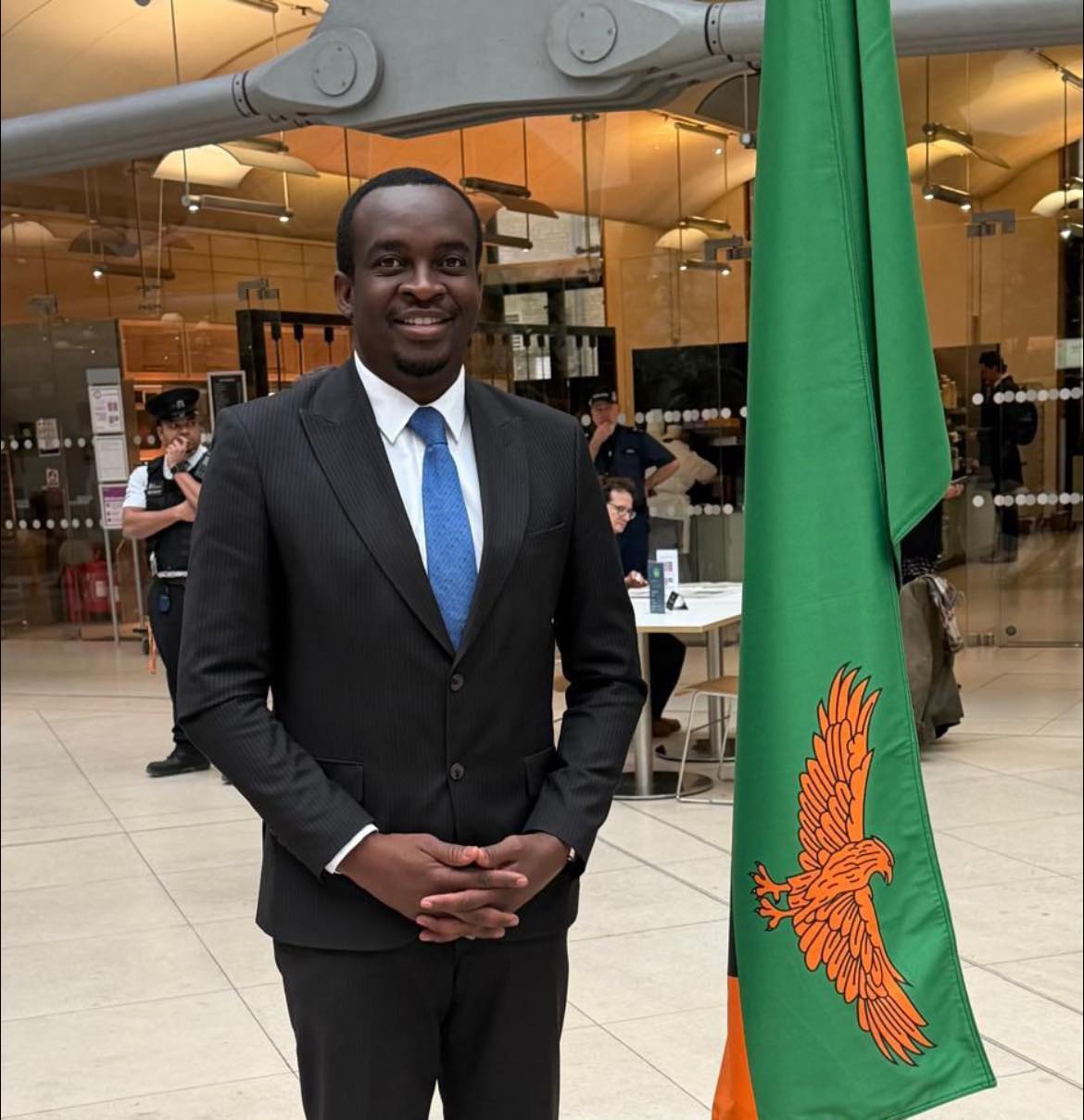
By Clara Chisenga
At 41, Christopher Kang’ombe is walking away from elective office at a time when many politicians are only beginning to consolidate their careers.
After more than two decades in public leadership — first as a councillor, then Mayor of Kitwe, and later Member of Parliament for Kamfinsa — Kang’ombe says he is stepping back from electoral politics to focus on mentorship, policy advocacy and what he describes as a larger role in shaping national conversations.
But while he is leaving Parliament, he insists he is not leaving politics.
“I don’t know if I can call it a break,” Kang’ombe said in an interview. “I think it is a transition into a different role that demands more community work and mentorship. But it is not the last time people are going to see Christopher participating in politics because politics affects people every day.”
His decision has attracted attention within political circles, particularly because he remains one of the former ruling Patriotic Front (PF)’s most recognisable young leaders and has often been viewed as a potential contender for higher office in the future.
Kang’ombe’s public service journey began more than 20 years ago when he was elected councillor for Riverside Ward in Kitwe while still a student at the Copperbelt University. He initially served as an independent before later joining the Patriotic Front (PF). He went on to serve as Mayor of Kitwe from 2016 to 2021 before winning the Kamfinsa parliamentary seat in the 2021 general elections.
“When you look at it holistically, I have been serving the community at different levels,” he said.
He says one of the key motivations behind his decision is a desire to spend more time helping young people prepare for leadership roles and higher education opportunities.
“In my work as Mayor and Member of Parliament, many young people would approach me with development proposals, empowerment ideas and business plans. I have realised there is a huge need for mentorship and guidance.”
Kang’ombe believes the knowledge he has accumulated through public service and academic studies can now be used differently.
Apart from engineering, he later pursued a Master’s Degree in Economic Policy and says he now feels equipped to contribute more through public lectures, policy analysis and leadership development programmes.
“I have reached a stage where I can offer advisory services on leadership, governance, economic policy and public administration. It is important to remain relevant and continue contributing to society.”
Looking Back at Kamfinsa
Reflecting on his tenure as MP, Kang’ombe says one of his proudest achievements was using Parliament as a platform to advocate for development projects in Kamfinsa Constituency.
He cited road infrastructure, water projects and youth empowerment programmes among the issues he consistently raised.
“I am proud of the opportunity I was given to serve. Every time there were concerns about water supply, sewer blockages, title deeds or infrastructure development, we raised those issues in Parliament.”
However, Kangombe believes many Zambians still misunderstand the role of an MP.
“The role of an MP is not to provide food at funerals. That is voluntary community work,” he said.
“The real responsibility of an MP is to make laws, approve the national budget and ensure resources are allocated towards development projects that benefit citizens.”
Lessons from the Opposition Benches
Having spent the last five years serving in opposition, Kang’ombe says preparation is one of the most important lessons he has learned.
According to him, elected leaders must understand their responsibilities regardless of whether they belong to the ruling party or the opposition.
“If you are a councillor, your responsibility is to ensure municipal services are working for the people. If you are an MP, your responsibility is to represent citizens and hold the government accountable.”
He encouraged aspiring parliamentarians to make greater use of research tools such as the Parliamentary Library and to actively participate in parliamentary debates.
“People want to see their MPs active in Parliament. Preparation is what allows you to contribute meaningfully.”
Kang’ombe also revealed that some motions he introduced were unsuccessful because of political divisions.
One example was his proposal advocating for a 24-hour economy.
“At the time, the motion was rejected. Today, government is promoting a 24-hour economy. These are conversations we could have started much earlier.”
He says Parliament should move towards evaluating ideas on merit rather than political affiliation.
“If a proposal is good, let it be considered. If it is bad, let people debate it intellectually.”
Parliamentary Independence
Kang’ombe believes one of the challenges facing Zambia’s legislature is the political nature of its leadership structure.
“The Speaker is produced by the political party that forms government. That reality naturally creates perceptions of bias,” he said.
He challenged students and researchers to examine how other democracies organise their legislative institutions and whether alternative models could strengthen parliamentary independence.
At the same time, he stressed that fairness ultimately depends on individuals understanding and respecting their responsibilities.
The Future of the PF
Kangombe says the difficulties currently facing the PF were largely predictable.
According to him, internal disputes and competing claims to leadership weakened the former ruling party and reduced its ability to function as an effective opposition force.
“The warning signs were there long ago,” he said.
“Court case after court case weakened the party and eventually affected its ability to participate effectively in the political process.”
He believes the PF’s internal divisions significantly damaged its prospects ahead of the 2026 general elections.
Political Alliances
On opposition alliances, Kang’ombe says cooperation between political parties can be beneficial if it is built on shared values and policy positions.
“What is the common agenda? What are the shared positions on agriculture, mining, education or governance?” he asked.
“Political alliances should be based on ideas and policies, not simply on winning elections.”
Looking Ahead
Despite stepping away from elective politics, Kang’ombe insists he is not retiring from public life.
In fact, he hinted that his political journey may not be over.
“The remaining position in public service is obviously the Presidency,” he said.
“But you do not simply wake up and contest for the Presidency. You plan, reflect and organise before presenting yourself to the people.”
While declining to elaborate further, Kangombe suggested that his current transition should not be interpreted as political withdrawal.
Instead, he says he is preparing for a larger role in shaping national conversations around governance, economic development and leadership.
The Future of Zambia
Looking ahead, Kangombe believes Zambia’s democracy must evolve towards issue-based politics and stronger institutions.
“We need political parties founded on principles and ideas, not simply on the desire to acquire power,” he said.
He also called for reforms in areas such as land ownership, healthcare access and economic participation.
Particular emphasis, he said, should be placed on ensuring ordinary citizens benefit more directly from sectors such as mining, agriculture and energy.
“We need to ask ourselves how Zambians can own the economy,” he said.
“Economic growth must translate into greater participation by citizens.”
Advice To Young People
For young people aspiring to enter politics, Kang’ombe’s message is simple: participate.
“Whether you win or lose, history will show that you offered yourself for public service,” he said.
He believes leadership is developed through experience and encourages young people not to be discouraged by limited resources or early setbacks.
“I was not the same leader 20 years ago. Leadership is something you learn at every stage.”
As he prepares for life outside Parliament, Kang’ombe says he hopes people will remember him as someone who rose from Ndeke Township in Kitwe and dedicated much of his life to serving the people of Kamfinsa.
And although his parliamentary chapter may be ending, he insists his contribution to public life is far from over.
Additional reporting by Kennedy Mbewe Jnr
Clara Chisenga is a journalist from Radio Icengelo in Kitwe. She is currently undertaking a three-month internship at MakanDay after earning third place in the 2025 MakanDay Awards for Investigative Journalism.


Discover more from MAKANDAY
Subscribe to get the latest posts sent to your email.


