

By Ennety Munshya
Zambia has committed itself to providing inclusive education for learners with disabilities. But government statistics and international assessments reveal continuing gaps in the specialised classrooms, trained teachers and learning materials needed to make that commitment a reality.
According to the Ministry of Education’s 2025 Education Statistics Bulletin, Zambia had 124 permanent special education classrooms at secondary school level, compared with 409 at primary school level.
The distribution was uneven. Lusaka Province accounted for 49 permanent special education classrooms at secondary level, while Central, Muchinga and North-Western provinces had none recorded.
These figures do not show how many schools have teachers trained in Braille or whether learners with visual impairments have access to the specialised learning materials they need.
The ministry also acknowledged broader challenges affecting education quality, including inadequate teacher training, insufficient teaching materials and funding constraints.
For learners with disabilities, the consequences can be significant.
In the first part of this investigation, MakanDay reported on 25-year-old Chilombo Chama, a grade 12 learner with a visual impairment who hopes to become a neurosurgeon.
His father says Chilombo struggled for years to access consistent specialised teaching support. Although additional teachers were assigned in 2026, his family says the assistance came too late to prepare him for his final examinations.
His experience raises questions about whether Zambia’s commitment to inclusive education is translating into practical support for learners.
Where are the specialist teachers?
The Ministry of Education says it is working to strengthen inclusive education through teacher training, the development of learning materials and the provision of resources to schools.
Dr Mwenya Nicholas Mwamba, the ministry’s Assistant Director for Specialised Services, said Braille and sign-language syllabi had been prepared for use in mainstream and special education schools.
He put the number of teachers qualified to teach learners with special educational needs and disabilities at 3,700.
However, Dr Mwamba acknowledged that finding teachers with both specialised education training and the appropriate subject qualifications remained a challenge.
“If you want a teacher for maths and has done education for the visually impaired the numbers begin to drop same applies with science subjects. That is where the challenge is,” he said.
The distinction is significant.
A teacher may have training in special education without being qualified to teach a subject such as mathematics or science. Equally, a subject teacher may lack the skills needed to teach a learner who uses braille.
The ministry’s figure of 3,700 qualified teachers does not establish how many have both sets of skills or how they are distributed among schools.
Dr Mwamba said the Zambia Institute of Special Education had been training teachers to support learners with visual impairments alongside another teaching subject.
He said changes to teacher-training programmes were also expected to increase the number of teachers with relevant specialisations.
A retired teacher with 37 years of teaching experience, who requested anonymity, questioned whether placing learners with disabilities in mainstream classrooms without adequate support amounted to meaningful inclusion.
“Their needs are different from their friends. You cannot place them in one classroom and call it inclusive learning,” the teacher said.
The concern is not that learners with disabilities should be separated from their peers, but that schools need the appropriate teachers, materials and teaching methods to accommodate different learning needs.
Shortages of learning materials and assistive technology
The challenges extend beyond the availability of trained teachers.
A 2018 UNICEF-funded study conducted by the University of Zambia in collaboration with SINTEF, a Norwegian research organisation, documented shortages of Braille textbooks, Braille paper and computers for learners with visual impairments.
The study also identified inadequate training and support for mainstream teachers working with learners with disabilities.
Charles Cheelo, a disability rights advocate associated with the Kabwe Network of Organisations for Persons with Disabilities, says shortages of Braille books and accessible learning materials can leave students dependent on sighted classmates to complete assignments.
“When a student has to rely on another person to transcribe written work, their opportunity to complete academic tasks independently is limited,” he said.
Cheelo says braille paper is particularly expensive.
“Braille paper is another challenge, it is very expensive. A ream of braille paper can be as expensive as K500,” he said.
He also highlights the amount of paper required to complete assignments in braille.
“If I give a student with visual impairment to write an assignment up to 7 pages, in braille that seven pages will translate into 30 to 40 pages. Where are they going to get the Braille paper from?” he asked.
Cheelo says students may receive braille paper for examinations but still have to find their own supplies for assignments.
He believes learners with visual impairments should also receive training in computer use and assistive technology to help them access information more independently.
Such technologies include screen readers, which read digital text aloud, and other audio-based learning tools.
A 2022 assessment conducted by the Zambian government, UNICEF Zambia and the Clinton Health Access Initiative found that 73.2% of respondents who needed an assistive device had not received one.
Although the assessment covered a wider population rather than learners with visual impairments alone, its findings highlight broader barriers to accessing assistive technology in Zambia.
Different disabilities, similar barriers
The difficulties are not limited to learners with visual impairments.
Ruth Daka, a learner with a hearing impairment, says she has sometimes had to interpret for fellow learners because teachers lacked the sign-language skills needed to communicate with them effectively.
Her experience reflects concerns raised by the United Nations Committee on the Rights of Persons with Disabilities.
In findings issued in April 2024, the committee identified barriers to inclusive education in Zambia, including shortages of trained teachers, accessible learning materials and assistive devices.
It recommended improved teacher training in Braille and sign language, alongside greater access to assistive technology.
More than two years later, the experiences of learners such as Ruth and Chilombo raise questions about how effectively those recommendations have been implemented.
What is the government doing?
The Ministry of Education says it is taking steps to address some of the barriers.
Dr Mwamba acknowledged gaps in the availability of assistive devices and learning technologies, describing their distribution as a major challenge to inclusive education.
He said the government was seeking to procure assistive devices, textbooks and other learning technologies centrally for distribution to schools that needed them.’
He also cited special education grants to schools as part of the government’s response to the UN committee’s recommendations.
Dr Mwamba said teachers in Kabwe and Chibombo districts had received inclusive education training under the Realising Inclusive and Safe Education (RISE) Project.
The training, he said, included early identification, screening and assessment to help teachers recognise learners who may be experiencing difficulties and identify barriers to learning.
According to Dr Mwamba, these assessments are conducted at school level, with schools able to request additional specialised expertise where necessary.
However, the number of Braille-trained teachers deployed to individual schools and the extent to which learners have received the required equipment remain important questions.
A right promised, but is it being delivered?
Zambia’s Persons with Disabilities Act No. 6 of 2012 provides a legal framework for protecting the rights of persons with disabilities, including their right to education.
Section 23 addresses special education facilities and equipment in educational institutions, while other provisions deal with access to education for children with disabilities.
Yet research findings and the experiences of learners with disabilities raise questions about how these legal protections are being translated into practical support in schools.
The Ministry of Education acknowledges that shortages remain, particularly among teachers with both specialised education training and the qualifications needed to teach specific subjects.
The ministry also recognises gaps in the availability of assistive devices and learning technologies.
For learners with disabilities, the challenge is not simply gaining admission to school but receiving the support needed to participate meaningfully and complete their education.
The government’s commitments and planned interventions provide a framework for improvement.
But without clear information on where qualified teachers are deployed, which schools have accessible learning materials and how many learners receive the assistance they need, it remains difficult to assess the reach of those interventions.
For learners such as Chilombo, the consequences of delayed support can be measured in missed lessons, additional family expenses and postponed examinations.
The question for Zambia’s education authorities is whether the measures being introduced will reach learners early enough to prevent others from experiencing similar setbacks.
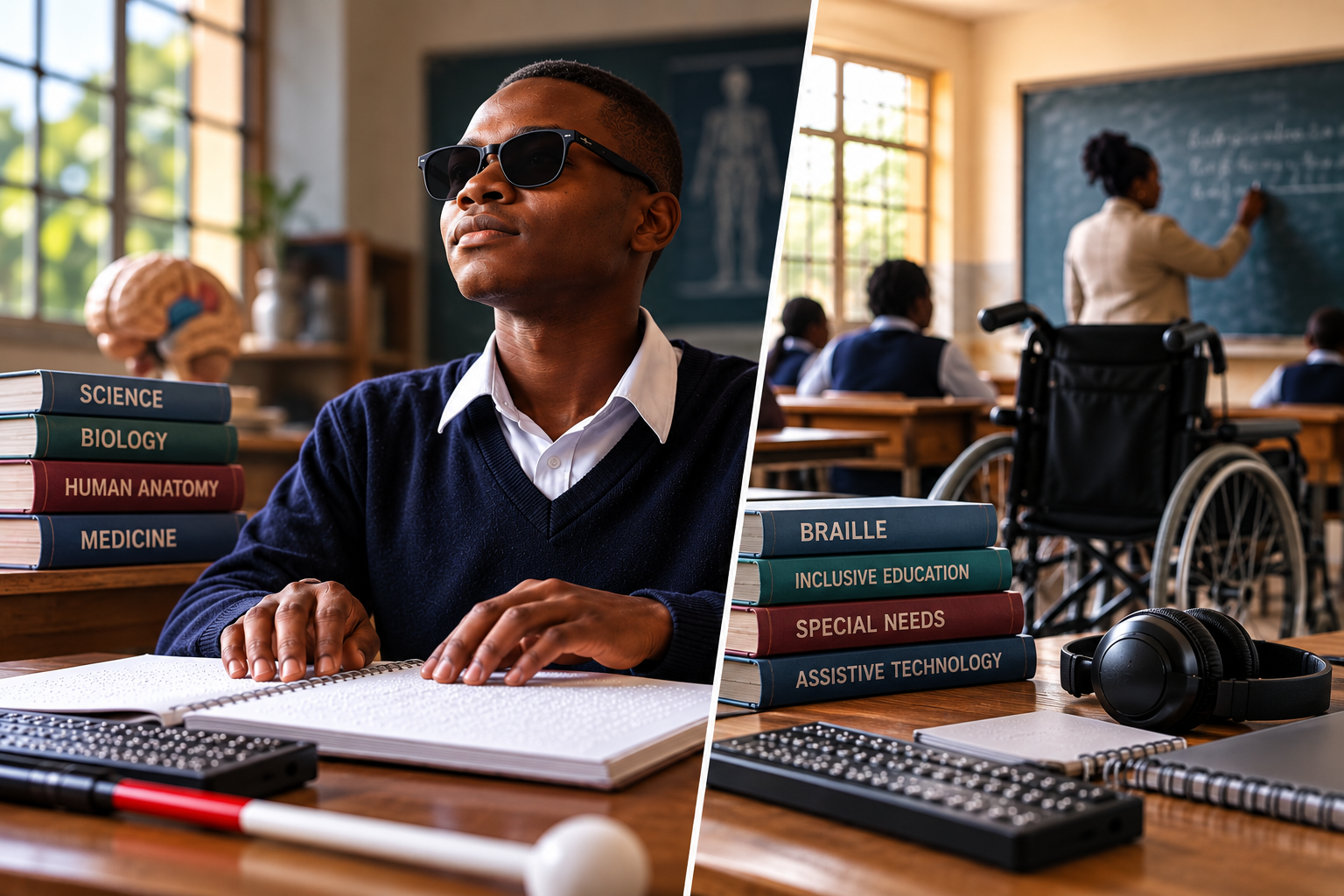
Editorial note: AI-generated illustration. The person depicted is not Chilombo Chama.


Discover more from MAKANDAY
Subscribe to get the latest posts sent to your email.


