

By Ennety Munshya
At 25, Chilombo Chama is still in grade 12, determined to fulfil his childhood dream of becoming a neurosurgeon. But his journey through school has been marked by inconsistent access to teachers trained to support learners with visual impairments.
He now expects to sit his final examinations in 2027, a year later than planned, after his family says the specialised teaching support he needed arrived too late to prepare him for this year’s examinations.
“Sometimes I would learn and sometimes I would not learn because the teachers were not available. Because of the lack of teachers all the time I would delay in my school work. But now that I have been given a teacher learning is serious,” he said.
Chilombo lost his sight in May 2007, while in grade one, following an illness that led to surgery to remove a brain tumour at the University Teaching Hospital (UTH) in Lusaka.
According to his father, Fredrick Chilombo Chama, Chilombo spent approximately two to three years out of school after losing his sight.
It was during his treatment that Chilombo developed the ambition to become a neurosurgeon, inspired by the doctors who operated on him.
“I want to be a neurosurgeon. When I went to UTH, I asked the doctor who was operating on me about his work. He was a neurosurgeon, and he inspired me,” Chilombo said.
His father recalls how the experience shaped his son’s ambition.
“My son got encouraged by the team of doctors led by Dr (Laston) Chikoya at UTH that operated on him. From that time, he has always said that he wants to be a neurosurgeon,” he said.
Chilombo hopes to study medicine in the United States before returning to Zambia to help patients, just as the doctors who treated him helped him.
But his father says the education system has not consistently provided the specialised support his son needs to pursue that dream.
When specialised support became harder to access
Although Chilombo received specialised attention in primary school, the situation changed when he entered grade eight.
His secondary school had no dedicated special education unit, leaving him in mainstream classes without consistent access to teachers trained to support learners with visual impairments.
His father says he has had to arrange private lessons, buy braille equipment and help his son with schoolwork.
In August 2026, the District Education Board Secretary’s office assigned a teacher to assist Chilombo with braille and English.
By late September, his father said he was still waiting for support in other subjects. MakanDay later received information that additional teachers had been assigned.
But his father says the assistance came too late to adequately prepare Chilombo for the 2026 grade 12 examinations.
According to Mr Chama, the newly assigned teachers recommended that Chilombo sit the examinations in 2027 instead.
He also says he discovered that his son had not been registered for the 2026 examinations.
The family has faced difficulties securing appropriate examination support in the past.
When Chilombo sat his grade nine examinations, his father says, another person read the questions aloud, recorded his responses and entered the answers on his behalf.
His newly assigned teachers have reportedly recommended that the family purchase a Dictaphone (voice recorder) to assist him during his Grade 12 examinations.
For Chilombo, the difficulties have made the journey through secondary school longer than he had hoped.
The financial burden on his family
The shortage of specialised teaching support has also placed a financial burden on Chilombo’s family.
His father says he bought a Braille slate through Alibaba, an online marketplace, for approximately US$25 (about K500 at the time). He estimates that the family has spent close to K6,000 on Braille equipment and learning materials.
Private tuition costs another K800 a month, while transport to and from school costs approximately K40 a day.
When he cannot accompany Chilombo on public transport, the family sometimes pays about K100 for a taxi.
For Mr Chama, these are additional expenses incurred to help his son participate in education.
The challenges facing learners with visual impairments have been documented for years.
A 2018 UNICEF-funded study conducted by the University of Zambia in collaboration with SINTEF, a Norwegian research organisation, documented shortages of Braille textbooks, Braille paper and computers for learners with visual impairments.
The study also identified inadequate training and support for mainstream teachers working with learners with disabilities.
For Chilombo’s family, however, the immediate concern is ensuring that he receives the teaching and learning materials he needs to complete Grade 12.
The ministry’s response
The Ministry of Education acknowledges that finding teachers with both specialised education training and qualifications in particular subjects remains a challenge.
Dr Mwenya Nicholas Mwamba, the ministry’s Assistant Director for Specialised Services, said Zambia had approximately 3,700 teachers qualified to teach learners with special educational needs and disabilities.
However, he acknowledged that the number becomes smaller when schools require teachers who have both specialised training and qualifications in subjects such as mathematics and science.
“If you want a teacher for maths and has done education for the visually impaired the numbers begin to drop same applies with science subjects. That is where the challenge is,” he said.
Dr Mwamba said the ministry was working to strengthen specialised teacher training and improve the availability of assistive devices and learning materials.
He also said schools could request specialised expertise when they were unable to meet a learner’s needs.
Referring to Chilombo’s situation, Dr Mwamba suggested that alternative schooling arrangements could have been considered.
“If the school failed to attend to this learner, they would have even sent him to Mumbwa Secondary School,” he said.
The ministry’s response highlights the challenge of ensuring that qualified teachers are available in the schools where learners need them.
For Chilombo, the additional support has now arrived. His family’s concern is that it came too late for him to complete his secondary education as planned.
A dream delayed
Nearly two decades after undergoing surgery to remove a brain tumour, Chilombo still dreams of becoming a neurosurgeon.
But before he can pursue that ambition, he must first complete grade 12.
His family says the specialised support he needed was not consistently available during his secondary education. Although additional teachers have now been assigned, his father believes the intervention came too late for him to sit the 2026 examinations.
Chilombo hopes to sit his final examinations in 2027.
His experience raises a wider question: how many other learners with disabilities are falling behind while waiting for the specialised support they need?

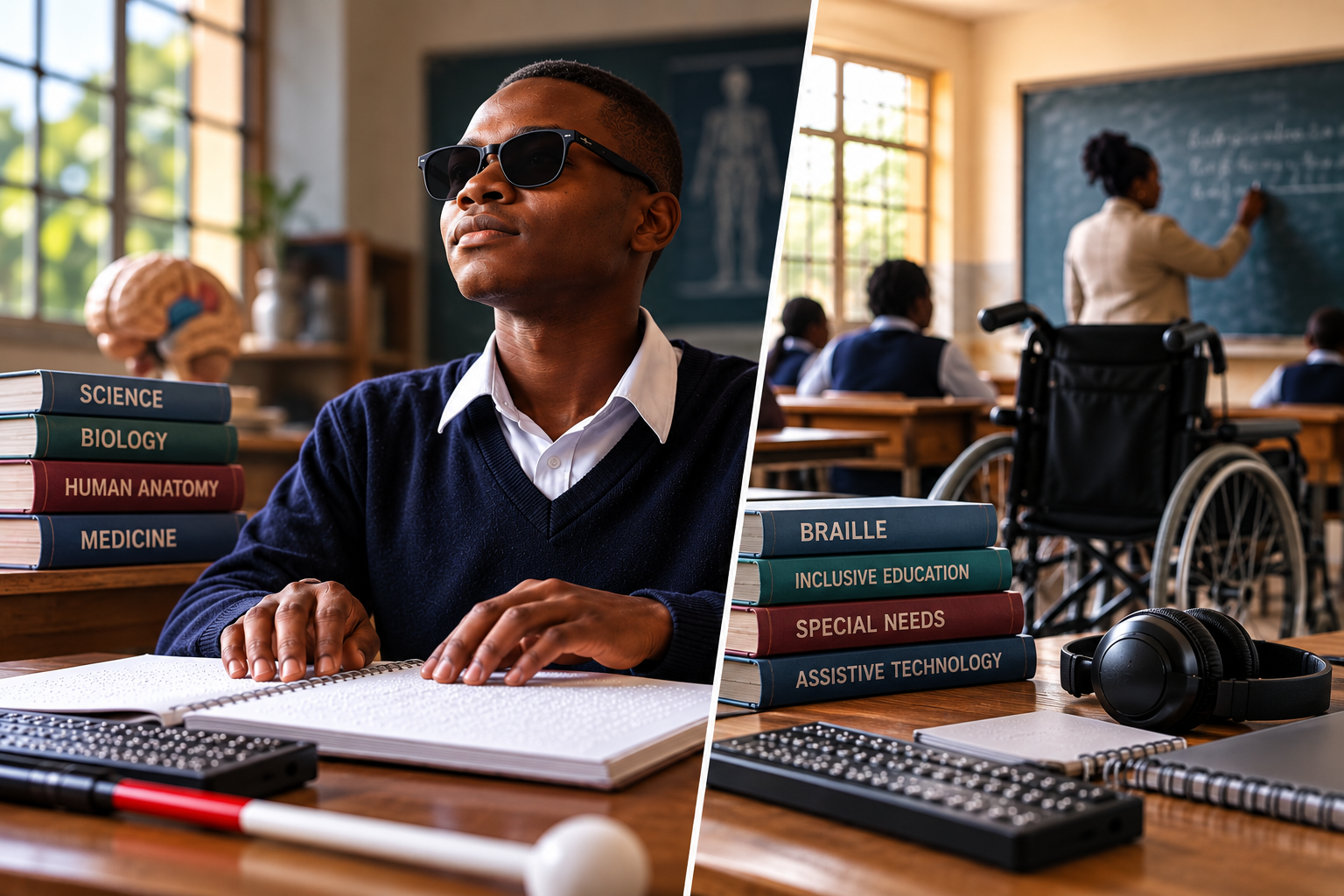
Editorial note: AI-generated illustration. The person depicted is not Chilombo Chama.
In Part 2, MakanDay examines government statistics, research findings and Zambia’s commitments to inclusive education to establish why learners with disabilities continue to face barriers in classrooms.


Discover more from MAKANDAY
Subscribe to get the latest posts sent to your email.


