


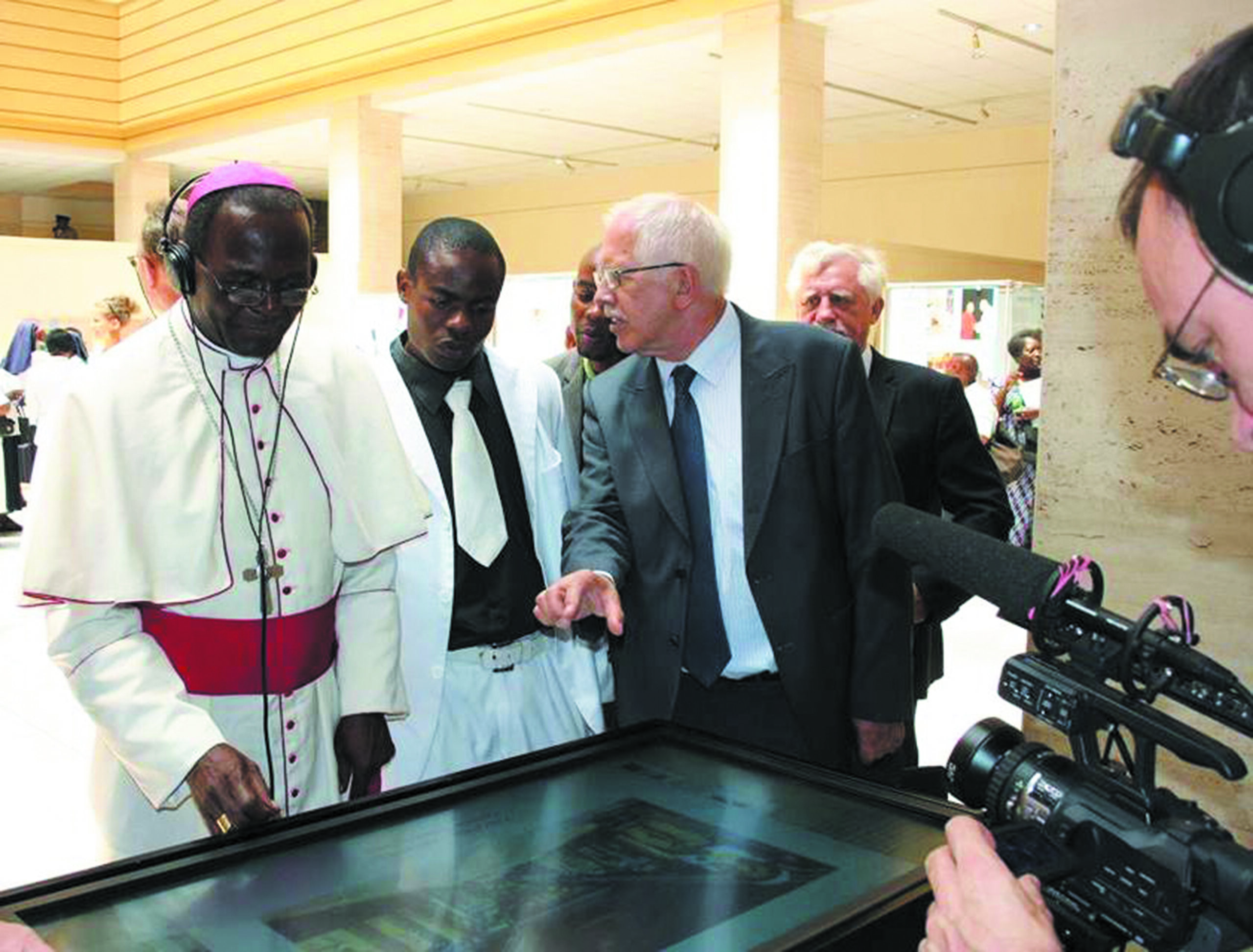
When prayer became a matter of state
This week, we return to November 2015, when Zambia was debating an unusual intervention in the country’s economic and political troubles: a presidential call for a national day of prayer and fasting.
Then-President Edgar Lungu had declared October 18 a day of national prayer and fasting in response to the social and economic challenges facing the country. The declaration drew support from some church leaders, but it also triggered a wider debate about where religion ends and the responsibility of government begins.
Among the strongest voices in that debate was Archbishop Telesphore Mpundu, then president of the Zambia Episcopal Conference, who argued that prayer could not substitute for practical solutions to the country’s economic problems. University lecturer Phineas Bbaala and satirist Roy Clarke, writing as Kalaki, raised similar questions from different perspectives.
More than a decade later, both President Lungu and Archbishop Mpundu have died. But the questions at the heart of this November 2015 Bulletin & Record story remain strikingly familiar: What place should religion occupy in public affairs, and when a country faces economic problems, where should prayer end and policy begin?
As Archbishop Mpundu put it at the time, in a memorable analogy: “You pray first and foremost, then you go to UTH.”
‘You pray first and foremost, then you go to UTH’
By Charles Mafa
God has was kept busy in Zambia last month, since President Lungu declared 18 October a day of prayer and fasting. By issuing this religious decision, the president moved from a secular to a spiritual leader, and the podium of the House of Representatives from whence his statement was issued, became a pulpit.
Politics and religion do mix occasionally, sometimes uneasily. University lecturer and political analyst, Phineas Bbaala, pointed out that “religion is not just about praying, preaching or fasting. The major objective of religion is to transform our behaviour.”
Prior to the prayers, the late Dr Roland Msiska, then Secretary to the Cabinet, ordered the suspension of all public forms of entertainment “during the period when Zambians dedicate the day as a solemn fast in response to the social and economic challenges.”
The Council of Churches in Zambia (CCZ) backed the day of prayer through a pastoral letter issued by its president, Rev. Alfred Kalembo. He, however, cautioned against the continued antagonism of citizens by the state if the day of prayer was to bear fruit.
Said Mr Bbaala: “People should exercise the freedom of worship. I should be free to believe in something or not to believe….praying is the lazy man’s first choice, isn’t it? It is easier to turn to God when things are bad. But when things are okay, usually people don’t care about God.”
Satirist Roy Clarke, who writes under the pseudonym Kalaki, asked on social media, “Did we elect Lungu as president to lead the government or to lead the nation in prayer? Don’t we have archbishops for that?”
And said Archbishop Telesphore Mpundu, president of the Zambia Episcopal Conference: “We don’t receive orders from the president on when we should pray or not pray. It is okay for the president to say look, we need some prayers. We’re asking our churches to pray for us. We can get organised ourselves. But not to tell us that this is the time for you to fast. No. Only the Pope has that authority. We do not take kindly instructions of that kind because in that rhythm, it is us who are the masters. We’re doing something but in our own way.”
Phineas Bbaala found it “quite strange that we should rush into prayer before we can take any meaningful action to try and resolve our national problems”. What the country is going through was “created by man and can only be solved by man”.
He continued: “It is only a fool who thinks that come 19th October then all the problems the country is facing will be a thing of the past. That is foolishness. I’m not trying to be a prophet of doom but I stand to be challenged if, after 19th October, the kwacha will have tremendously gained because of prayer; mealie meal prices would have come down because of prayer; if the demand for copper would have gone up because of prayer, if by-elections would have come to an end because of prayer,” he said.
The Archbishop says the government is contending with an economic problem which needs an economic solution. “The problems that we have, we take them to God but that does not absorb us from using our God-given intelligence to tackle this problem. We can’t just wait and say God is going to solve the problems for us.”
Catholic Bishops have in the past denounced poor management of public resources, by-elections motivated by greed, political violence, unequal distribution of resources and high youth unemployment. There are some critics now who think the Church has “gone to sleep because they have eaten too much from government”.
Said Archbishop Mpundu: “People have a right to go and vote and no one has the right to tell them what political party to vote for. It is not true when you say the church has been too silent because it has eaten too much. These are careless statements, which are coming from people who do not know where they are because they don’t know where we come from. You want to know the present, study the past. We were the only voice. We wanted people to have a voice, now they have a voice, but they’re still waiting for us to speak.
He said that if he told people to vote out President Lungu next year because his performance has not been good, they “will tell me go to heaven. Christians don’t have to listen to me. It is a political issue,” says the Archbishop.“Even if I say vote for UPND or MMD to come back, the fact of saying that President Lungu has failed now, I am saying vote for someone else. Now, this is being partisan. I am not partisan and the Catholic Church is not partisan.”
Mr Bbaala points out that philosopher Karl Marx said religion is the opiate of the masses. Faith is serious but it is trivialised when it’s toted too readily and stridently into the political arena. “Those in leadership have tried to use religion in order to perpetuate their stay in power and actually to oppress their followers without the followers noticing.”
Despite the influence the Catholic Church has in the country with its more than 3.5 million followers, Archbishop Mpundu says “We have never sat as a conference to assess the performance of one particular leader. What we can say is that the people of Zambia put them where they are. Not me. It is up to the people of Zambia to assess them.
“We in the Catholic Church are so proud of the diversity of political opinions in our country. That is how it should be. So, anyone who stands up and says go and vote for this, especially from the pulpit is wrong. The people have a right to reject him. We’re there to pass moral judgment on the performance of any institution – whether it is government or not. We say look, the performance can be judged from the results. We’re not going anywhere, this institution is just wasting people’s time. It is not putting value to people’s lives.
The belief that an appeal to faith has a calming influence on the public is working in Zambia. But the leadership of the Catholic Church has repeatedly opposed the declaration of Zambia as Christian nation. “I am telling you… I still tell you, I’m very contemptuous of those people who say Zambia is a Christian nation. So, Christianity is now a state religion? No. It’s not. We want Zambia to be a secular state. Secular state doesn’t mean it is devoid of religious values. It is. But whether anyone belongs to a religion or not to any religion at all as a Zambian, they’re welcome.”
Roy Clarke’s alter ego Kalaki followed up with another posting: “Rather than calling for national prayers for economic recovery, Lungu might instead consider appointing a competent Minister of Finance.” That view is echoed by UNZA’s Mr Bbaala, who believes the head of state should have called for a national indaba, which would be more productive than this event where people will be praying and fasting. In Africa, we have a unique way of solving problems. Even in the villages, when there is a problem, people come together to consult one another and come up with a solution.”
As for Archbishop Mpundu: “This is a national (economic) issue. It is above partisan politics. How do we get out of this quagmire? Those who are in administration, they should take the lead to do that. You’re suffering from a disease which is communicable: you pray first, yes, but first and foremost go to the UTH.”

Discover more from MAKANDAY
Subscribe to get the latest posts sent to your email.