

By Gibson Zulu
For communities in Mutama Bweengwa in Chief Hamaundu’s area in Pemba district – Southern Province, the struggle is no longer just about finding water. It is also about protecting the structures built to conserve it.
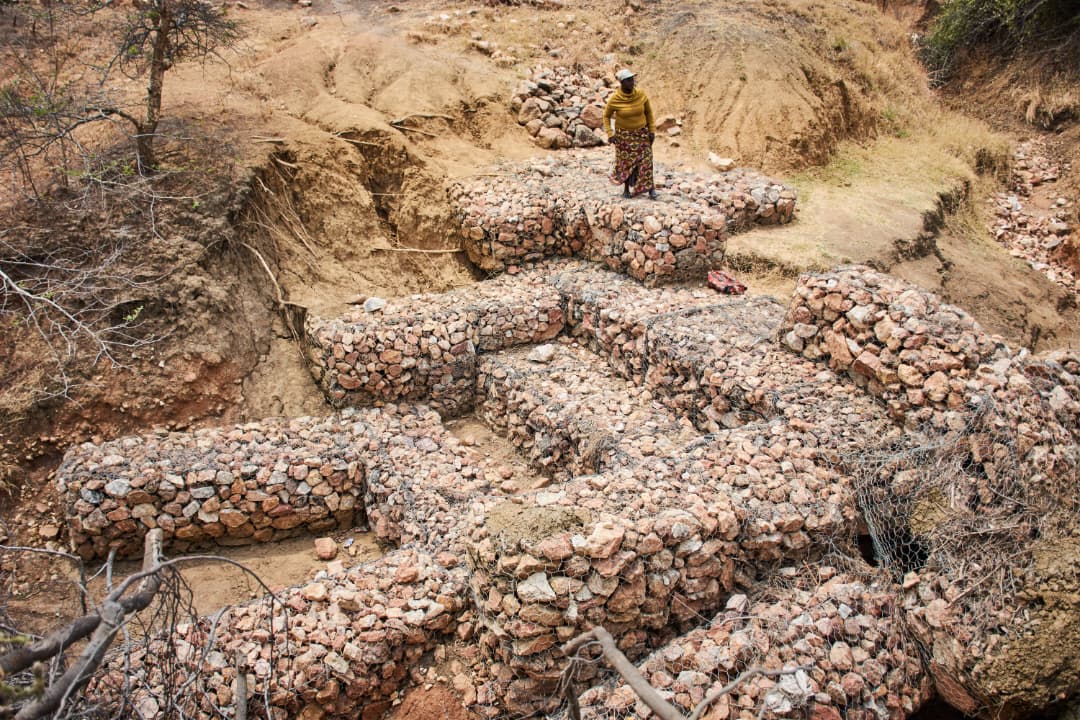
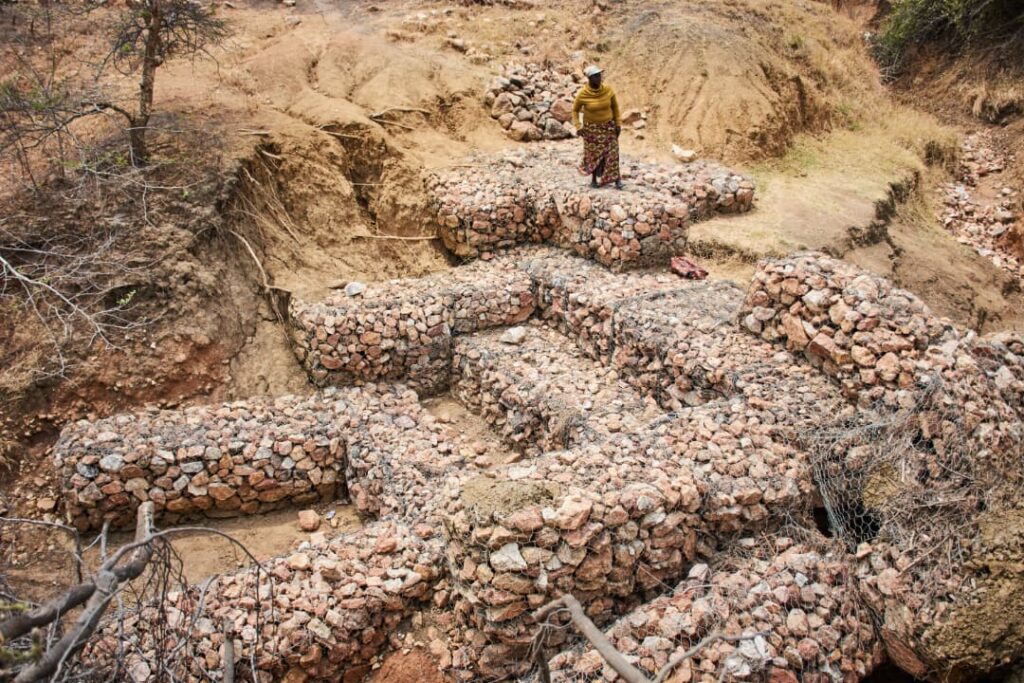
Thousands of soil bunds, trenches and check dams were constructed under a multimillion-euro donor-funded project to slow rainwater runoff, prevent soil erosion and help replenish underground water sources.
But years after the work began, some of these structures are deteriorating, and the communities that helped build them say they lack the resources to maintain them.
Coswell Hatuleke, a project supervisor with the local Water Users Association, says no rehabilitation work has been carried out on the structures since 2022.
“The water-holding capacity is now very low,” he told MakanDay.
His concern reflects a wider challenge facing communities that benefited from the €17.2 million Accelerate Water and Agricultural Resources Efficiency in Zambia (AWARE 1.0) project: what happens when donor support ends, but the need to maintain the investments remains?
Thousands of trees planted, hundreds survive

Soil bands
In Mutama Bweengwa, the AWARE project supported the construction of about 3,500 soil bunds, trenches and two 55-metre-long check dams to capture runoff and allow water to seep into the ground.
The community also planted approximately 7,860 trees to restore vegetation and protect the environment, alongside star grass to stabilise the soil and prevent erosion.
But according to Hatuleke, only about 500 trees survived.
Some were destroyed by floods, while others failed to adapt to local conditions. Livestock also damaged some of the surviving trees.
“Some trees were lost during floods, while others supplied by the Forestry Department failed to adapt to the local conditions,” he said.
Despite these setbacks, residents say the interventions have made a huge difference.
One community member who participated in the project told MakanDay that improved water retention had helped farmers access water for gardening and supported livestock grazing during the dry season.
The resident said no borehole in the area had dried up since the interventions were introduced.
However, the same resident expressed concern that one of the check dams was beginning to collapse in places because of soil erosion, unstable soil and heavy rainfall.
Without regular maintenance, the community fears that some of the improvements could be lost.
For Hatuleke, the immediate challenge is finding the labour, materials and financial support needed to rehabilitate the structures before further damage occurs.
When a project ends, who takes responsibility?
Mutama Bweengwa was among the communities that benefited from AWARE 1.0, which ran from 2019 to 2023.
The project was funded by the European Union, which contributed €13.5 million, and Germany’s Federal Ministry for Economic Cooperation and Development (BMZ), which provided €3.7 million.
Implemented in the Lower Kafue sub-catchment across Southern and Central provinces, the programme supported water conservation, agricultural advisory services, farmer training and the rehabilitation of small-scale water infrastructure.
According to Anke Peine-Ellis, Water and Energy Cluster Coordinator at the German development agency GIZ (Deutsche Gesellschaft für Internationale Zusammenarbeit) in Zambia, the project initially planned eight pilot sites for nature-based solutions before expanding to 16, eight of them in Southern Province.

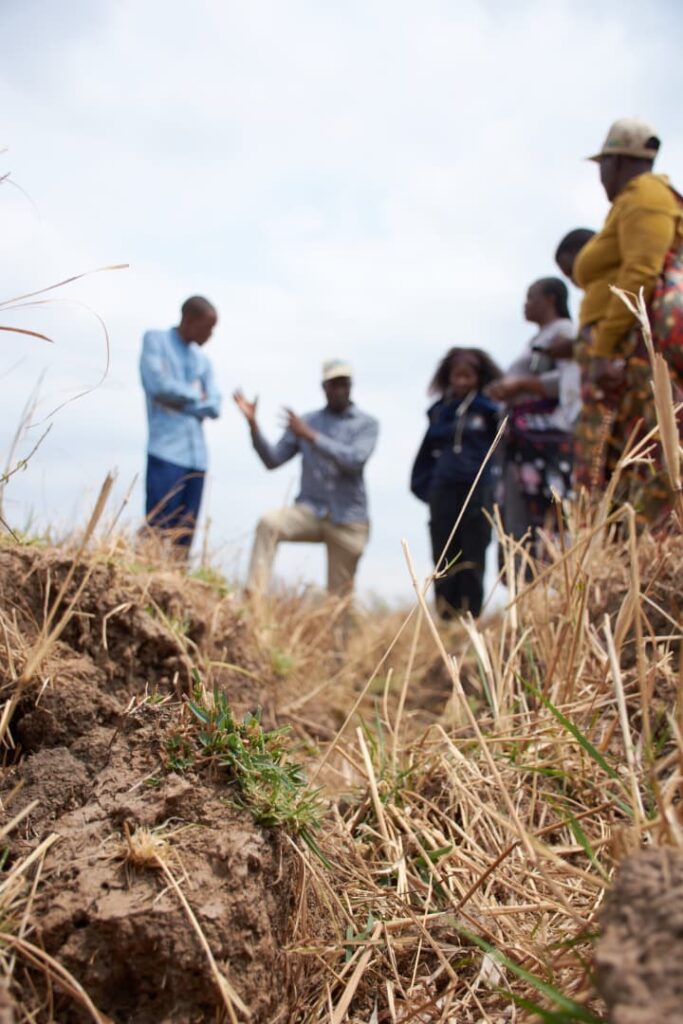
Participating community members initially received payments through a Cash for Work arrangement. This was later replaced by non-monetary compensation, including agricultural inputs and bicycles.
“Payments to participating community members and the provision of inputs were handled directly by the project,” Peine-Ellis said.
But the transition from donor-supported implementation to community responsibility has exposed a difficult question.
While residents may have the knowledge and willingness to maintain the interventions, do they have the resources?
At Mutama Bweengwa, Hatuleke believes Government and local authorities should consider using Cash for Work and other support mechanisms to help communities rehabilitate the damaged structures.
Another community source said that although residents were encouraged to take ownership of the interventions, they often lacked the money and materials required to sustain them.
In Sibuchinga, the lessons remain, but resources are scarce
The experience is similar in Sibuchinga, where residents also participated in tree planting and the construction of soil bunds, trenches and half-moon structures to conserve water.
Mr. Monde
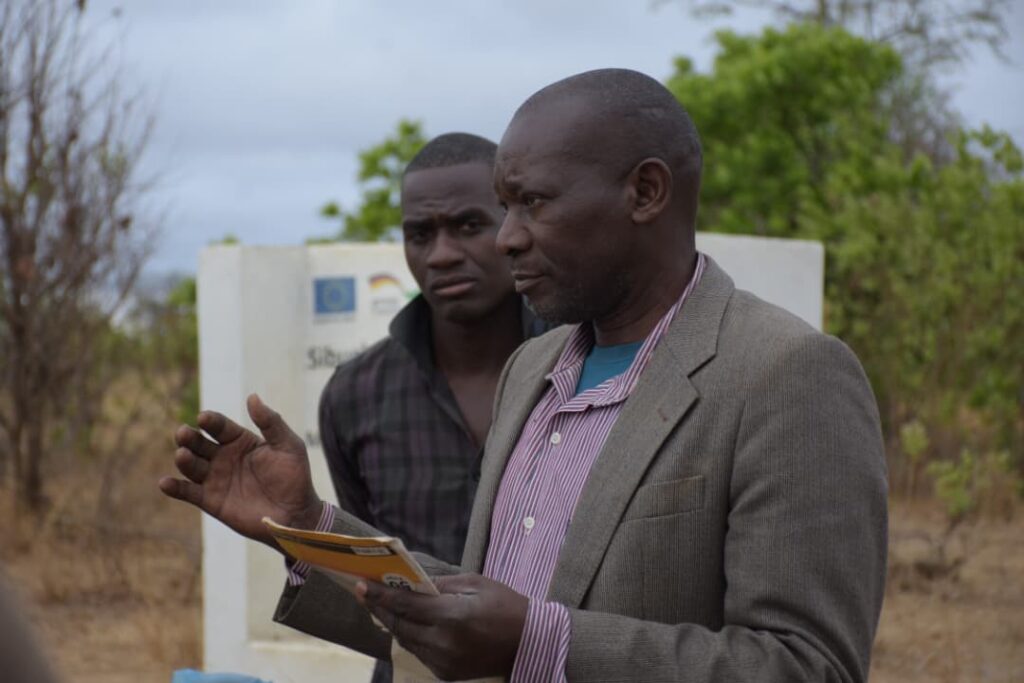
Charles Monde, a Water Users Association project supervisor, recalls how the initiative started with just 20 community members mobilised through the Forestry Department.
Participation eventually grew to 83 people, including supervisors, team leaders and field workers.
The community set out to plant 14,000 trees but managed approximately 9,000. Drought proved to be one of the biggest obstacles.
“We tried watering some of the seedlings using a borehole, but they still did not survive,” Monde said.
Nevertheless, he believes the interventions have improved local conditions.
He said groundwater levels, vegetation and grazing conditions had improved, making water more accessible to residents.
The structures also helped prevent a gully from extending into agricultural fields by intercepting rainwater runoff.
Importantly, residents have continued applying what they learnt.
In areas previously affected by flowing water, community members have constructed contour ridges to reduce erosion and protect their fields.
But some work remains unfinished.
The community has identified a site for a check dam and gathered stones for its construction. GIZ has also supplied gabion wire, a material used to hold stones together in erosion-control structures.
What is missing, according to Monde, is the support needed to complete the work.
He said residents were ready to proceed if Government Cash for Work or other assistance became available.
The situation illustrates how community commitment alone may not be enough to complete and sustain conservation projects.
Mbabala offers another approach
In Mbabala Ward in Choma, residents have taken a different route, using knowledge acquired through donor-supported training to develop their own conservation initiative.
Ward councillor Offer Haluciso said the community received training from GIZ before organising and implementing its own nature-based solutions project.
Residents constructed soil bunds and trenches with support from the Government’s Cash for Work programme.
Unlike interventions that depend primarily on direct donor implementation, the Mbabala approach links community conservation work to an existing Government financing mechanism.
Haluciso believes the experience offers lessons for other communities seeking support to protect water sources and restore degraded land.
But the model has also encountered difficulties.
He said the community was unable to achieve its wider targets or extend the interventions to other parts of the ward after the Cash for Work programme was halted.
Haluciso remains hopeful that the programme will resume, allowing residents to expand the work using Government support alongside other available resources.
For communities such as Mbabala, the challenge is not necessarily a lack of willingness to participate, but the uncertainty surrounding continued financial and technical assistance.
GIZ: Communities cannot carry the burden alone
GIZ acknowledges that communities cannot be expected to meet every maintenance requirement without outside support.
Peine-Ellis said nature-based solutions are generally designed to require limited technical maintenance once vegetation has become established.
However, she acknowledged that soil conditions and environmental pressures can create a need for rehabilitation.
In Mbabala, for instance, sandy-loam soils may require periodic clearing of soil bunds to restore their ability to hold water.
“Community participation is essential, but communities should not be expected to address every maintenance or rehabilitation need without support,” she said.
Peine-Ellis explained that the second phase of AWARE seeks to strengthen the connection between community conservation activities and Government planning, technical services and financing.
AWARE 2.0 began in November 2023 and is scheduled to run until April 2028, with a budget of €16.5 million.
The European Union is contributing €8 million, while Germany, through BMZ, is providing €8.5 million. Sweden is also a co-funder of the wider Green Nexus Programme.
The second phase combines soil and water conservation with farmer-managed natural regeneration, improved rangeland management and wetland restoration.
It is also intended to strengthen Government institutions responsible for planning and financing catchment protection.
Peine-Ellis said communities with check dams are being advised to register the structures under the Department of Water Resources Development’s annual dam maintenance activities, through which the Ministry makes materials and tools available for water infrastructure maintenance.
The approach is intended to reduce dependence on individual donor-funded projects and establish longer-term Government support.
Government calls for community ownership
Government officials, meanwhile, emphasise that communities must take responsibility for the projects they receive.
Gibson Chingwalala, Provincial Water Development Officer at the Ministry of Water Development and Sanitation in Choma, said sustainability depends on community ownership, supported by Government policy, technical assistance and monitoring.
“Once the project is handed over there should be that full ownership to drive sustainability,” Chingwalala said.
He said Government’s responsibilities include monitoring progress, identifying challenges, providing technical expertise and working with partners to strengthen successful interventions.
But the experiences of Mutama-bweengwa, Sibuchinga and Mbabala reveal the tension between expectations of community ownership and the resources required to make that ownership meaningful.
Residents have participated in building conservation structures, planting trees and learning techniques to protect their land.
Some have continued applying those techniques after the initial interventions.
Yet damaged structures, unfinished works and interruptions to Government support programmes continue to threaten progress.
A source familiar with the project told MakanDay that GIZ was working with the Zambian Government to develop guidelines that could enable farmers and communities implementing nature-based solutions to access Cash for Work funding.
The source said the programme’s initial structure lacked clear guidelines for this type of work.
The real test begins after the funding
The experiences of the three communities illustrate both the promise and the fragility of donor-supported environmental projects.
In Mutama-bweengwa, residents have seen improvements in water availability but now face deteriorating structures that need rehabilitation.
In Sibuchinga, communities have retained the skills to conserve soil and water but are waiting for support to complete additional works.
And in Mbabala, residents have demonstrated how Government financing can support locally driven conservation, although interruptions to the programme have limited expansion.
For Peine-Ellis, long-term success will depend on making catchment protection part of routine Government planning and financing rather than treating it as a temporary donor intervention.
“Scaling up depends on integrating catchment protection into government planning, financing and technical services, alongside community participation,” she said.
Back in Mutama Bweengwa, the urgency is already visible in structures that are losing their ability to hold water.
For residents who depend on the land for farming, gardening and livestock, maintaining these interventions is more than a question of protecting a donor investment. It is about preserving the water and grazing conditions that support their livelihoods.


Discover more from MAKANDAY
Subscribe to get the latest posts sent to your email.


