

PART II | Foreign advisers are nothing new in politics. But an investigation into Zambia’s election raises a more difficult question: how much should voters know about the consultants, companies and interests helping shape political campaigns?
By Charles Mafa
Foreign consultants advising political parties are not necessarily interfering in an election. Professor Stephen Chan, a veteran observer of African politics who has longstanding ties to Zambia, puts it more simply.
“You have to give consultants a very clear agenda: we want you to focus on A, B, C and D,” he said. “And you publish that to the general public — these people are here to advise on this, this and this.”
That distinction lies at the heart of the second part of MakanDay’s examination of the less visible forces surrounding Zambia’s 2026 election.
Foreign participation in a political campaign, foreign influence over political strategy and foreign interference in a democratic process are not necessarily the same thing, experts say.
Consultants can provide polling, communications, research, media advice and campaign strategy without covertly manipulating an election.
The more difficult questions arise when voters cannot establish who is paying for political messaging, whose interests lie behind it or whether material presented as independent information is actually part of a political campaign. In Zambia, those questions have become particularly relevant.
A consultancy and a long relationship
A Global Witness investigation published weeks before Zambia’s August election alleges that foreign political consultants and mining interests have played a significant — and at times largely invisible — role in the country’s political campaigns.
One of the organisations it examined was SABI Strategy Group, a British political and corporate consultancy founded by Henry Sands.
Sands, a former British Army officer turned political strategist, has advised President Hakainde Hichilema and the UPND across several election campaigns. He has also been associated with the Brenthurst Foundation, while SABI previously worked on Britain’s Vote Leave campaign.
Global Witness, citing sources familiar with the campaign, reported that Sands is again involved in Hichilema’s 2026 campaign.
MakanDay conducted its own checks, and established the depth of SABI’s historical involvement in Hichilema’s campaigns.
A now-removed page from SABI’s website, recovered through the internet archive’s Wayback Machine, states that the consultancy had worked with Hichilema since 2015, forming a “central part” of UPND campaign support during the 2015, 2016 and 2021 elections.
According to SABI’s archived account, its work included polling and focus groups, campaign messaging, content production, media engagement, voter mobilisation and efforts to “protect the vote”.
It also said it helped mobilise “a network of civil society and diplomatic actors, both domestic and international”. The page containing that account is no longer available on SABI’s current website.
MakanDay found further evidence of the relationship in an archived screenshot of a LinkedIn post attributed to Sands and provided by a British journalist.

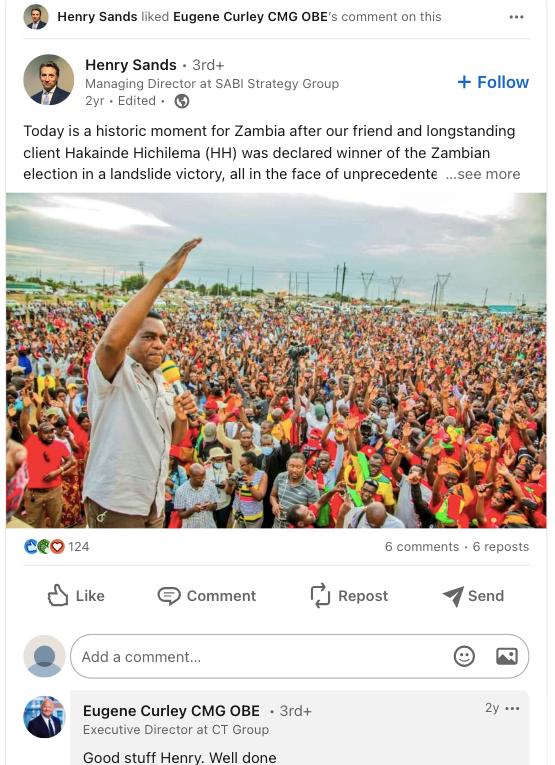
Following Hichilema’s 2021 election victory, Sands described the incoming president as “our friend and longstanding client”. That post is also no longer publicly available on Sands’ LinkedIn account.
MakanDay’s checks uncovered another connection between SABI and Hichilema’s inner circle. One of his senior advisors at State House, was listed on an archived version of SABI’s website as a member of the consultancy’s advisory committee. The page, captured by the Internet Archive in 2019, is no longer available on SABI’s current website.
SABI did not respond to MakanDay’s questions about the nature and extent of the relationship.
Consultancy or interference?
None of this, however, establishes foreign information manipulation. MakanDay’s interviews with experts, examination of documents and independent research found no basis for treating the use of foreign campaign consultants, on its own, as evidence of improper interference in an election.
Cheeseman says the practice is widespread.
“Most political parties that I’ve engaged with have at some point engaged with advisors and consultants from outside the country as well as those from within the country,” he says.
The more important questions, he argues, concern transparency and conduct.
“I think it is good for citizens to have a clear idea of who is engaging with and providing election services for political parties.”
Some international consultants provide legitimate professional services, Cheeseman says. Others have advised authoritarian governments on tactics ranging from manipulating social media to demobilising opposition supporters and radicalising political bases.
“In some ways I would say the location of the advisor is less important than what is the advisor willing to do,” he says.
“The key question should be: are they operating according to key democratic norms?”
Chan reaches a similar conclusion from another direction.
The issue, in his view, is not simply whether a consultant comes from Zambia or abroad, but whether the public knows the consultant’s mandate. That brings the investigation back to transparency.
When political messaging looks independent
Global Witness alleges that SABI was involved with Open Zambia, a website that presented itself as an independent Zambian media platform while, according to the organisation’s investigation, supporting Hichilema’s campaigns and publishing negative stories about political opponents.
Global Witness reported that documents leaked to The Guardian appeared to show that the website was funded by an unnamed mining-industry client.
A former SABI employee told Global Witness that managing Open Zambia became a core part of the consultancy’s work.
Global Witness further reported that Sands and former Brenthurst Foundation head Greg Mills are involved in Hichilema’s 2026 campaign, working alongside a team established by the Tony Blair Institute for Global Change (TBI).
Again, these relationships do not, by themselves, establish FIMI. But they raise a question that runs throughout MakanDay’s investigation. When political communication reaches a voter, can that voter tell who is actually behind it?
Political scientist and former University of Zambia lecturer Dr Neo Simutanyi takes a more critical view of foreign involvement. He argues that concerns extend beyond election campaigns to international organisations and advisers working around the Presidency.
“The problem is that we have a President who has turned State House into [an avenue for foreign influence] by allowing foreign investors, foreign interests, in the name of the (Tony) Blair Institute [and] the (now defunct) Brenthurst Foundation, to take over the role of advising the President,” he told MakanDay.
He pointed specifically to the Presidential Delivery Unit (PDU), arguing that externally supported advisory structures risk creating parallel centres of influence alongside established government institutions.
“He has created two parallels of advice: one is funded by donors, another by taxpayers,” Simutanyi said.
Simutanyi further argued that this arrangement could influence which economic policies receive priority, citing debt restructuring and government spending choices as examples.
TBI rejected any suggestion that its work in Zambia extends to political campaigning. In a response to MakanDay, a TBI spokesperson said the not-for-profit organisation advises the government on strategy, policy and delivery, but does not engage in political campaigning, polling, campaign communications or voter targeting.
TBI said the Presidential Delivery Unit (PDU) is a government-owned mechanism designed to strengthen the systems, structures and processes through which government priorities are translated into implementation and results for citizens.
The US$50 million allegation
Global Witness says four sources with inside knowledge alleged that First Quantum Minerals (FQM) had become the UPND’s largest funder ahead of the election and was prepared to spend up to US$50 million supporting Hichilema’s re-election.
Global Witness explicitly says it does not allege that such financial support would breach Zambia’s domestic electoral laws.
In response to MakanDay’s pre-publication questions, FQM strongly disputed the central allegations contained in the Global Witness investigation.
The company’s position is that it has neither funded the UPND in the past nor promised to fund its 2026 election campaign. It also denies telling Hichilema or his representatives that it was willing to spend up to US$50 million to secure his re-election.
FQM says it remains politically neutral and engages with whichever government holds office in its capacity as a long-term investor.
It acknowledged having had a professional relationship with the Brenthurst Foundation and using paid media as part of its corporate communications.
But it denied that Brenthurst acted as its agent to influence government policy or that its media activities constituted covert political campaigning.
MakanDay has not independently established that FQM provided the alleged campaign funding.
Who is watching the watchers?
Determining where legitimate consultancy ends and inappropriate influence begins also depends on Zambia’s institutions.
MakanDay sought answers from State House, ECZ, the Financial Intelligence Centre, Drug Enforcement Commission, Zambia Police Service and Zambia Cyber Security Agency about political financing, foreign interference, coordinated online influence operations and the safeguards in place to protect the election.
State House was separately asked whether the Presidency or governing party had received financial, logistical, strategic or advisory support from FQM or entities acting on its behalf, and whether foreign firms or advisers had been engaged to provide political or strategic communications advice.
None of the institutions had provided substantive responses by the time of publication. DEC acknowledged MakanDay’s questions and said it would respond.
Their silence is not evidence that Zambia lacks safeguards against political manipulation. But days before voting, it leaves unanswered questions about how those safeguards work in practice — and whether authorities have identified attempts, foreign or domestic, to covertly influence the election.
Before the ballot is cast
For Cheeseman, electoral integrity cannot be measured only by what happens on polling day.
“An election isn’t free and fair if the vote counting is done perfectly, but all of the parts of the election until then were not conducted freely and fairly,” he says.
Which brings Nathan Banda back into the picture.
He does not speak about FIMI, algorithms, political consultancies or opaque campaign financing. His question is much simpler. What can he believe?
On Thursday, Banda will once again walk into a polling station and make the same fundamental choice he has made since Zambia returned to multiparty democracy.
But the journey to the ballot box has changed.
In 1991, much of the battle for his vote happened in public — at rallies, in newspapers, on radio and in conversations with neighbours.
In 2026, some of it has happened in the palm of his hand.
And as Zambia’s 8.7 million registered voters prepare to choose their next government, experts say protecting the integrity of the election depends not only on what happens to their ballots after they are cast, but also on the information that shaped their choices before they entered the polling station.

Discover more from MAKANDAY
Subscribe to get the latest posts sent to your email.


