

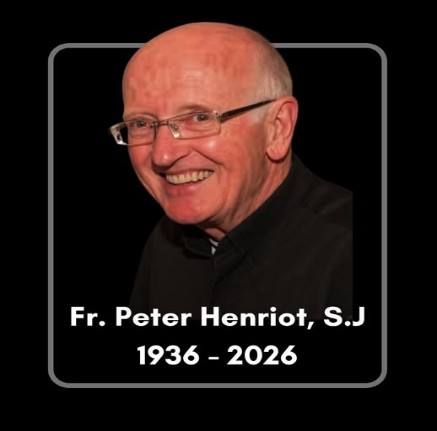
For more than two decades in Zambia, Fr. Peter J. Henriot was a familiar voice in debates about poverty, economic justice and the role of faith in public life. But behind the respected scholar and outspoken social justice advocate was a Jesuit priest remembered by those who knew him for his simplicity, mentorship and commitment to the poor. Following his death at the age of 90, Dr. Privilege Hang’andu, a former Jesuit student who lived and worked with Fr. Henriot, reflects on the priest who helped shape his own intellectual journey — and whose influence reached far beyond the institutions he helped build.
Fr. Pete Henriot: A Jesuit Priest whose Persona and Charism Transcends Humanity
On September 13, 2026, many Zambians learned of the passing of Fr. Peter J. Henriot in Los Gatos, California, USA, at the age of 90. The reason I decided to write these reflections in honour and memory of Fr. Henriot (or Pete, as he preferred to be called), is because of the impact he left in my life and what I believe is the impact he left on the Zambian people, the country’s policy systems, and around the world.
I worked and lived with Pete in 2008-2010, and he, in many ways, shaped the scholar and the social justice advocate I am today. Until very recently after my doctoral studies, Pete faithfully continued to write reference letters for me and to publicly share my academic publications. He also exposed me to many intellectual circles that have immensely benefited my academic career and professional life.
Who was Pete Henriot?
A native American, Fr. Henriot was born in Tacoma, Washington, in 1936. The youngest of five siblings, he went to Jesuit schools throughout his youth and later joined the Society of Jesus (popularly known as the Jesuits). After his regular priestly studies and formation, he pursued doctoral studies and obtained a Ph.D. in Political Science at the University of Chicago that would later combine with his Jesuit charism to leave a lasting legacy in the work of social justice in North America and in Africa.
Immediately after his doctoral studies, Pete held a postdoctoral fellowship at Harvard. His academic formation was impeccably solid! Pete lived and worked in Zambia for over 22 years, building from the ground-up an incredible record as a social justice advocate, educator, and researcher. He was a household name in the civil society, NGOs, religious, and government circles, building the Jesuit Centre for Theological Reflection (JCTR) and later helping to found the Civil Society for Poverty Reduction (CSPR).
Those who knew Pete well and those who worked with him would know that he was a dynamo of a social justice enthusiast and influencer beyond Zambia. In Africa, Pete was a driving force of the Africa Forum for Catholic Social Teaching (AFCAST), and a popular name in higher institutions of learning across the continent.
In 2008, when I joined the JCTR as a Jesuit in training, Pete asked me to travel internationally for various conferences. To earn a sit at the table or some respect in conversations, all I needed to mention was his name and that he was my boss. His work was corrosively infectious. In X, while Directing the Centre of Concern in Washington DC, Pete wrote a powerful book that many young people in priestly and religious training still use as a reference book: CST – The best kept secrete. Prior to that, he and X worked on a project that would later become institutional Catholic teaching – The Pastoral Circle.
A humble public intellectual
For many years, Pete worked with influential but similarly humble scholars like Professor Venkatesh Seshamani (RIP) to conduct complex micro and macro economic analysis, breaking it down to the ordinary Zambian reader. He trained and mentored an arsenal of young intellectual Zambians who went on do incredible work for Zambia, the United Nations, and the global community (e.g., Dr. Jack Jones Zulu, Dr. Miniva Chibuye, Dr. Charity Musamba, Dr. Chrispin Mphuka, Dr. Tina Moyo, Ms. Nachilala Nkombo, Mr. Simson Mwale, Fr. Leonard Chiti, Sr. Kayula Lesa, Mr. Muyatwa Sitali, Ms. Chilufya, Chileshe, Mr. Rueben Lifuka, and others). His social justice work, public intellectual life, and mentorship of Zambian intellectuals have left a lifetime legacy that will outlive any of us. Pete wrote two influential books (i.e., Catholic social teaching: Our best kept secret; Social Analysis: Linking Faith and Justice) and numerous articles.
In early 2000s, Pete wrote a weekly column for the Post Newspaper on various social justice issues. I would watch him write his drafts every Sunday, always after prayerful reflection and (sometimes) consultation with those of us close to him and to his work. His column was popular and referenced in theology, philosophy, and other social science and humanities classrooms across the African continent.
Not only was he a contagious thinker and public intellectual; he loved teaching. He left an indelible mark on Zambian priests and religious men and women, spending many years teaching at St. Dominic’s Seminary, giving invited lectures at St. Bonaventure College, St. Augustine’s Major Seminary in Kabwe, and all-around Catholic formation and teaching places around Zambia and Africa. He selflessly gave of himself entirely to the service of the Church in Zambia and beyond.
A Pro-Poor Jesuit
Anyone who encountered Pete saw a simple and ordinary Jesuit. One would not correspond the person they met on the streets of Lusaka or in the villages in Monze with the sophisticated intellectual they watched on national television, engaged in complicated discussions on micro and macro economic issues. Pete was a very simple and relatable Jesuit and priest. For the whole time I knew him, he owned one pair of sandals, a simple pair of black dress shoes, and a pair of running shoes. He owned one blue necktie, a couple of trousers, a few white shirts and a blue jacket he wore at every formal public event.
When he traveled internationally, he had no luggage to check in. His carry-on and his laptop bag were all he carried. Pete was a pro-poor Jesuit and priest, and he lived poverty in his own life. His simple life was not a mockery of the poor, but an expression of solidarity with them and a reflection of his religious vow of total surrender to Jesus Christ. In fact, it was his consternation against poverty that drove him wild to found tools such as the JCTR basic Needs Basket that samples household living conditions around major cities in Zambia, and the subsequent advocacy for improved policy instruments to better people’s lives. One popular line in his public addresses was “we Jesuits believe in a faith that does justice”. To him, faith was obsolete without justice. He was unambiguous about solidarity with the poor and this permeates all his writings, public commentary, and example of life.
“We Jesuits believe in a faith that does justice”: Fr. Henriot
A deeply pastoral priest
While most Zambians knew him as a public intellectual and social justice advocate, and associated him with his public speaking persona, Pete was a deeply pastoral priest. He loved his priesthood and committed to celebrating Sunday Masses not in the affluent parishes of Lusaka, but in the peripheries of the city. His regular centre for Sunday masses was Situmbeko near Mwembeshi. He faithfully drove there every Sunday morning to celebrate Mass with the village community, bringing back to his Jesuit community deep reflections about his encounters.
Pete’s work and impact in Zambian society reverberated all strata of life. Appreciative of his deep intellectual life and writing skill, the Zambia Catholic Bishops often consulted him and, several times, asked him to help draft pastoral letters. His name and legacy will live not only in our hearts and minds, but also in the indelible texts in libraries in Zambia, Africa, North America, and around the world. May his gentle soul rest in eternal peace, and may many beneficiaries of his selflessness and generosity rise to make our country what he envisioned it to be: A rich country without poor people!
Adieus, Pete!
Dr. Priva Hang’andu, a protégé of Fr. Pete Henriot, is a political scientist, public policy advisor, and academic based in Ottawa, Canada. A former Jesuit student, he works as a policy advisor at the Canadian Institutes of Health Research (CIHR) and as an adjunct professor at the Canada School of Public Service (CSPS). Dr. Hang’andu has written and published extensively on electoral democracy, social policy reforms, and human rights in Sub-Saharan Africa, with his most recent book published in December 2025: "The State and the Imperative for Social Policy Reform in Africa”.


Discover more from MAKANDAY
Subscribe to get the latest posts sent to your email.


