

By Ackim Mugala
Fifteen kilometres west of Kitwe lies Kamakonde – known also as Kitwe West, a new township sprouting along the route to Kalulushi, testimony of Kitwe’s steady expansion.
In early 2023, men in work suits arrived with a clear mission, to construct a communal piped water station for Kamakonde’s market traders.
The project, thanks to the Community Development Fund (CDF), was one of four sites where Kitwe City Council had earmarked new boreholes for Kamakonde’s communities.
Typically, drilling a borehole and equipping it with the necessary hardware should not take more than a month.
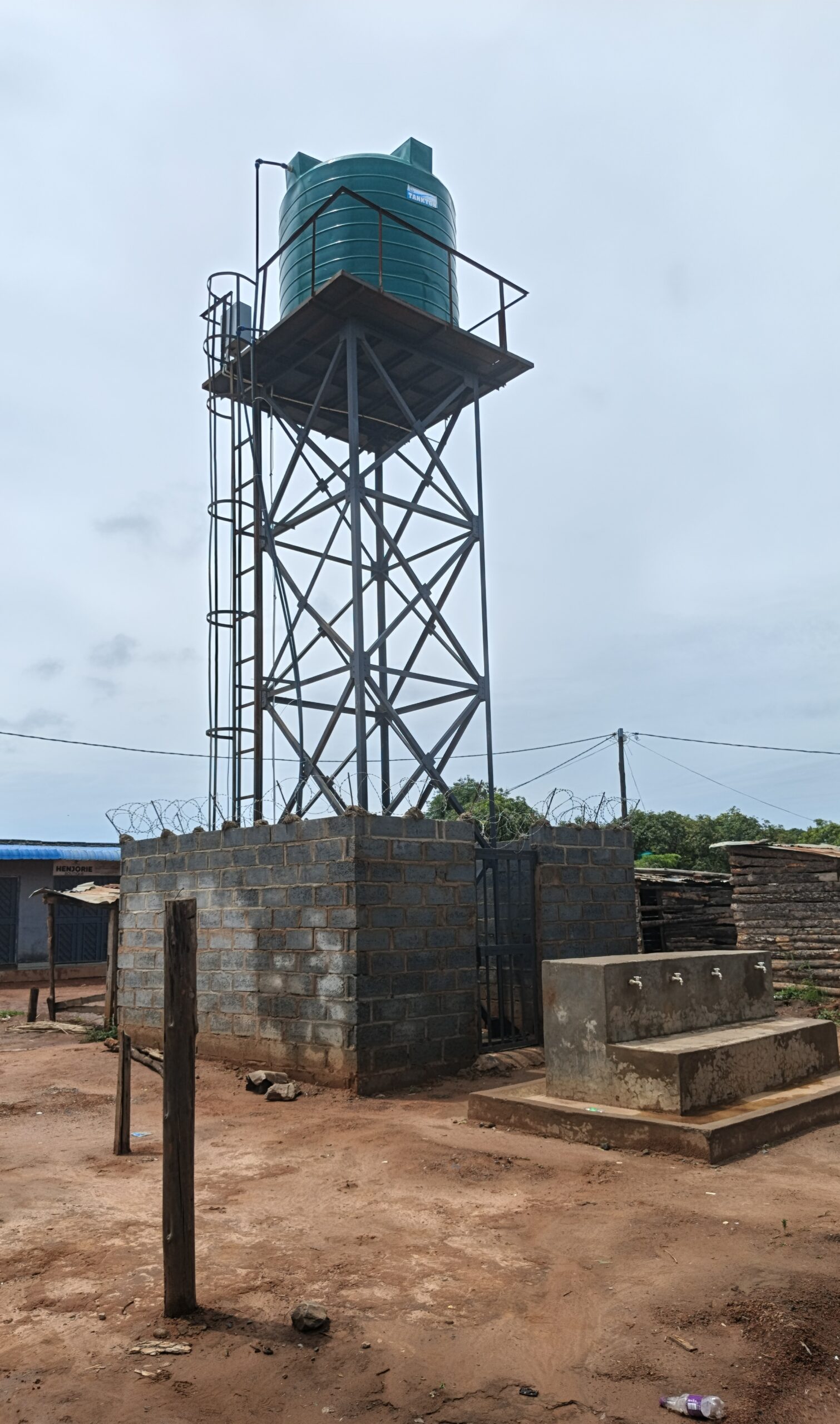
For Kamakonde market’s traders, over two years since the beginning of the project, the plastic taps still sit dry at the market.
This has forced traders to continue operating without running water.
The project, funded from the 2023 CDF allocation, saw Kitwe-based Ocean Drilling company winning the contract to sink the borehole at a cost of K51,000.
And so, the drillers came, drilled the borehole and then promptly disappeared and it was many months later that other men came.
The new crew, from another company, Chichema Construction Limited, was contracted to equip the borehole at the contract sum of K181,000.
But Chichema only moved on site in January 2025 to equip the borehole and despite this, the facility still remains dormant as at the time of writing this report.
By any measure, two years is a long time to wait for a borehole that could have taken a month to complete, and understandably, the traders at the market are frustrated by the delay.
Soon, rumours began to fly.
One version was that Conly Munji, chairperson of the CDF committee in charge of the Kamakonde market borehole, had awarded the contract for the borehole’s drilling and construction to his own private company.
That was why completion of the project had stalled, according to several residents interviewed by this reporter.
Invited to respond to this allegation, Munji laughed it off as a total fabrication.
So what happened? And why the two-year delay?
The first culprit in the chain of events appears to have been the procurement process and authorisation.
“Sometimes, project procurement officers are overwhelmed,” revealed Lishomo Kazoka, Quantity Surveyor at Kitwe City Council.
“They are overwhelmed with numerous requests and tasks, and sometimes, jobs get stuck in the pile,” he said.
Then there was the issue with the initial contractor tasked with drilling the borehole.
He failed to deliver after pulling out from the deal.
His quote for the works was later discovered to cost more than what had initially been quoted.
If it can take two years to complete a simple borehole, and with CDF allocation rising annually from K1.6 million in 2021 to next year’s K40 million for each constituency, it is likely that implementation loopholes and bottlenecks will increase.
While the contractor and the council may have faced unforeseen hurdles to finalise the borehole project, the two-year delay to complete a basic borehole project points to serious weaknesses in CDF project management at council level.
Patrick Kambita, Kitwe City Council Town Clerk, puts these challenges into perspective when he says project implementation success rate is at 80% and that “CDF has been improving with every single annual allocation.
“If you want to see whether CDF has delivered, you must give yourself a picture of what it was like before CDF and after CDF,” he argues.
Kambita cites contractor capacity as one of the main challenges encountered.
Initially, the assessment of contractors’ capacity to deliver was based largely on claims made in their paper credentials, claims that were often false.
“But we now have a database of contractors who can perform and contractors who cannot perform. We now know each other,” Kambita says.
“We also have contractors whose work speaks for itself. These are contractors who have proven they can deliver according to the expectations of the council and stakeholders.”
Commenting on project completion delays, Kambita explains that the phased project design has been largely to blame.
For example, a contractor moves on site and completes the work. But thereafter “we discover that we cannot open the facility because it lacks the necessary equipment. Then we have to go back to the drawing board to start budgeting for the necessary equipment and it takes another year. Meaning after the completion of the project you cannot hand it over to the public because it is incomplete”.
Kambita says future projects will need to integrate everything together so that “when we are handing over a completed project it can be used the following day by the public”.
Meanwhile, as the CDF annual allocation increases, allegations of abuse and corruption continue to cloud the process.
Such as unscrupulous individuals reportedly taking advantage of the funds through bogus skills training centres.
In Kitwe and Ndola, some known training centres claim to offer CDF-sponsored courses in operating heavy mining equipment such as excavators, front-end loaders, and forklift machines that cost millions of U.S. dollars.
There are questions on the capacity of such training centres to acquire or access this expensive machinery, with some of the institutions operating from small rented rooms in Kitwe city centre.
At the Kitwe office of one such centre, a single small room is staffed by a woman seated behind a desk, while a large, colourful poster depicting various heavy-duty mining machines hangs on the main wall.
The woman says the centre has branches in Kitwe, Lusaka, Solwezi, Kalulushi and Choma but when the Lusaka, Solwezi and Choma numbers are called, they are unreachable.
At the number listed for Kalulushi, the woman who answers fails to confirm or prove the claims on the college’s faded photocopied marketing leaflet with various high-end mining vehicles on offer to trainees.
One of the machines is the Rigid Dump Truck, at K10,500 for a month-long operational course with the centre.
But at a landed cost of about $4 million, according to an FQM source, it is quite evident this particular centre, with its faded photocopied marketing leaflets, lacks the capacity to procure such a machine.
CDF chairperson for Kamfinsa constituency, Rodgers Nyirongo, confirmed that some training institutions were banned for offering sub-standard trainings by the Ministry of Local Government and Rural Development.
This raises further questions about whether councils are adhering to the ministry’s directive, as some of the banned institutions are reportedly still operating.
Former Ndola District Commissioner Joseph Phiri also revealed that a training institution in Ndola was banned from offering courses under CDF after it emerged that students were given “practical lessons” on machinery the institution did not possess.
Delays in project completion, coupled with the mushrooming of bogus skills-training institutions highlights the urgent need for stricter monitoring and enhanced accountability in implementation of CDF projects.
Where large sums of public funds are involved, the risk of abuse and corruption cannot be ignored.
PHOTO CAPTION: Two years on, Kamakonde market borehole, abandoned and dry. Photo by Ackim Mugala.
Ackim Mugala reports for Kitwe’s Radio Icengelo. This article was fact-checked and edited by MakanDay as part of an investigative journalism in-house reporting clinic collaboration with Icengelo radio.

Discover more from MAKANDAY
Subscribe to get the latest posts sent to your email.