

The truth behind Kalomo’s water crisis
By Kebby Sianjame in Kalomo, Southern Province
Despite paying monthly water bills, some residents of Kalomo in Southern Province say they have gone months—and in some cases years—without reliable access to running water, forcing families to queue at communal hand pumps, draw water from rivers, and rely on unsafe sources to meet their daily needs.
An investigation by Voice of Kalomo Community Radio has found that the district’s persistent water shortages are being driven by a widening gap between water demand and supply, ageing infrastructure, delayed maintenance, and unsuccessful efforts to secure new water sources.
Official figures from the National Water Supply and Sanitation Council (NWASCO) show that Kalomo’s water system currently produces only 2,000 cubic metres of water per day against a demand of approximately 3,800 cubic metres, leaving a daily deficit of 1,800 cubic metres.
The consequences are being felt across the district. In Mawaya Compound, residents say they wake up before dawn to draw water before supplies run out.
“We wake up very early to draw water because if you delay, you may spend the whole day without any,” said Mrs Sileu, a resident of the area.
Others have abandoned the taps altogether. Charity Muyaba said low water pressure has become a common feature in many parts of Kalomo, forcing residents to collect water from the Sichikwenkwe and Kalomo rivers.
“Most of the time there is low pressure, forcing residents to draw water from the rivers,” she said.
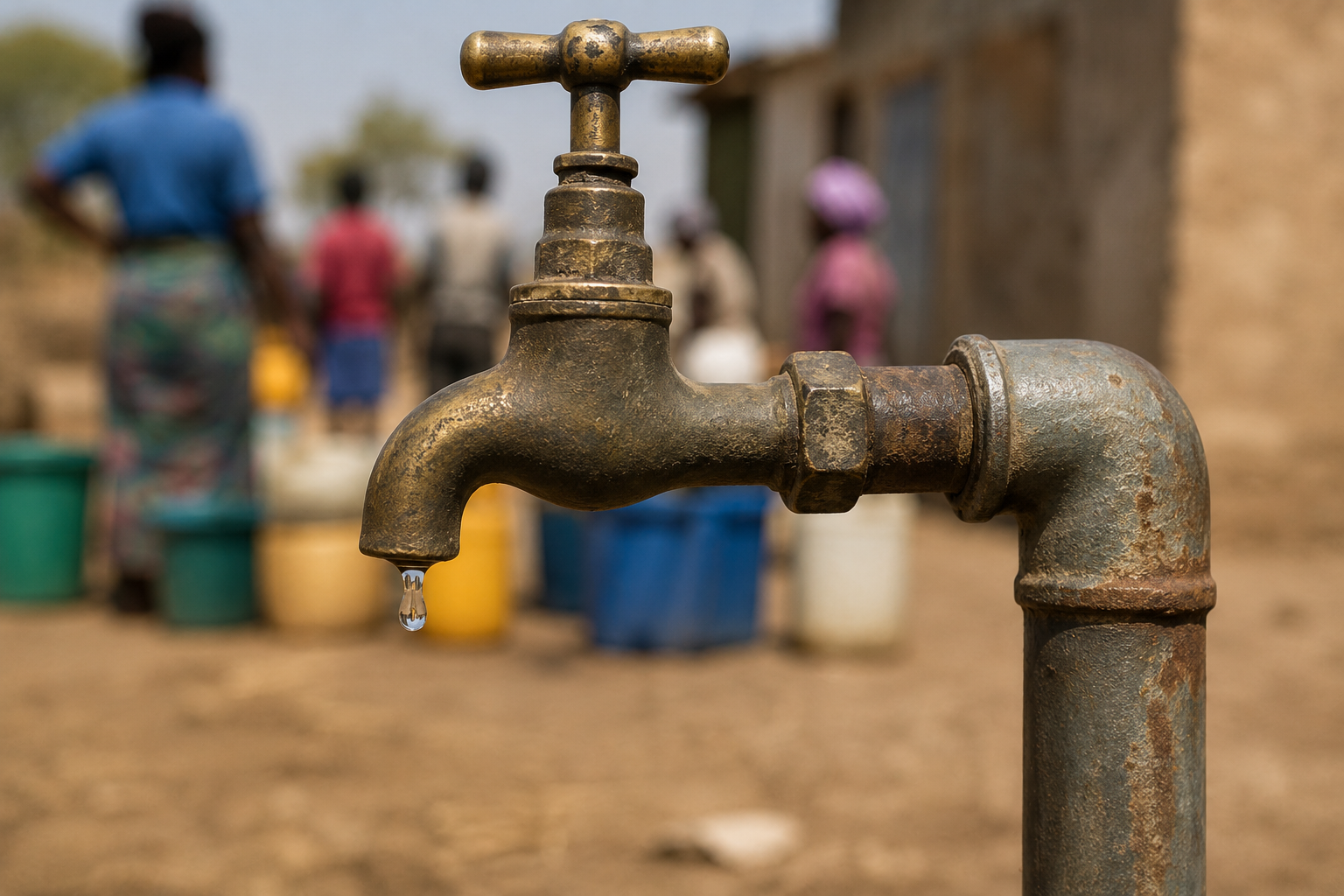
In some communities, residents now depend almost entirely on communal hand pumps. At one hand pump visited by Voice of Kalomo, residents had already formed long queues before sunrise. Ruth Phiri said the pump only becomes operational around 05:00 hours, resulting in long waiting times.
“We draw water in turns because the queues are very long. Sometimes people spend hours waiting,” she said.
For vulnerable residents, the situation is even more challenging. Bina Muleele, who lost a leg and relies on crutches, said a broken hand pump in her yard has left her dependent on others for access to water.
“I used to draw water from this hand pump in the yard but it has been broken for a long time. Sometimes I have to pay people to help me draw water,” she said.
In Maclaymond Compound, resident Cosmas Sikano questioned why he continues receiving water bills despite going for prolonged periods without supply.
“I have never seen a drop of water for more than two years, but bills keep coming. I don’t know what I am paying for,” he said.
Residents’ complaints about receiving bills despite prolonged water shortages raise broader questions about service standards and consumer protection. Water utilities are expected to meet agreed service levels and respond to customer complaints, yet many residents interviewed said they feel abandoned by a system that continues to bill them even when taps remain dry.
Residents also complained about delayed responses to reports of burst pipes and damaged infrastructure. Aaron Kambeu of Chikoli 620 accused Southern Water and Sanitation Company (SWASCO) of taking too long to repair damaged pipelines.
“Sometimes it takes too long before action is taken. I cannot understand their way of working,” he said.
Health professionals warn that the growing dependence on rivers, streams and shallow wells could expose residents to serious health risks. A clinician at Kalomo Urban Clinic warned that untreated water can lead to outbreaks of cholera, dysentery, typhoid and other waterborne diseases.
“When people fail to access safe water, they turn to unsafe sources. Clean water is essential for public health,” the clinician said.
While residents describe the crisis through daily struggles, official records point to deeper structural challenges.
Research by Voice of Kalomo based on NWASCO data found that water demand in Kalomo exceeds available supply by nearly 50 percent.
The report also highlights broader challenges across the water sector, including ageing infrastructure, water losses through leakages, and operational inefficiencies that reduce the amount of water reaching consumers. NWASCO inspections found that many utilities continue to struggle with infrastructure deterioration, delayed maintenance and high levels of water losses, limiting their ability to provide reliable services.
Despite the supply challenges, Southern Water and Sanitation Company has received positive ratings in some areas of service delivery. NWASCO’s 2023 performance assessment awarded the utility an overall “A” rating for water quality compliance with a confidence level of 88 percent. However, the regulator also recorded turbidity failures in some districts served by the utility, highlighting the ongoing challenges of maintaining water quality standards across a large service area.
Questions have also emerged over investment in sanitation services. NWASCO records show that Southern Water and Sanitation Company had collected K14.36 million through sanitation surcharges by the end of 2023 but had spent K6.07 million on approved sanitation projects. While the figures do not indicate any wrongdoing, they raise questions about the pace at which sanitation investments are being implemented in communities facing water and sanitation challenges.
SWASCO says it is aware of the challenges facing Kalomo and neighbouring Zimba District.
Speaking during a special programme on Voice of Kalomo Radio, SWASCO Kalomo Branch Manager Perry Lilanda attributed the shortages to increasing population growth, ageing infrastructure and occasional power interruptions that affect water pumping.
Lilanda said the company is exploring long-term solutions, including the construction of a new 3,000-cubic-metre water treatment plant at Golden Miles and the identification of alternative water sources.
However, efforts to increase water supply have faced setbacks. According to information obtained by Voice of Kalomo, four industrial boreholes drilled at Golden Miles failed to yield sufficient water.
Residents and community leaders are now seeking greater clarity on when the proposed water treatment plant will be constructed, how it will be funded and when households can realistically expect improvements in water supply.
For now, thousands of residents continue to queue for water, draw from rivers and depend on overcrowded communal pumps as they wait for a lasting solution to a crisis that has become part of daily life.
Until new sources are secured, Kalomo remains trapped in a system that produces only 2,000 cubic metres of water each day against demand for 3,800 cubic metres—a deficit of nearly half the town’s daily water requirements. For many households, the search for water still begins long before sunrise.
This article was produced by MakanDay’s Local Reporting Network. Subscribe through our website and follow our Facebook page to receive stories like this one as soon as they are published.
Discover more from MAKANDAY
Subscribe to get the latest posts sent to your email.


