

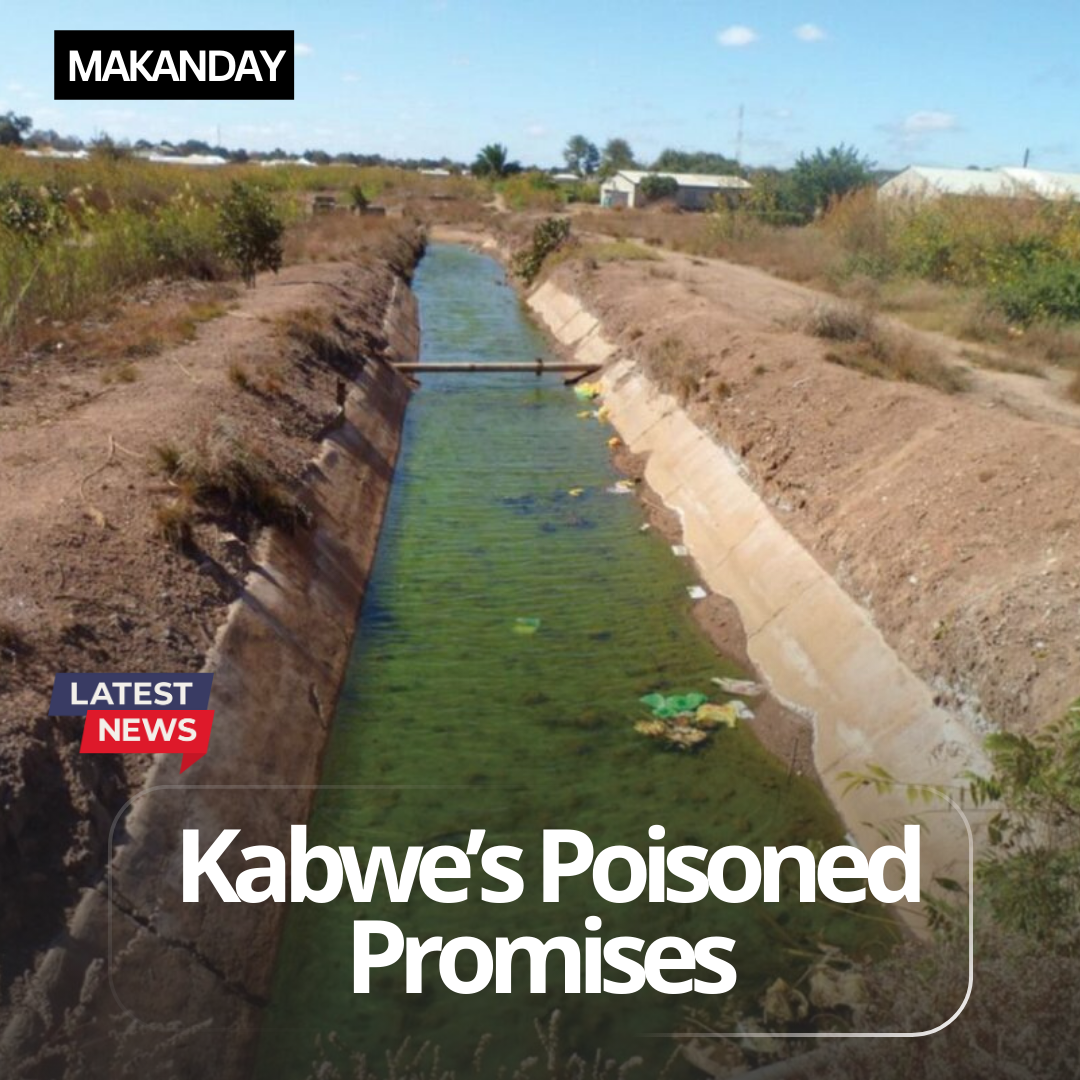
Despite a World Bank–backed remediation project and years of international scrutiny, Kabwe’s residents say contamination, illness, and broken promises still define daily life.
By Luckson Mwale
In Makululu township, 14-year-old Oliver struggles in school. Once energetic and curious, he now battles learning difficulties and stigma. Some teachers label him “slow”. Doctors later confirmed that his blood-lead levels were dangerously high.
Beyond illness, families describe anxiety, guilt, and economic strain. Hospital visits consume scarce income. Some children are pulled out of school. These costs never appear in financial statements, yet they remain the most enduring legacy of Kabwe’s pollution.
Kabwe’s lead poisoning crisis has been documented for decades, yet accountability remains elusive. Media reports dating back more than 40 years trace the contamination to the Kabwe mine, formerly Broken Hill, where Anglo American invested in lead mining operations in 1925 and is alleged to have exercised significant control and management until Zambia nationalised the mining sector in 1974.
The mine continued operating under state ownership before eventually closing in 1994, leaving behind widespread and enduring lead contamination that continues to affect thousands of residents.
Despite the scale of exposure, with tens of thousands of children and women of childbearing age reportedly poisoned by residual lead dust, comprehensive remediation came only decades later.
It was only after sustained public pressure and growing international scrutiny that the Zambian government, with World Bank support, launched the Zambia Mining and Environmental Remediation and Improvement Project (ZMERIP). The delay has raised persistent questions about responsibility for one of the world’s longest-running industrial poisoning cases—and why justice and redress have taken so long.
ZMERIP began in 2016 and was scheduled to end on June 28, 2024.
This investigation finds a persistent gap between funding and impact: while millions were disbursed for remediation, audits flagged waste and stalled contracts, procurement records show spending on vehicles and consultancy services, and residents say contamination and illness remain largely unchanged.
Ministry of Mines records show that the project had a core budget of US$50 million, aligned with the World Bank’s broader commitment. It was designed to reduce environmental and public health risks associated with mining pollution in Kabwe and parts of the Copperbelt by rehabilitating contaminated sites and strengthening regulatory oversight.
The project was structured around four main components, US$25 million was allocated to site remediation and environmental governance, US$10 million to institutional strengthening for agencies such as the Zambia Environmental Management Agency (ZEMA) and the Mines Safety Department, US$12 million to local environmental improvements, including works on the Kabwe canal and soil containment, and US$3 million to project management and monitoring.
In addition, US$1.2 million was spent during the preparatory phase in 2015 on consultancy services, baseline studies, and engineering designs.
According to the World Bank reports, the first component, remediation of contaminated hotspots and improvement of environmental infrastructure, financed targeted clean-up activities and related environmental infrastructure in Kabwe and parts of the Copperbelt.
But residents say that, on the ground, the promised support has yet to materialise. They report receiving little or no tangible assistance from government, while roads in affected communities remain in poor condition, worsening access and compounding the health challenges of those living near the mine.
“They told us the clean-up had started,” said Margaret Mwelwa, a resident of Makululu Township. “But the dust is still here, the children are still sick, and nothing has changed.”
The 2021 Auditor General’s Report raised serious concerns over the project’s implementation. It cited wasteful expenditure of more than US$1 million after over 20,200 doses of anti-lead poisoning drugs expired, attributing the losses to weak testing systems and poor follow-up of affected children. Health workers told auditors that many children who tested positive were never monitored again, even after elevated lead levels were detected.
The audit also flagged failures to recover advance payments for stalled contracts. These included a borehole project at hotspot schools in Kabwe that never commenced because required environmental management plans were not finalised. By mid-2022, substantial sums remained unrecovered.
Several critical engineering interventions also failed to progress. The Kabwe canal, identified as a major route for contaminated storm water through densely populated neighbourhoods, remains largely unimproved. Planned rehabilitation of tailings and overburden dumps on the Copperbelt advanced little beyond the design stage, despite funds being allocated.
Meanwhile, this investigation found that the government sank 12 boreholes under the project. Records further show that more than US$292,000 was spent on vehicles, including contracts for drones and drone pilot services, financed through the World Bank project.
Procurement data further indicate that in September 2020 alone, a contract worth US$44,000 was awarded for the procurement of a “motor vehicle for Kabwe,” according to information published on the World Bank’s website.
The result, residents say, was a project that exists more convincingly on paper than on the ground. As a result, children diagnosed with elevated lead levels were neither followed up nor treated consistently, undermining the project’s central public health objective.
Elizabeth Njovu, Project Manager at Environment Africa, says the failures point to a deeper accountability crisis.
“Kabwe’s poison is not history,” she says. “It is the cost of forgotten accountability.”
In October 2020, nearly 140,000 Kabwe residents, represented by the law firms Leigh Day and Mbuyisa Moleele, filed a class-action lawsuit in South Africa against Anglo American, which operated the Kabwe mine before Zambia’s independence. The case sought compensation for widespread lead poisoning linked to the mine.
In July 2023, the Gauteng Division of the High Court allowed the case to proceed to a certification hearing. United Nations experts and Amnesty International intervened in 2022 and were admitted as amici curiae, supporting the victims’ claims.
However, on December 15, 2023, the court refused to certify the proposed class action. In a 126-page judgment, Justice Leonie Windell ruled that holding a company liable decades after it ceased operations would set a “grave precedent,” particularly for harm assessed against standards that did not exist at the time.
At the same time, the court acknowledged that a class action remains the only realistic avenue through which Kabwe’s victims could access justice, underscoring the continuing legal impasse facing affected communities.
Anglo American has consistently denied responsibility. In a 2024 email to Colonist Report, the company said it “will fervently defend itself since we are not responsible for the situation in Kabwe – as the High Court in South Africa recently affirmed back in December 2023”.
Joackim Bunda, a father of three from Chowa township and one of the plaintiffs, says the wait has been agonising.
“We heard compensation would come,” he says. “But years have passed. Our children are still sick.”
No compensation has yet reached some affected families.
Kabwe’s experience exposes the limits of funding without accountability. Without transparency, enforcement, and sustained oversight, even the largest remediation budgets risk becoming another layer of dust over an unresolved crisis.
Implementation responsibility was split among government ministries and regulatory agencies, while the World Bank provided financing and oversight. This diffusion of responsibility, experts say, has made it difficult to enforce accountability when projects stall.
A set of questions were sent to the World Bank seeking comment on the project, including whether Anglo American was involved in supporting the loan provided to Zambia. By the time of publication, the World Bank had not responded.
Requests for comment were also sent to the Ministry of Green Economy and Environment, which sits on the committee overseeing the Kabwe Mine remediation initiative. By the time of publication, the Ministry had not responded.
The questions sought to establish what steps the ministry is taking to ensure Kabwe becomes lead-free, and to assess the impact of World Bank funds on affected communities.
Luckson Mwale is a fellow under the Wildlife Crime Prevention (WCP) environmental fellowship for journalists. The MakanDay Centre for Investigative Journalism, in partnership with WCP, supported the reporting of this story.


Discover more from MAKANDAY
Subscribe to get the latest posts sent to your email.


