



Police outnumbered, systems overwhelmed, and a community left to decide justice for itself.
By Linda Soko Tembo, Brenda Zulu & Stanley Fwataki
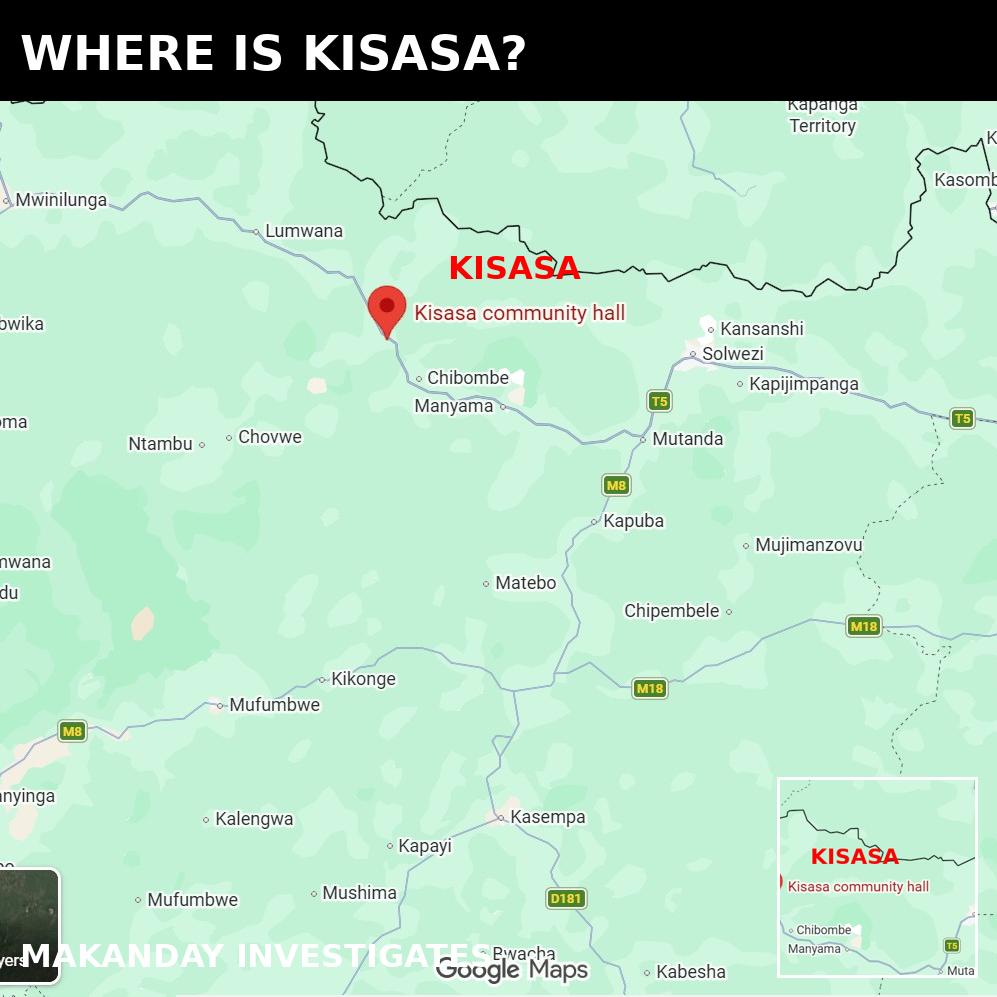
When MakanDay journalists arrived in Kisasa, along the Mutanda–Mwinilunga Road, about 120 kilometres south-west of Solwezi, the provincial capital of North-Western Province, Kisasa Market had fallen silent.
Where traders once shouted prices over loudspeakers and customers bargained across crowded stalls, there was only wind. Torn plastic sheets flapped against empty frames. Stones and sticks lay scattered across the ground, remnants of a mob attack that turned a place of trade into a crime scene.
Residents moved cautiously through the market, speaking in low voices. Many had fled. Others were afraid to stay.
At the centre of that silence is the killing of a woman.


What we have gathered about the woman who never returned home
What MakanDay has established is that the victim, Eneless Hellen Kamutumbe, 46, was a businesswoman, gold trader, and mother of six.
Originally from Ingwe Village under Chief Ingwe in Kasempa district, she lived in Chingola on the Copperbelt, where she supported her family through small-scale trading. According to her relatives, she travelled to Kisasa to follow up on a failed gold transaction.
She had given money to a man to buy gold on her behalf. When she contacted him, he said he was in Kisasa. But when she arrived, his phone was switched off.
Stranded without money to return to Chingola, Kamutumbe made a decision that would place her at the centre of a deadly chain of events. She tried to sell her phone.
The accusation
At a mobile services booth, she encountered 25-year-old Prince Ntambo, a SIM card replacement agent. Moments later, he accused her of making his genitals disappear. The claim, rooted in longstanding myths that have periodically surfaced in parts of Zambia, spread rapidly through the market.
“This is where everything started,” said a security guard stationed at a nearby communication tower.
Within minutes, he said, a crowd formed. What began as suspicion turned into confrontation, and quickly escalated into violence.
A breakdown of protection
Kamutumbe was taken to a nearby community police unit (CPU), a neighbourhood watch structure meant to provide immediate security. But the system did not hold.
Witnesses say officers tried to hide both Kamutumbe and Ntambo inside the small, chain-secured building as a crowd gathered outside. The mob quickly overwhelmed it and broke in. As violence escalated, the officers fled, leaving Kamutumbe behind.
An eyewitness then attempted to move her to the palace of Senior Chief Museli Musokantanda, about 100 metres away. But the Chief was not present.
By then, she was already severely injured. Witnesses said cultural beliefs also delayed intervention, with some insisting it was a bad omen to take a bleeding person to the Chief.
In a final attempt to escape, Kamutumbe asked to be taken to a house near Kisasa Secondary School, about 400 metres away. However, the mob followed. They broke in, dragged her outside, and continued beating and stoning her.
“They looted everything,” said the homeowner, Peter Ndumba, deputy headteacher at Kisasa Primary School.
He reported losing K10,000 in cash, two smartphones valued at K6,500, clothes, food, and a Samsung smart TV. The money had been set aside for his daughter’s school fees.
“My family has been left in a very difficult situation,” he said.
Kamutumbe was later killed near Pentecost Holiness Church.
Police outnumbered
Police response came, but it was not enough. Five officers from Kisasa Police Post and Kalumbila Police Station attempted to intervene at Kisasa Secondary School but were confronted by a large crowd. Stones were thrown, their vehicle was damaged, and the officers were forced to withdraw.
A community primed for violence
MakanDay has established that the killing did not happen in isolation. A pattern is emerging.
Residents told MakanDay that a 17-year-old boy was found dead at the same market on January 1, 2026, followed by another killing on January 17. Kamutumbe’s death on March 20 marks at least the third major incident in under three months in this informal roadside settlement, largely populated by unemployed residents.
“This one was the most brutal,” said Phillison Ackson Mukanzu, a relative of Chief Museli. “It has shaken the entire chiefdom.”
Two days before Kamutumbe’s killing, rumours had circulated widely on social media about alleged cases of genital disappearance in Chingola. By the time she arrived in Kisasa, fear had already taken hold.
“When the accusation was made, people were ready to believe it,” said one trader.
A market shut down
Following the killing, Chief Museli ordered the closure of Kisasa Market for two months. According to market officials, the market previously generated between K300,000 and K500,000 daily, supporting thousands of traders and informal workers. That activity has now stopped.
Many residents have fled, fearing arrest following President Hakainde Hichilema’s directive targeting those involved in the violence.
“People are not running because they are guilty,” said one resident. “They are afraid.”
Schools emptying out
The impact has extended to the area’s two schools, Kisasa Primary and Kisasa Secondary. During a check on March 25, 2026, only seven pupils were present out of more than 2,000 at the primary school, while attendance at the secondary school dropped to 193 out of 1,456.
According to school authorities, 13 pupils are among those arrested during police operations that followed the killing.
“These learners are mentally affected,” said Kenneth Lingunja, headteacher at the secondary school.
Police say investigations are ongoing. Police Public Relations Officer Godfrey Chilabi confirmed that as of March 31, 2026, 12 suspects had been charged with murder, while 22 others face charges of riotous conduct. A total of 257 people, including Ntambo, a SIM card replacement agent, are currently in custody in connection with the violence that led to Kamutumbe’s killing.
“The number of arrests may increase as investigations continue,” Chilabi said.
School authorities have appealed for the screening process to be expedited so that affected learners can return in time for their end-of-term examinations.
Weak systems, predictable outcomes
Kisasa Police Post, established three years ago, serves a population of nearly 40,000 people. Residents say this has led to heavy reliance on informal security structures such as neighbourhood watch groups and traditional authority systems.
In this case, both systems failed. The community police unit could not contain the crowd. Traditional authority was inaccessible at a critical moment. Police were outnumbered. The result was fatal.
Unanswered questions
The circumstances that brought Kamutumbe to Kisasa remain unresolved. Her family believes the mystery man involved in the gold transaction may hold key information. His identity, and whether he played any role beyond the failed transaction, has not been established.
“If he had met her earlier, she would not have come here,” a relative said.
The deadly accusations of “genital theft” are not new. They first surfaced in Kasumbalesa on the Zambia–DRC border, before spreading to Chingola and later to Kisasa in Kalumbila, where Kamutumbe was killed by a mob. Similar incidents have also been reported in other parts of Zambia and across the border in Tunduma.

Discover more from MAKANDAY
Subscribe to get the latest posts sent to your email.