

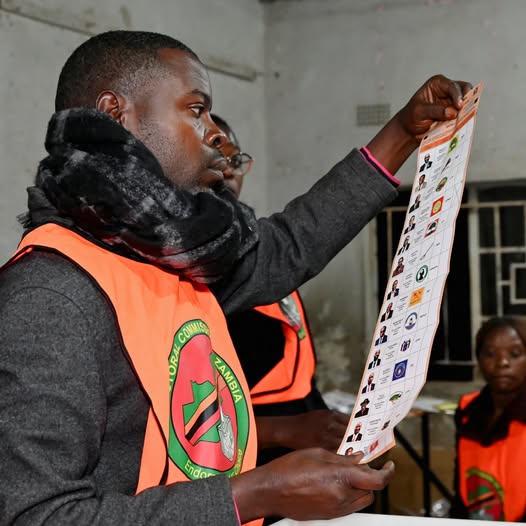
PART TWO | In Part One of this series, Dr Blessing Vava assessed how digital platforms, misinformation and artificial intelligence are reshaping Zambia’s democracy. In Part Two, attention shifts from the digital battlefield to the institutions responsible for protecting electoral credibility. Dr Tamuka Charles Chirimambowa and Dr Vava argue that Zambia should not spend the next five years perpetually contesting the 2026 election. Instead, the country should use the questions it exposed to repair its electoral institutions well before voters return to the polls in 2031.
By MakanDay Editor
In their post-election briefing, Zambia After the Ballot: The Result, the Anomalies, and the Road to Institutional Renewal, Dr Tamuka Charles Chirimambowa and Dr Blessing Ivan Vava argue that Zambia should resist turning the disputed aspects of the 2026 general election into a five-year political contest.
Instead, they argue, the country should begin repairing the institutions whose weaknesses were exposed during the electoral process.
Their central argument is that Zambia’s priority should now be institutional repair rather than perpetual electoral contestation. The credibility of the next election, they say, will depend on reforms undertaken well before 2031 and on whether Zambian institutions can demonstrate how an election result was produced rather than simply asserting that it was sound.
Their argument begins from a position that may be uncomfortable for both sides of Zambia’s post-election divide.
The authors conclude that President Hakainde Hichilema won the 2026 presidential election. They say the available independent evidence does not establish that another candidate received more votes, while two independently conducted verification exercises placed Hichilema above the 50 percent threshold.
At the same time, however, Chirimambowa and Vava reject the suggestion that confirmation of the winner settles every question about the election.
They identify unresolved concerns involving results management, presidential-parliamentary turnout discrepancies, the interruption of the national count, differences between the Electoral Commission’s declared tally and two independent parallel verification exercises, the declaration and re-declaration of parliamentary results and broader questions of institutional transparency.
Their central distinction is between an anomaly, malpractice and an outcome-changing manipulation.
The report argues that these are three different propositions requiring different standards of evidence. While some anomalies are sufficiently documented to require investigation, the authors say the available evidence does not establish the full chain from those discrepancies to deliberate, coordinated manipulation capable of changing the presidential result.
But they warn that the opposite conclusion would be equally problematic.
The fact that an irregularity has not been shown to have changed the winner does not mean it should be ignored.
That distinction changes the question Zambia should now be asking. Instead of remaining trapped between claims that the election was stolen and assertions that everything was sound, the authors argue that the outstanding questions should be settled through evidence.
“The correct response is therefore neither to declare the argument proved nor to declare it refuted. It is to obtain the evidence required to test it,” Chirimambowa and Vava argue.
Let the documents speak
One of the strongest arguments running through the report is that electoral credibility should be demonstrable.
Chirimambowa and Vava point to differences between the official presidential result and two independent verification exercises. Both exercises placed Hichilema above the constitutional threshold required to win, but both also estimated his share below the Electoral Commission’s declared figure.
The Electoral Commission declared Hichilema at 60.5% and Brian Mundubile at 37.8%. The Christian Churches Monitoring Group estimated the two at 56.0 percent and 42.3% respectively, while a separate civil society consortium estimated 57.9% and 40.2%.
The authors stress that this does not establish manipulation.
What it establishes, they argue, is something that requires explanation.
They therefore propose a publicly accessible reconciliation of the entire results chain, covering polling stations, constituencies, provincial aggregation, the national results centre and the final declaration.
They recommend that polling-station results for all contests be published in machine-readable form and that electoral materials — including ballots, forms, seals, logs and digital audit trails — be preserved until statutory dispute processes have been exhausted.
“Polling-station results for all contests should be published in machine-readable form. Ballots, forms, seals, logs and digital audit trails should be preserved until all statutory dispute processes are exhausted,” Chirimambowa and Vava recommend.
Such transparency, they argue, would not undermine the Electoral Commission. It could strengthen it by allowing the Commission to demonstrate, through the electoral record itself, how the final result was reached.
The institutional problem goes beyond ECZ
The report argues that the institutional weaknesses exposed in 2026 were not confined to election administration.
The two academics also raise concerns about access to electoral justice, particularly the closure of Zambia’s superior courts on 24 August, the final day of the constitutional window for filing an election challenge.
“Election disputes are time-bound by law. The closure of courts on the final day of the petition period therefore raises a constitutional question independent of the merits of any particular petition,” Chirimambowa and Vava argue.
They argue that Zambia should establish an election-period judicial protocol guaranteeing access to the courts even during security emergencies. They also recommend clearer legal distinctions between clerical errors, procedural irregularities, material electoral violations and systematic manipulation, including clearer thresholds for when irregularities justify annulment.
The authors’ broader point is that institutions are tested most seriously when political pressure is greatest.
An electoral justice system cannot work only when circumstances are normal. Its credibility depends on remaining accessible precisely when an election is disputed.
Opposition parties also have work to do
Chirimambowa and Vava do not place responsibility for reform solely on the government or Electoral Commission.
They argue that the opposition’s organisational weaknesses contributed to its difficulties in documenting its allegations after the election.
The report notes that the UPND deployed polling agents to almost all polling stations, while the NRPUP struggled to deploy agents particularly in areas where it had not actively campaigned. Because polling agents receive copies of the GEN-20 forms, weak coverage also meant weaker access to the documentary evidence required to independently verify results.
For the authors, this produces an important principle: the burden of evidence must apply equally.
They argue that the Electoral Commission must explain discrepancies in its returns, but political parties claiming to possess alternative results must similarly publish the stations, forms, aggregation methodology and statistical assumptions upon which those claims are based.
Political parties therefore need to strengthen their nationwide structures long before the next election.
2031 must not start in 2030
Perhaps the most important lesson from the report is about timing. Electoral reform cannot be left until Zambia is already campaigning for the next election.
The authors identify several reforms they believe should be completed well before 2031, including publication of polling-station-level results, a permanent results-audit mechanism, stronger chain-of-custody procedures, clearer rules governing declarations and corrections, guaranteed access to electoral justice, greater transparency around parallel vote tabulations and campaign-finance disclosure.
They also recommend stronger protections for election observers and journalists and the establishment of a standing information-integrity mechanism involving the Electoral Commission, civil society, the media and digital platforms.
Chirimambowa and Vava further propose a post-election national dialogue involving government, opposition parties, the Electoral Commission, churches, civil society, the media and academia.
But they make an important distinction: such a dialogue should not become another negotiation over who won in 2026. Instead, it should look forward, focusing on electoral reform, institutional independence, political-party reform, electoral justice, civic space, campaign finance and peaceful political competition.
The objective, as the report puts it, should be to “fix the system before 2031 rather than litigate the same problems again in 2031”.
That perhaps captures the central lesson of their assessment. Chirimambowa and Vava argue that the 2026 election should neither be presented as administratively flawless nor dismissed as fraudulent without sufficient evidence. Their assessment is that Hichilema won, but that significant institutional questions remain.
For Zambia, therefore, the question is no longer only what happened in August 2026, but what the country does with the weaknesses the election exposed.
If electoral records become more transparent, results independently auditable, courts reliably accessible, political parties better organised and electoral institutions capable of answering disputes with documents rather than declarations, Zambia will enter the next election with stronger safeguards and greater public confidence.
If those reforms are postponed, the country risks carrying the unresolved institutional weaknesses of 2026 into another election. The credibility of Zambia’s next election, the authors’ analysis suggests, will depend on what the country chooses to repair now.


Discover more from MAKANDAY
Subscribe to get the latest posts sent to your email.


