

Five years after winning power on a platform of reform, freedom and accountability, President Hakainde Hichilema is seeking a second term. But as his campaign posters dominate Lusaka’s skyline, questions remain about how much of the promised democratic transformation has been achieved.
By Charles Mafa
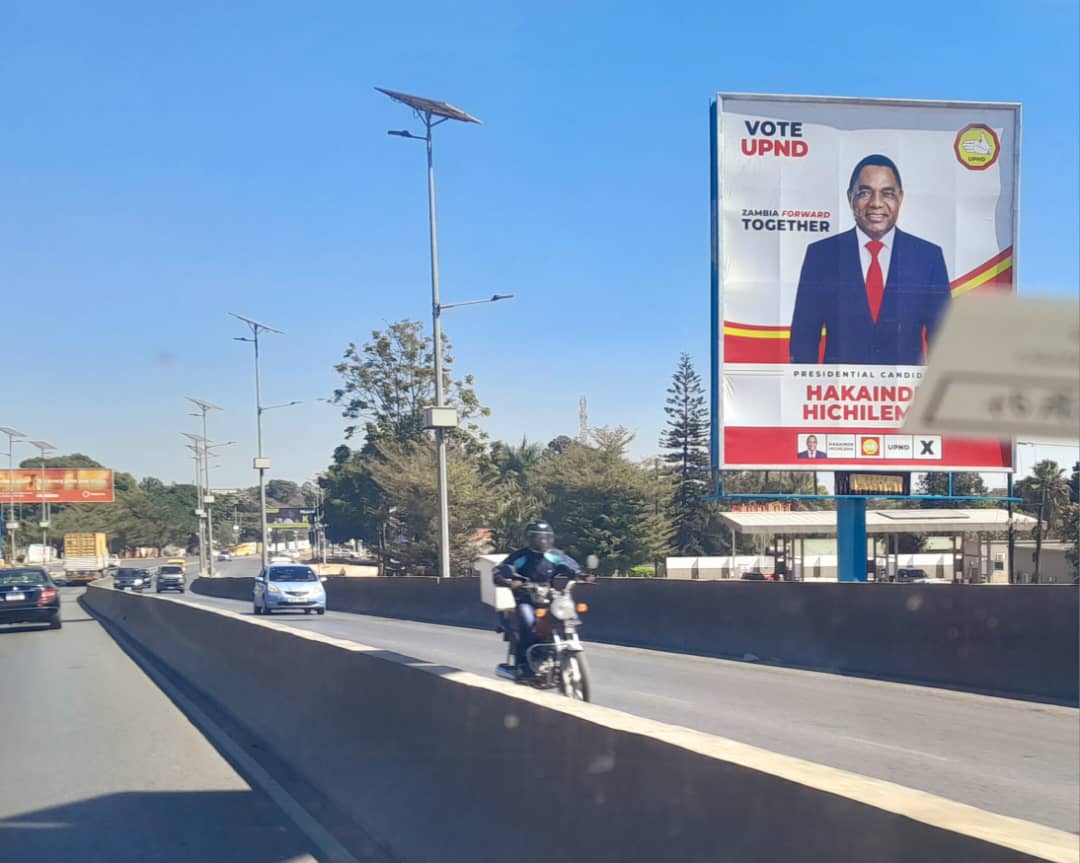
Driving into Lusaka from the eastern side of the city, motorists crossing the Munali flyover bridge are greeted by a towering campaign billboard of President Hichilema.
Mounted high above one of the capital’s busiest roads, the poster presents the incumbent smiling confidently beneath the slogan “Zambia Forward Together”. For many commuters, it is difficult to miss.
What is perhaps more striking, however, is what is missing.
Despite 14 presidential candidates having entered Zambia’s August general election, few rival campaign posters are visible in prominent parts of the capital. In some locations, it is as though Hichilema is campaigning against no one at all.
Whether this reflects superior organisation, greater resources, incumbency advantages or simply the early stages of the campaign is open to debate. But the image offers a fitting backdrop to a broader question confronting Zambia as it heads towards a crucial election: has the administration that came to power promising democratic renewal delivered the reforms many citizens expected, or has the gap between promise and reality begun to widen?
Assessing Hichilema’s performance largely depends on the lens through which it is viewed.
His objective of the 2026 election is clear: secure a renewed mandate and project Zambia as a stable, democratic nation that is open for business despite growing criticism from sections of the opposition and civil society.
Hichilema is making his case before an electorate of more than 8.7 million registered voters. Fourteen political parties have fielded presidential candidates, while 226 constituency-based parliamentary seats are up for contest.
However, the election campaign has not been without controversy. Allegations emerged that some independent candidates perceived to be aligned with the ruling party were pressured to withdraw from parliamentary races. As a result, 16 candidates from the United Party for National Development (UPND) have already secured victory even before the vote is cast.
For critics, these developments raise questions about the competitiveness of the electoral process.
Hichilema’s election in August 2021 was widely viewed as marking a new chapter in Zambia’s democratic journey after years of concerns about democratic backsliding under the Patriotic Front (PF) administration of the late former President Edgar Lungu. His victory raised expectations of democratic renewal, stronger institutions, greater respect for civil liberties, and expanded media freedom.

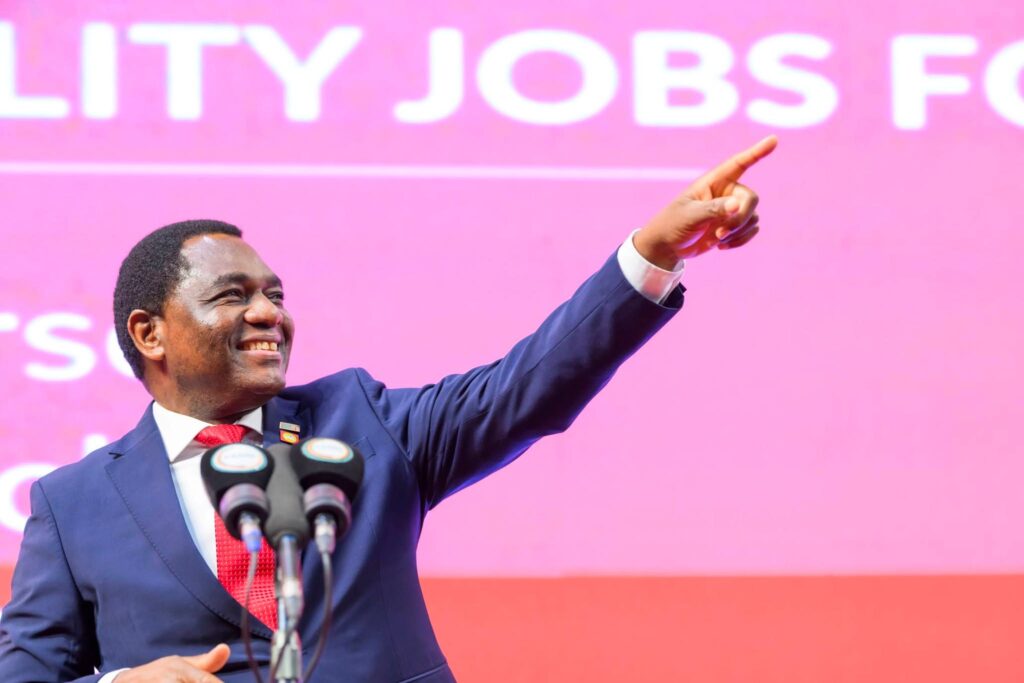
In the early years of his presidency, Zambia received international praise for achieving another peaceful transfer of power and for rebuilding relations with key international partners. The government has also highlighted efforts to strengthen governance and restore confidence in public institutions.
However, questions have increasingly emerged about the durability of these democratic gains. Critics have raised concerns about an alleged shrinking civic space, claims that legal and administrative processes have been used against political opponents, allegations of executive influence over public institutions, and the slow or uneven implementation of some promised reforms.
According to Freedom House’s Freedom in the World 2025 report, Zambia remains classified as “Partly Free”. The organisation states that while the country continues to hold competitive multiparty elections and respects a range of civil liberties, opposition parties face legal and practical obstacles to fair competition, while laws restricting political space and online expression remain in force.
Similarly, Human Rights Watch has raised concerns about the use of the Public Order Act to restrict opposition activities, as well as broader issues affecting freedom of expression, assembly and civic participation. These concerns have contributed to an ongoing debate about the state of Zambia’s democracy and whether the institutional reforms promised in 2021 have been fully realised.
Questions have also persisted in other areas central to Hichilema’s reform agenda. Media organisations and press freedom advocates have welcomed the generally more open environment compared to previous years, but some journalists and civil society groups continue to report incidents of intimidation, political pressure and restrictions on access to information.
Debates have also continued over the pace of constitutional and institutional reforms, and the extent to which key state institutions are able to operate independently of political influence. Some critics point to the comparatively rapid establishment of the Cyber Security Agency, while the full implementation of the Access to Information Act has progressed more slowly, as evidence of uneven reform priorities.
Supporters of the government, however, argue that meaningful progress has been made in strengthening democratic governance and modernising state institutions. Critics counter that some of the structural reforms promised in 2021 remain incomplete as the country heads into another election.
Yet governance is only one measure by which voters are likely to assess Hichilema’s first term. Economic performance is expected to play an equally important role in shaping electoral choices.
Economy: Strongest Area of Performance
One of the biggest achievements of Hichilema’s administration has been progress in restructuring Zambia’s debt and restoring overall economic stability after the country defaulted on its external debt in 2020.
The International Monetary Fund has repeatedly cited Zambia’s progress under its economic reform programme, pointing to advances in debt restructuring, fiscal consolidation and efforts to restore macroeconomic stability. IMF officials have praised the government’s progress in reducing economic imbalances and restructuring debt despite significant domestic and external shocks. Meanwhile, Zambia’s Ministry of Finance projected economic growth of 5.8 percent in 2025, a forecast supported by improving economic indicators following years of debt distress.
International financial institutions and investors have also pointed to Zambia’s debt restructuring agreements as a significant achievement, helping restore investor confidence and improve the country’s economic outlook.
The government has highlighted a number of achievements during Hichilema’s tenure, including the introduction of free education, increased allocations to the Constituency Development Fund (CDF), and expansion of mining investment. These initiatives have been presented as evidence of efforts to improve public services, stimulate economic growth and strengthen the country’s financial position.
However, economic recovery has not translated equally across society. Many Zambians continue to face significant challenges, including a high cost of living, food insecurity, persistent youth unemployment and slow growth in household incomes. While key macroeconomic indicators have shown signs of improvement, many citizens say the benefits have yet to be fully felt at community level, particularly among poorer and more vulnerable households.
Although former President Edgar Lungu was decisively defeated in the 2021 general election, his political legacy remains a significant factor in Zambia’s political landscape ahead of the August 2026 polls. Following his death, many of his supporters have shifted their allegiance from the Patriotic Front (PF), which is not fielding candidates in this year’s election, to parties aligned with the Tonse Alliance.
Much of that support has coalesced around Brian Mundubile, the Tonse Alliance presidential candidate. However, Zambia’s opposition remains fragmented, with Citizens First leader Harry Kalaba, Socialist Party president Fred M’membe and several other candidates also competing for support from voters dissatisfied with the current government. Political analysts note that unless opposition forces can coordinate more effectively, the anti-incumbent vote risks being split among multiple candidates.
Ultimately, the 2026 election may be less a contest between political personalities than a referendum on Hichilema’s first term in office.
Hichilema enters the race with achievements he can point to: debt restructuring, improved international standing, free education, expanded CDF funding and relative macroeconomic stability. Yet he also faces criticism from those who argue that democratic reforms have been incomplete and that economic gains have not sufficiently improved the lives of ordinary citizens.
As voters head to the polls in August, they will be asked to decide whether the promise of 2021 has been fulfilled, whether it remains a work in progress, or whether a different path is needed.
Back on the Munali flyover, Hichilema’s billboard continues to tower above the traffic below. The election will determine whether the optimism it projects still resonates strongly enough with Zambians to secure him a second term.
The author is the Editor of MakanDay Centre for Investigative Journalism


Discover more from MAKANDAY
Subscribe to get the latest posts sent to your email.


