

By Paul Ng’ambi | Kwenje FM | Chama district
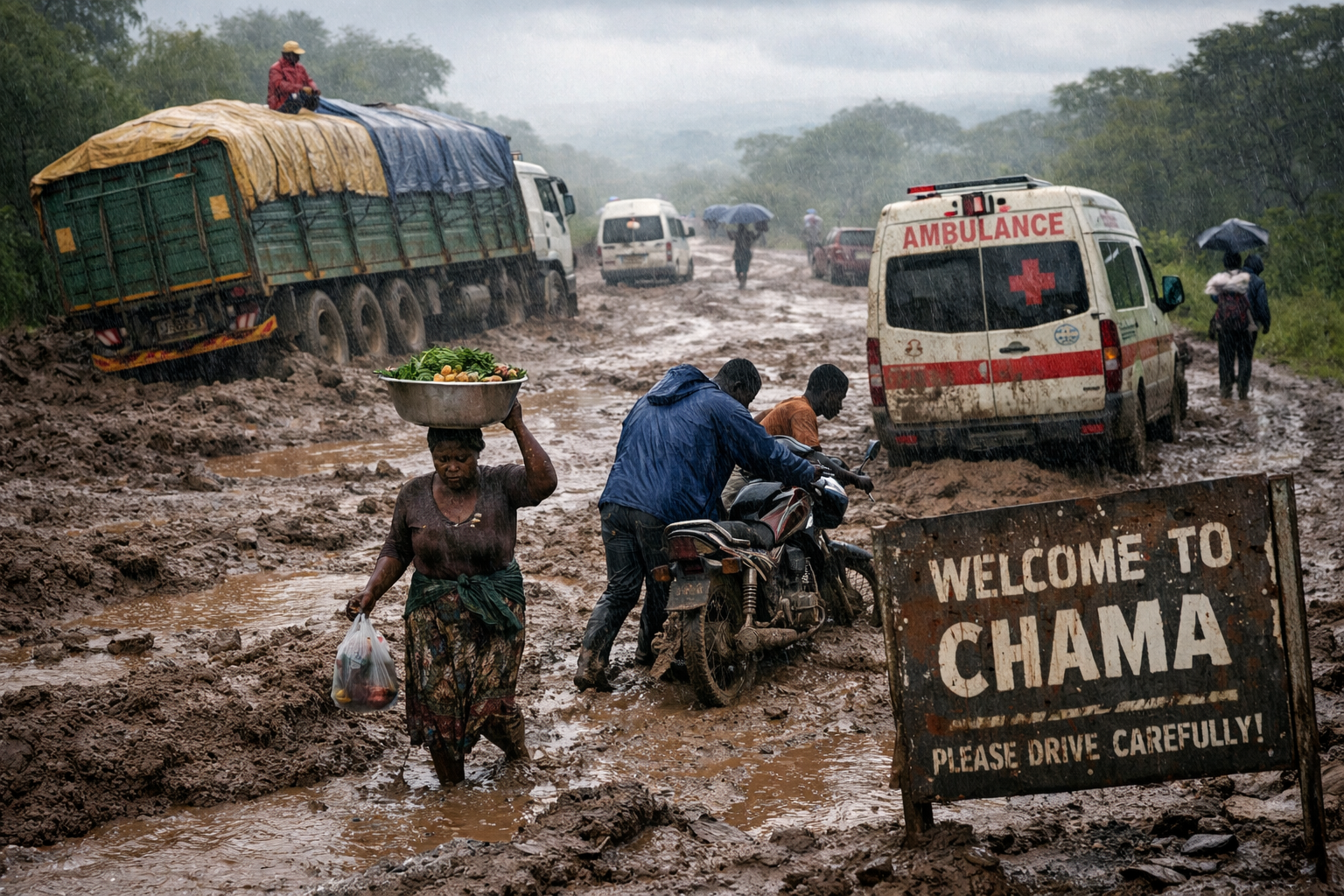
The Chama–Lundazi and Chama–Matumbo roads in Chama district, eastern Zambia, have deteriorated to a critical state, with conditions worsening following the start of the rains.
Heavy rains have caused flooding in several sections, rendering parts of the roads impassable and leaving motorists, traders, patients and farmers stranded. What should be a vital transport corridor has instead become a daily struggle for the people who depend on it.
Roads are widely recognised as the backbone of economic and social development. They connect farmers to markets, children to schools, patients to hospitals and communities to economic opportunities. In Chama, however, poor road conditions have disrupted these connections, affecting livelihoods and undermining service delivery.
According to transport experts and government policy documents, inadequate road networks increase the cost of doing business, limit access to social services and slow down rural development.
The importance of the Chama–Lundazi and Chama–Matumbo corridor was formally acknowledged as far back as 2010 under the Link Zambia 8000 programme, when it was identified as a strategic national road.
In 2011, the government signed a US$90 million contract with Shanghai Construction Group to rehabilitate the Lundazi–Chama section. The project was reaffirmed as a national priority in 2014. However, by 2021, parliamentary reports revealed that construction works had stalled due to financing challenges.
Subsequent expectations that international financing, including a US$458 million Millennium Challenge Corporation (MCC) grant, would revive the corridor have not materialised, leaving the road largely unfinished to date.
Despite its strategic importance, the Chama–Lundazi and Chama–Matumbo roads have not seen full rehabilitation for decades. The corridor links Chama, one of the most remote districts in Eastern Province, to Lundazi, Chipata and Chinsali in MUchinga Province, and provides potential cross-border access to Malawi, Mozambique and Tanzania.
Currently, only about 30 kilometres from Chama town have been upgraded to bituminous standard, while more than 120 kilometres remain in extremely poor condition. During the rainy season, vehicles frequently get stuck, travel times double, and essential services are disrupted.
Residents say the situation has reached crisis levels. Those from areas such as Dunda to the Muyombe turn-off report that the road becomes almost impassable during the rains. Some travellers say they fall sick after enduring long journeys over deep potholes and muddy sections. Beyond inconvenience, the road poses serious safety risks to motorists and other road users.
Transport operators and motorists are among the hardest hit. Noah Banda, a motorist who frequently uses the Chama–Lundazi road, says vehicle damage has become routine.
“The road is very bad, full of potholes. Almost every trip the vehicle gets damaged, and we end up at the garage each time,” he said. “A journey that should take three hours now takes about five. Because of these costs, we are forced to increase charges.”
The poor state of the road has also affected the movement of goods and people, driving up the cost of living. Zacks Goma, a long-time Chama resident and businessman, says transport delays and high charges have stifled business growth. He explains that suppliers charge exorbitant fees due to the bad road, forcing traders to pass on the costs to consumers.
“Since independence, we do not even have a fuel station here because the road is bad,” he said. “Development starts with roads. During the rainy season, we are completely cut off. I hire trucks every month from Chipata to Chama at about K20,000. To recover that cost and still make a profit, commodity prices become very high.”
Goma notes that Chama has strong agricultural potential, producing crops such as rice and maize, and could benefit significantly from improved road connectivity. He adds that with better roads, the corridor could link to the Great North Road and the Nakonde border, increasing traffic and potential government revenue through tolling.
Farmers and traders echo similar concerns, saying poor roads lead to delays, spoilage of goods and missed markets. In some areas, such as Mwataluzi, trucks reportedly get stuck for days due to damaged bridges, forcing traders to hire manual labour at high cost and pushing prices further up for consumers.
The health sector has not been spared. At Chama District Hospital, Senior Resident Medical Offer said the poor road conditions delay drug deliveries and patient referrals. He explained that ambulances often take too long to transfer patients to Chipata for specialist health services, which hosts the provincial referral hospital.
“These delays worsen patients’ conditions, increase pain and discomfort, and in some cases lead to life-threatening complications,” he said, adding that delayed care can result in organ failure or even death.
Responsibility for national road infrastructure lies with the Ministry of Infrastructure, Housing and Urban Development, working through the Road Development Agency (RDA) and the National Road Fund Agency (NRFA).
In response to concerns over prolonged delays, Minister of Infrastructure, Charles Milupi said funding constraints have been the main challenge. He explained that the US$458 million MCC grant was earmarked to rehabilitate roads linking agricultural production areas to markets, including the Chipata–Lundazi–Chasefu route, which had been prioritised. However, changes in United States government policy led to the cancellation of MCC and USAID programmes, forcing Zambia to reassess its financing strategy.
“At the moment, government resources are limited due to debt and economic pressures,” the minister said. “Public-private partnerships work where there is heavy traffic, but roads like Chama–Matumbo do not yet attract private investors. With the cancellation of the MCC funding, we have to look for alternative ways to finance these roads.”
At district level, officials say efforts are being made to manage the situation. A district works supervisor observed that Chama was placed under a programme intended to improve feeder roads, but implementation has been slow due to coordination challenges with RDA.
Meanwhile, Chama District Commissioner Yobe Goma said government has been carrying out periodic grading and gravelling from Lundazi to the Muyombe turn-off and plans to continue these temporary measures while searching for funds to upgrade the road to bituminous standard.
Members of Parliament for Chama North and Chama South have also raised the matter in parliament, pushing for budget allocations and clear timelines. However, the roads were not included in the 2026 national budget, raising further concerns about when permanent works will begin.
Efforts to obtain clarification from project financiers and contractors have yielded mixed results.
Representatives of Shanghai Construction Group confirmed that their contract covered the Chipata–Lundazi and Lundazi–Chama sections under a concessional loan arrangement with the China Exim Bank. However, the company says the project did not commence because the financing agreement between the Zambian government and the lender did not take effect.
As the rains continue and communities remain cut off, residents of Chama are left asking the same questions: when will the Chama–Lundazi and Chama–Matumbo roads finally be rehabilitated, how will they be funded, and who will be held accountable for years of delays on a road that is central to the district’s development and survival?
Image disclaimer: The main image was generated using artificial intelligence for illustrative purposes. It does not depict real individuals, locations, or events and is intended solely to visually represent the issues discussed in the story.
Produced by Radio Kwenje in Chama for MakanDay. The article has been edited and fact-checked by MakanDay.


Discover more from MAKANDAY
Subscribe to get the latest posts sent to your email.


