

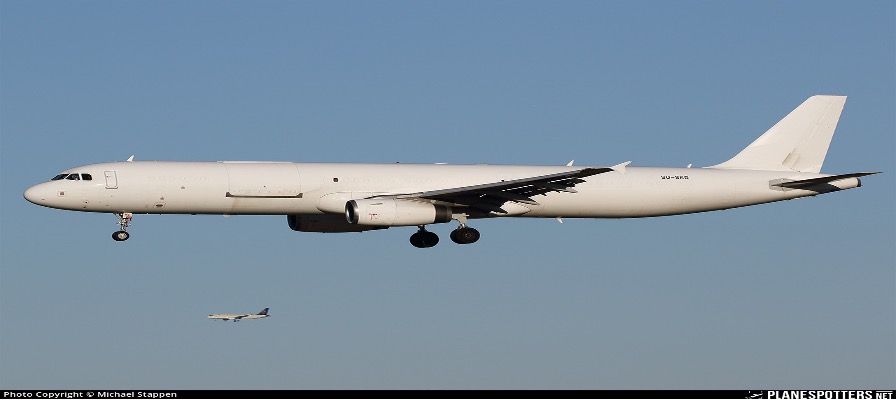
Malawi Defence Force’s former commander, General Paul Valentino Phiri, was arrested in October on charges of trafficking weapons via Malawi to Sudan. Two new sets of records—a military certificate and flight data—now offer the clearest insight yet into how this suspected international arms-trafficking network operated.
BY JACK MCBRAMS, GREGORY GONDWE AND GOLDEN MATONGA.
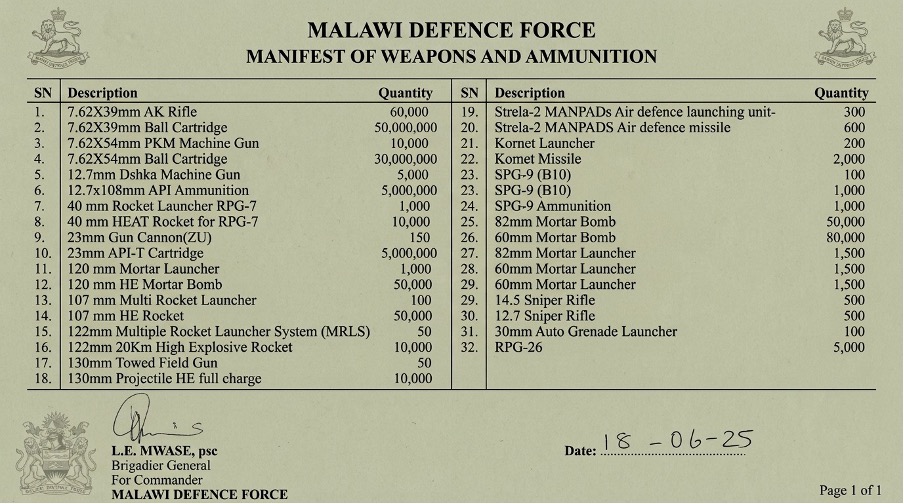
On paper, the scale of the weapons order is staggering. An official Malawi Defence Force (MDF) end-user certificate lists 60,000 AK rifles, 15,000 machine guns, artillery, missiles and 90 million rounds of ammunition, all listed as being for Malawi’s Ministry of Defence.
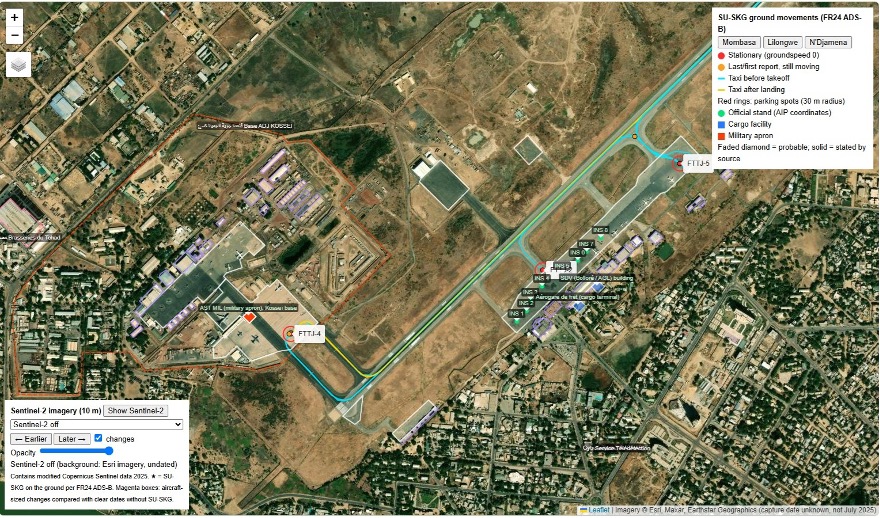
The aircraft movements tell another part of the story. Data analysed by the Platform for Investigative Journalism (PIJ) shows that the SU-SKG, the cargo plane at the centre of the criminal case against retired General Paul Valentino Phiri, made repeated flights between Mombasa and Lilongwe in July 2025, followed by 11 flights between Lilongwe and N’Djamena in Chad.
Phiri led the MDF until October 2025. Prosecutors allege that he facilitated the movement of the weapons from Kenya, through Malawi and on to Chad.
The certificate and the flights made by SU-SKG are consistent with the Anti-Corruption Bureau’s five-count case against Phiri. Prosecutors allege that he helped arrange an end-user certificate, which is supposed to be a guarantee that the weapons are for the MDF, when they were actually meant for rebels in Sudan. Weapons arrived in Kenya aboard SU-SKG and were received at the Malawi Air Cargo warehouse at Kamuzu International Airport in Lilongwe before being sent on to Chad.
The scanned end-user certificate in PIJ’s possession is dated 18 June 2025, the same day as the certificate cited in the prosecution’s case against Phiri. The certificate states that the equipment is intended for MDF use and must not be transferred or re-exported without written permission from Malawi’s state export control service. This matters to the case against Phiri, especially if investigations can show that the goods were received by the MDF, whether the certificate was genuine, and whether the later transfer was authorised.
Outstanding questions
The certificate in PIJ’s possession identifies the exporter as Jabari Industries Limited, with an address at PO Box 100798, Jamia, Nairobi, Kenya.
The certificate is also signed by Brigadier General L.E. Mwase, with the designation “For Commander”, rather than Phiri’s name. This does not prove that Mwase knew of or was involved in any alleged arms diversion. It also does not show whether the document was formally approved through Malawi’s export-control procedures.
Naming Jabari Industries as the exporter also does not prove that the company manufactured, supplied, or shipped the listed equipment, knew of any proposed diversion, or engaged in wrongdoing. Questions remain about the company’s actual role, the document’s provenance, and any associated supply and shipment records. In its investigations, the PIJ has not established that the scanned inventory certificate in its possession is the exact instrument referred to in the charges or that the quantities listed were ever supplied, imported, or transported aboard SU-SKG.
The document is not a cargo manifest or proof of delivery. It does not identify an aircraft, shipment dates, or consignment numbers, nor does it establish that any of the listed equipment reached Malawi, Chad, or Sudan. Its authenticity, provenance, and relationship to the alleged shipments remain subject to further verification.
The vast weapon inventory recorded in the scanned certificate does not prove that the weapons were indeed imported into Malawi or sent to another recipient, and the document comes with no shipment records, delivery receipts, or other evidence that the items were supplied.


The aircraft at the centre of the case
Flight tracking data places the aircraft named in the criminal case on the same routes that the ACB and prosecutors say were used to bring weapons from Kenya into Malawi.
The ACB charge sheet names the plane as an Airbus A321-200, SU-SKG. Aviation records give its serial number as 1707 and its ICAO transponder code as 010277. It was converted from passenger to cargo configuration in March 2024 and entered service the following year.
A PIJ analysis of the aircraft model used and the weaponry load suggests that the 60 000 AK47s would weigh an estimated 243 tonnes, and with the plane’s capacity restricted to 28 tonnes, it would take nearly all the trips recorded on the tracker to complete the delivery of all military hardware listed on the end-user certificate.
The PIJ tracked this aircraft’s flights using FlightRadar24 to reconstruct its movements over the six weeks between 4 July and 14 August 2025.
The records reveal 33 flights that fall into four main stages: Cairo to Mombasa, repeated flights between Mombasa and Lilongwe, a concentrated series of flights between Lilongwe and N’Djamena, and a departure from Malawi to Egypt.
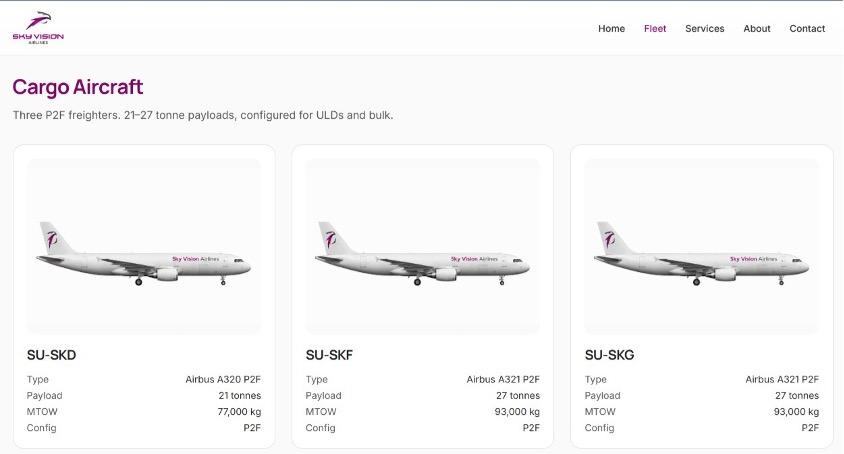
FlightRadar24 identifies Sky Vision Airlines as the aircraft’s operator. However, its publicly available aircraft profile does not establish who chartered SU-SKG for the July 2025 flights, who arranged the cargo-handling operations, or who owned or leased the aircraft during the period.
The warehouse named in the charge sheet is one focus for further investigation. Ground-handling records and cargo documentation would be needed to establish whether equipment was transferred there.
Malawi Air Cargo chief executive Eunice Napolo told PIJ that the company could not comment because the matter was before the courts.
PIJ sent detailed questionnaires to Phiri, Airport Developments Limited (ADL), the Malawi Revenue Authority (MRA) and the Civil Aviation Authority (CAA). None of them had responded by the time of publication.


Shuttling between Mombasa and Lilongwe
Flight tracker data place SU-SKG in Cairo, Egypt, on 4 July 2025. After an earlier flight, it returned to Cairo and then departed in the evening heading south towards East Africa. One of the flight records lists Sharm el-Sheikh as its destination, and the position trail suggests it continued towards Mombasa. PIJ could not establish a confirmed landing at Sharm el-Sheikh from the available records.
On 5 July, the aircraft appears at Moi International Airport, where it stayed for 105 hours, more than four days.
On 9 July, the aircraft leaves Mombasa for Kamuzu International Airport in Lilongwe, arriving at about 3.44pm UTC. It leaves Malawi about three hours later and returns to Kenya.
A recurring shuttle between the two cities begins. FlightRada24 records show at least five fully identifiable legs between July 9 and 13 alongside incomplete entries. Each trip takes about one hour and 50 minutes.
The dataset also records an unusual movement on 12 July. The aircraft departed Mombasa and returned to the same airport after approximately six hours, covering about 2 577 kilometres. The available tracking records do not establish the purpose of that flight or whether it involved an intermediate stop.
The aircraft left Mombasa again on 13 July.
The flights to Chad
From 17 July, the aircraft’s recorded movements shifted towards a recurring route between Lilongwe and N’Djamena.
PIJ’s analysis identifies approximately 11 flights between the two airports between 17 and 16 July. Each journey covered roughly 3 500 to 3 600 kilometres and generally took between four and a half and five hours.
The records show flights alternating between Lilongwe and N’Djamena, with the aircraft repeatedly returning to Malawi before departing again for Chad.
On 22 July, for example, SU-SKG departs Lilongwe shortly before 9.30am UTC and arrives in N’Djamena at 2pm. It leaves Chad later that afternoon, at about 4.47pm, and returns to Lilongwe at 9.17pm.
A similar round trip took place on 24 July. The aircraft departed Lilongwe shortly before 6.45am UTC, arriving in N’Djamena at 11.36am. It departed Chad at about 4.18pm and landed back in Malawi at approximately 8.57pm.
Other records capture movements in both directions on 18, 19, 20 and 21 July, as well as further journeys on 26 July. Some of these flight records have incomplete take-off or landing information, making it impossible to reconstruct every leg with the same degree of certainty.
The repeated Lilongwe–N’Djamena movements are, however, clearly visible in the available position data.
On 30 July, the aircraft departs Lilongwe for Cairo on a flight lasting approximately seven hours, covering about 5 600 kilometres.
The sequence is striking. After spending several days operating between Mombasa and Lilongwe, the aircraft undertook an intensive series of flights connecting Malawi and Chad before departing for Egypt.
SU-SKG at the heart of another investigation
In a separate investigation, the European Institute for Peace and Governance (EIPG) names the SU-SKG among aircraft that flew from Cairo to Port Sudan in June 2026, along with another Sky Vision freighter, SU-SKF.
The report examines Egypt’s alleged military and logistical support for the Sudanese Armed Forces. It says that flight tracking shows a recurring cargo route but does not establish what the aircraft carried. The PIJ has asked Sky Vision Airlines to explain the aircraft’s movements during this period.


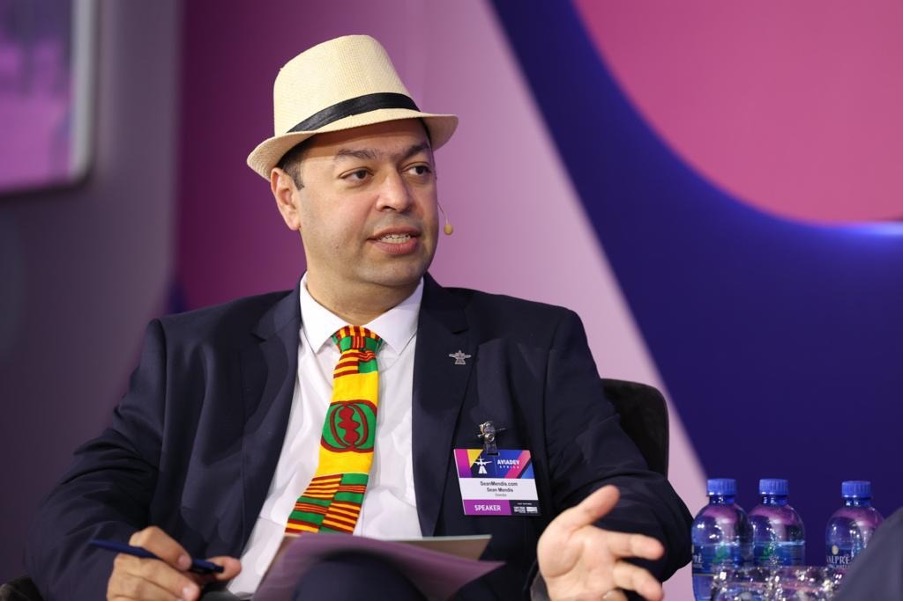
Aviation expert Sean Mendis said the pattern of flights between Kenya and Malawi deserved scrutiny, particularly given the limited regular air links between Malawi and Chad.
“I am absolutely not surprised. Malawi has been used as a transshipment cover for a long time,” Mendis said. “Jurisdictions like Malawi with poor regulatory oversight are ripe to be exploited for illicit cargo trans-shipments like arms trading.”
He said operators involved in illicit arms trading often shifted their activities between jurisdictions to exploit weaknesses in oversight, rather than relying on a single country.
Mendis also said Malawi’s role appeared to be expanding both as a potential transshipment point and as a registry of convenience for aircraft used in such operations.
“Any route that doesn’t have consistently operated flights is irregular by definition, so it invites additional scrutiny notwithstanding any potential involvement with illicit activity,” he said.
Mendis said he was unaware of documented significant trade links between Malawi and Chad, adding that a large volume of cargo flights between the two countries was therefore irregular.
His assessment raises questions about the commercial rationale for the aircraft’s repeated journeys between Lilongwe and N’Djamena. It does not, however, establish that SU-SKG was carrying illicit cargo. The flight records document the movements, not the commercial arrangements or the contents of the aircraft.




Discover more from MAKANDAY
Subscribe to get the latest posts sent to your email.


